
Japanese Camel Cricket
Diestrammena japanica
This record describes Diestrammena japanica (species). Recorded family: Rhaphidophoridae. Recorded order: Orthoptera.
Identification and Appearance
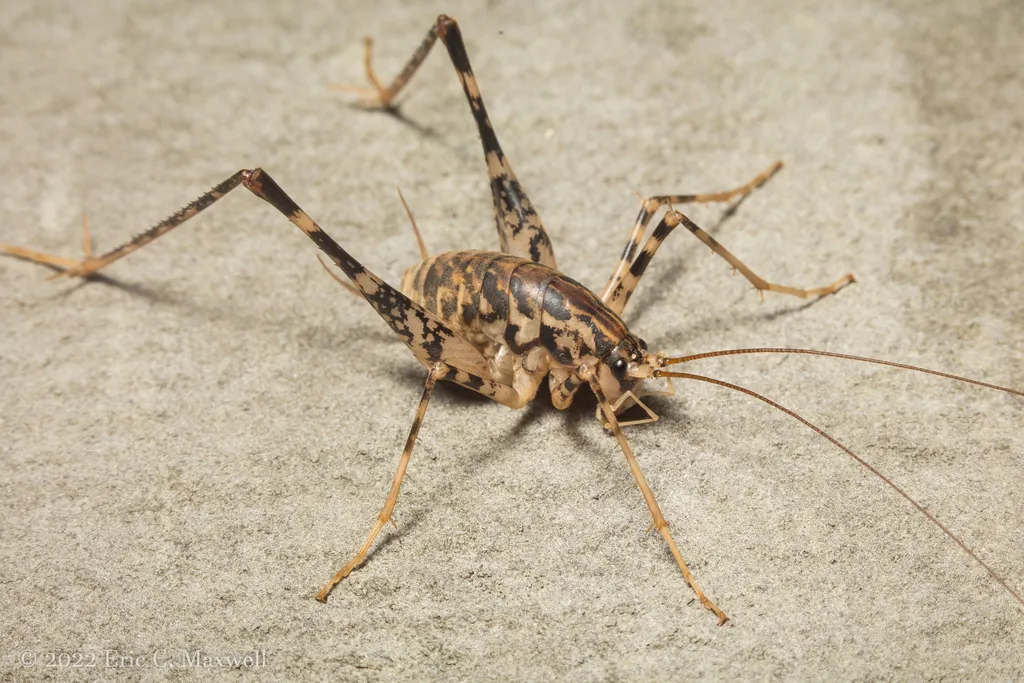
Very similar to D. asynamora , but differing in certain details of leg armature and genitalia. However, D. japanica is easily distinguished by the more contrasting and broken color pattern, which has dark areas of different shapes in different locations. Most noticeable are perhaps the dark markings of the thorax, where there are markings mid-dorsally that are lacking in the other species.
Wikipedia reference for Diestrammena japanica: https://en.wikipedia.org/wiki/Diestrammena_japanica.
Classification
- Kingdom
- Animalia
- Phylum
- Arthropoda
- Class
- Insecta
- Order
- Orthoptera (Grasshoppers, Crickets, Katydids)
- Suborder
- Ensifera
- Family
- Rhaphidophoridae (Camel Crickets)
- Subfamily
- Aemodogryllinae
- Genus
- Diestrammena
Imported taxonomy record. Source availability varies; see the source references and editorial policy below.
Habitat and Range
Habitat
Probably favoring the same sort of humid dark places as D. asynamora , such as cellars, basements, wells, pump houses, etc. Apparently occasionally wandering into homes.
Geographic Range
Apparently originally native to Japan, and/or the Indochina Peninsula in southern Asia. Introduced into the northeastern U.S. (perhaps from Vietnam???), and now found in states surrounding New York City.
Seasonal Activity
Likely all growth stages may be present year-round; however, records imply that adults are found mostly in summer and autumn.
Diet and Behavior
Diet: Probably an omnivorous scavenger.
Additional species information
Species notes from the sources
Etymology: This name was used mistakenly for D. asynamora in Europe up until 1914 and in the United States until 1944. Ironically it appears that the real D. japanica is now well established in the area roughly surrounding New York City. Due to confusion with D. asynamora it is unclear when it first came to be found in the United States, but perhaps only relatively recently. An examination of museum specimens might prove enlightening as to just when and where it came to be in the country. The original description of the name D. japonica was explicitly stated by Blatchley to be a replacement name for D. marmorata when he first published the name - he wrote: "This is the species hitherto known in literature as Diestrammena marmorata DeHaan (1843, 217). It was described by him as Locusta marmorata and is therefore a primary homonym of Locusta ( Scirtetica ) marmorata Harris (1841, 145). A new specific name is therefore necessary for DeHaan's insect." This is important, because in the same description, Blatchley went on to illustrate and describe what are really Diestrammena asynamora . It has generally been agreed that, even though the insects in hand were misidentified, the primary intent of the name D. japanica was to replace D. marmorata (which was an invalid name), and thus the name D. japanica goes with the insect that actually was properly represented by the name " marmorata ", and not with the misidentified insect then found in North America. This situation caused a great deal of confusion as well as some disagreement for a time, but it is was outlined well by J.A.G. Rehn in 1944.
About Grasshoppers, Crickets, Katydids: the wider group
Order-level background for Orthoptera, the group containing Diestrammena japanica. Species-specific details appear above.
Group overview
Orthoptera includes ~28,000 described species of grasshoppers, crickets, and katydids. Desert locusts can form swarms covering 460 square miles containing up to 80 million individuals per square kilometer.
Ecological role of the group
Grasshoppers and crickets are a primary food source for birds, reptiles, and small mammals. Cricket farming is a growing industry - crickets require 12× less feed than cattle to produce the same amount of protein, using 2,000× less water.
Economic and practical significance of the group
A single large locust swarm can consume the same amount of food in one day as 35,000 people. The 2019-2021 East Africa locust crisis affected food security for 42 million people across multiple countries. Global crop losses from locusts can reach billions annually.
Recorded sources for this group: FAO, UN World Food Programme, research publications. Imported estimates may describe particular regions or reporting periods.
Photos of Japanese Camel Cricket (2)
Photo credits: Contributed by David J. Ferguson
Frequently Asked Questions About Japanese Camel Cricket
What is Japanese Camel Cricket?
Japanese Camel Cricket (Diestrammena japanica) is a species in the family Rhaphidophoridae, within the order Orthoptera.
How do you identify Japanese Camel Cricket?
Very similar to D. asynamora , but differing in certain details of leg armature and genitalia. However, D. japanica is easily distinguished by the more contrasting and broken color pattern, which has dark areas of different shapes in different locations. Most noticeable are perhaps the dark markings of the thorax, where there are markings mid-dorsally that are lacking in the other species.
Where is Japanese Camel Cricket found?
| Feature | Details |
|---|---|
| Habitat | Probably favoring the same sort of humid dark places as D. asynamora , such as cellars, basements, wells, pump houses, etc. Apparently occasionally wandering into homes. |
| Range | Apparently originally native to Japan, and/or the Indochina Peninsula in southern Asia. Introduced into the northeastern U.S. (perhaps from Vietnam???), and now found in states surrounding New York City. |
What does Japanese Camel Cricket eat?
The diet of the Japanese Camel Cricket includes Probably an omnivorous scavenger..
When is Japanese Camel Cricket active?
Japanese Camel Cricket: seasonal activity - Likely all growth stages may be present year-round; however, records imply that adults are found mostly in summer and autumn..