
Diatraea evanescens - Hodges#5478
Diatraea evanescens
This record describes Diatraea evanescens (species). Recorded family: Crambidae. Recorded order: Lepidoptera.
Identification and Appearance
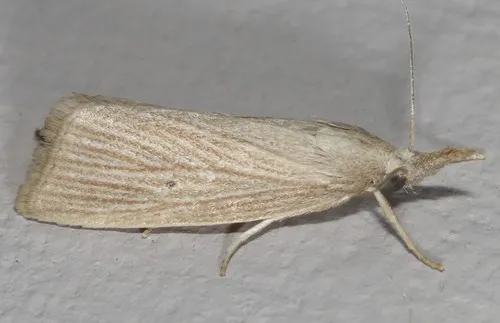
| Feature | Description |
|---|---|
| Additional details | Introduced into Florida from Brazil in 1914. Has spread north. Not cold-hardy but can take light frost. |
| Head | Head: Large eyes, no hair. Palpi very long, beak-like, 2 to 3 times longer than head. Antenna: Simple, reaching to mid wing. |
| Wings | Wings: Forewing: Pale brownish on female; light tannish on male. Rounded discal spot at mid wing in center. |
| Forewing | Forewing veins are brown , flanked by narrow pale edging; streaks in the middle of the intervenal spaces are brown. (This is the opposite of genera like Eoreuma ). Dark dots usually present at base of fringe and are situated at the ends of the brown intervenal streaks. Fringe the same color as wings. |
| Hindwing | Hindwing: White, slightly more brownish on male. |
| Legs | Legs: The legs are moderately stout, cream. |
| Abdomen | Abdomen: White. Male has a pair of lateral tufts on second segment. Segments 2 and 3 more reddish-brown on male. |
Classification
- Kingdom
- Animalia
- Phylum
- Arthropoda
- Class
- Insecta
- Order
- Lepidoptera (Butterflies and Moths)
- Superfamily
- Pyraloidea
- Family
- Crambidae (Crambid Snout Moths)
- Subfamily
- Crambinae
- Tribe
- Chilonini
- Genus
- Diatraea
Imported taxonomy record. Source availability varies; see the source references and editorial policy below.
Habitat and Range
Habitat
Wet meadows and lawns.
Geographic Range
Across southern U.S., also Ohio, Maryland. Canada: Ontario. Possibly a migrator to north during the summer. Not cold hardy.
Seasonal Activity
April to September in south. Probably June to Aug in north.
Diet and Behavior
Diet: Assumed to feed on Slender Paspalum Paspalum setaceum in northern U.S. and southern Canada. It is the only Paspalum species available in Ontario, listed as rare. Common names of Paspalum are Dallisgrass, Sticky Heads or Argentine Bahia grass in southern U.S. Very similar to crabgrass, grows to 40 inches (100 cm) tall. Note: Paspalum is also used by the Clouded Skipper Lerema accius in the south.
Life History
Larva bore inside grass shoots, particularly ones with seed heads. Larva are thin with strong tubercles. Prolegs hooked. Segments 8 and 9 are plated. Pupa cylindrical, top end square. Tongue short.
About Butterflies and Moths: the wider group
Order-level background for Lepidoptera, the group containing Diatraea evanescens. Species-specific details appear above.
Group overview
Lepidoptera includes approximately 180,000 described species of butterflies and moths. Moths outnumber butterflies roughly 10:1. The monarch butterfly's eastern population has declined by more than 80% since the mid-1990s, and the western population by over 95% since the 1980s. The IUCN lists the migratory monarch as Vulnerable.
Ecological role of the group
Butterflies and moths are essential indicators of ecosystem health. As caterpillars, they are a primary food source for birds - a single nest of blue tit chicks requires ~10,000 caterpillars. Adult moths pollinate many night-blooming plants.
Economic and practical significance of the group
Lepidoptera are critical pollinators. In Europe, grassland butterfly species have declined by almost 50% since the early 1990s. In the UK, three-quarters of butterflies are in decline. In the U.S., five butterfly species have gone extinct since 1950, with 29 listed as endangered.
Recorded sources for this group: IUCN Red List, Xerces Society, USFWS, PNAS, WWF. Imported estimates may describe particular regions or reporting periods.
Photos of Diatraea evanescens - Hodges#5478 (2)
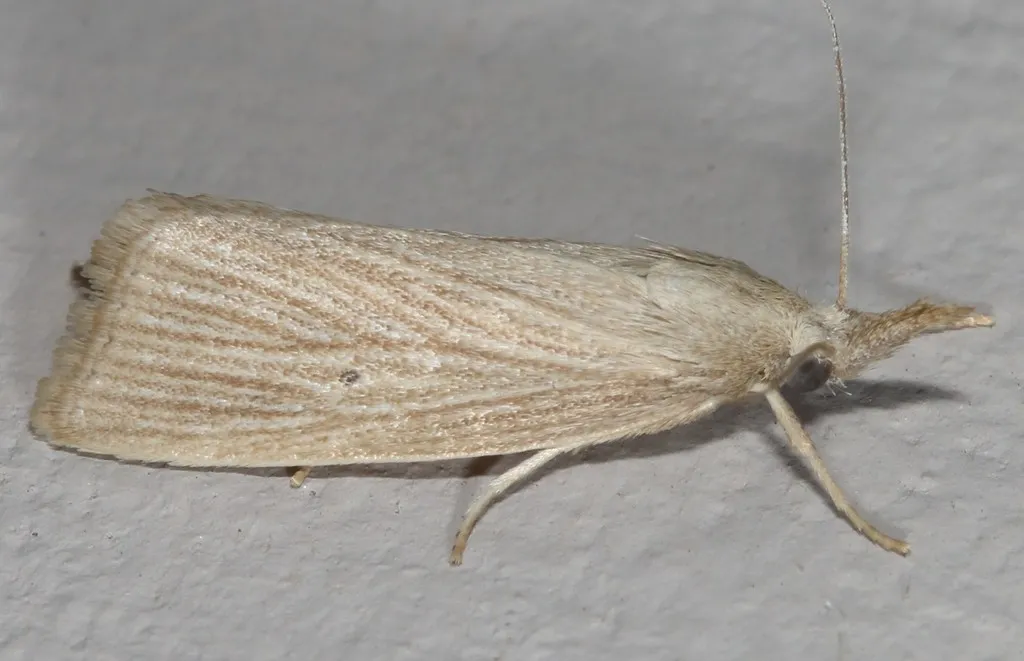
Photo credits: Contributed by tom murray; Additional contributions by Robert Lord Zimlich , Chuck Sexton , lee_penner
Frequently Asked Questions About Diatraea evanescens - Hodges#5478
What is Diatraea evanescens - Hodges#5478?
Diatraea evanescens - Hodges#5478 (Diatraea evanescens) is a species in the family Crambidae, within the order Lepidoptera.
How big is Diatraea evanescens - Hodges#5478?
10 to 20 mm long. Large in southern U.S., smaller in the north.
How do you identify Diatraea evanescens - Hodges#5478?
| Feature | Description |
|---|---|
| Additional details | Introduced into Florida from Brazil in 1914. Has spread north. Not cold-hardy but can take light frost. |
| Head | Head: Large eyes, no hair. Palpi very long, beak-like, 2 to 3 times longer than head. Antenna: Simple, reaching to mid wing. |
| Wings | Wings: Forewing: Pale brownish on female; light tannish on male. Rounded discal spot at mid wing in center. |
| Forewing | Forewing veins are brown , flanked by narrow pale edging; streaks in the middle of the intervenal spaces are brown. (This is the opposite of genera like Eoreuma ). Dark dots usually present at base of fringe and are situated at the ends of the brown intervenal streaks. Fringe the same color as wings. |
| Hindwing | Hindwing: White, slightly more brownish on male. |
| Legs | Legs: The legs are moderately stout, cream. |
| Abdomen | Abdomen: White. Male has a pair of lateral tufts on second segment. Segments 2 and 3 more reddish-brown on male. |
Where is Diatraea evanescens - Hodges#5478 found?
| Feature | Details |
|---|---|
| Habitat | Wet meadows and lawns. |
| Range | Across southern U.S., also Ohio, Maryland. Canada: Ontario. Possibly a migrator to north during the summer. Not cold hardy. |
What does Diatraea evanescens - Hodges#5478 eat?
The diet of the Diatraea evanescens - Hodges#5478 includes Assumed to feed on Slender Paspalum Paspalum setaceum in northern U.S. and southern Canada. It is the only Paspalum species available in Ontario, listed as rare. Common names of Paspalum are Dallisgrass, Sticky Heads or Argentine Bahia grass in southern U.S. Very similar to crabgrass, grows to 40 inches (100 cm) tall. Note: Paspalum is also used by the Clouded Skipper Lerema accius in the south..
When is Diatraea evanescens - Hodges#5478 active?
Diatraea evanescens - Hodges#5478: seasonal activity - April to September in south. Probably June to Aug in north..
What is the life cycle of a Diatraea evanescens - Hodges#5478?
Larva bore inside grass shoots, particularly ones with seed heads. Larva are thin with strong tubercles. Prolegs hooked. Segments 8 and 9 are plated. Pupa cylindrical, top end square. Tongue short.