
Desmocerus californicus
This record describes Desmocerus californicus (species). Recorded family: Cerambycidae. Recorded order: Coleoptera.
Identification and Appearance
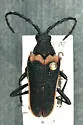
The forewings of the male are primarily red with dark green spots, whereas those of the female are dark metallic green with red margins. females of the subspecies are basically indistinguishable without DNA or locality data (per Phil Schapker, 2013) Current efforts to save the Valley Elderberry Longhorn Beetle (VELB) have focused on revegetating riparian habitats. The California Department of Water Resources has assisted the U.S. Fish and Wildlife Service in replanting elderberry along parts of the American River. Efforts are currently underway to reintroduce the beetle itself into areas which it formerly inhabited. Some success has been achieved by transplanting inhabited trees to a site near Sacramento.
Classification
- Kingdom
- Animalia
- Phylum
- Arthropoda
- Class
- Insecta
- Order
- Coleoptera (Beetles)
- Suborder
- Polyphaga
- Superfamily
- Chrysomeloidea
- Family
- Cerambycidae (Longhorn Beetles)
- Subfamily
- Lepturinae
- Tribe
- Desmocerini
- Genus
- Desmocerus (Elderberry Longhorn Beetles)
Imported taxonomy record. Source availability varies; see the source references and editorial policy below.
Habitat and Range
Habitat
In CA's Central Valley, the elderberry tree is associated with riparian forests which occur along rivers and streams. Historically the beetle ranged throughout the Valley, but recent surveys have revealed the beetle to persist only in scattered localities along the Sacramento, American, San Joaquin, Kings, Kaweah, and Tule rivers and their tributaries. Over 90% of CA's riparian forests have been cleared in the past century for agricultural, urban, and suburban development.
Geographic Range
D. c. dimorphus is restricted to California's Central Valley
Diet and Behavior
Diet: asso. w/ elderberry trees ( Sambucus spp.) during its entire life cycle.
Life History
The adults emerge in the spring from pupation inside the wood of these trees as they begin to bloom. The exit holes made by the emerging adults are distinctive, small oval openings. Often these holes are the only clue that the beetles occur in an area. The adults eat the elderberry foliage until about June when they mate. The females lay their eggs in crevices in the bark. Upon hatching, the larvae then begin to tunnel into the tree where they will spend 1-2 years eating the interior wood, their sole source of food.
Additional species information
Species notes from the sources
Etymology: ' dimorphus ' - refers to differences in appearance between the males and females.
About Primitive Winged Insects: the wider group
Order-level background for Coleoptera, the group containing Desmocerus californicus. Species-specific details appear above.
Group overview
Coleoptera is the largest order of insects with over 400,000 described species, representing ~25% of all known animal species and ~40% of all insects. In the U.S. alone, nearly 30,000 beetle species have been identified.
Ecological role of the group
Beetles are prominent decomposers, especially in forests, breaking down dead wood and recycling nutrients. As predators, they reduce populations of pest insects. Many species are also important pollinators of flowering plants.
Economic and practical significance of the group
Beetles have major economic significance: leaf beetles (Chrysomelidae) and weevils (Curculionoidea) are among the most destructive agricultural pests globally, costing billions annually, while predatory species like ladybugs provide natural pest control.
Recorded sources for this group: Britannica, Smithsonian, NCSU Entomology. Imported estimates may describe particular regions or reporting periods.
Photos of Desmocerus californicus (5)
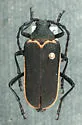
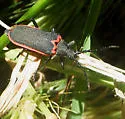
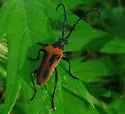
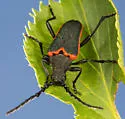
Photo credits: Contributed by Phillip Harpootlian; Additional contributions by Mike Quinn
Frequently Asked Questions About Desmocerus californicus
What is Desmocerus californicus?
Desmocerus californicus is a species in the family Cerambycidae, within the order Coleoptera.
How big is Desmocerus californicus?
~2cm
How do you identify Desmocerus californicus?
The forewings of the male are primarily red with dark green spots, whereas those of the female are dark metallic green with red margins. females of the subspecies are basically indistinguishable without DNA or locality data (per Phil Schapker, 2013)
Where is Desmocerus californicus found?
| Feature | Details |
|---|---|
| Habitat | In CA's Central Valley, the elderberry tree is associated with riparian forests which occur along rivers and streams. Historically the beetle ranged throughout the Valley, but recent surveys have revealed the beetle to persist only in scattered localities along the Sacramento, American, San Joaquin, Kings, Kaweah, and Tule rivers and their tributaries. Over 90% of CA's riparian forests have been cleared in the past century for agricultural, urban, and suburban development. |
| Range | D. c. dimorphus is restricted to California's Central Valley |
What does Desmocerus californicus eat?
The diet of the Desmocerus californicus includes asso. w/ elderberry trees ( Sambucus spp.) during its entire life cycle..
What is the life cycle of a Desmocerus californicus?
The adults emerge in the spring from pupation inside the wood of these trees as they begin to bloom. The exit holes made by the emerging adults are distinctive, small oval openings. Often these holes are the only clue that the beetles occur in an area. The adults eat the elderberry foliage until about June when they mate. The females lay their eggs in crevices in the bark. Upon hatching, the larvae then begin to tunnel into the tree where they will spend 1-2 years eating the interior wood, their sole source of food.