
Azalea Caterpillar Moth - Hodges#7905
Datana major
This record describes Datana major (species). Recorded family: Notodontidae. Recorded order: Lepidoptera.
Identification and Appearance
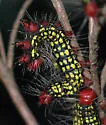
Adult: forewing orangish-brown, darker brown toward costa (not tawny to reddish-brown, as in Drexel's Datana); hindwing solid orangish-brown [adapted from description by Charles Covell] D. major is not safely separable from D. drexelii except by examination of the male valves (Hugh McGuinness, pers. comm.) Both species have brown forewings, usually with orange shading along the costa. The reniform and orbicular spots are usually distinct, often quite bold. D. major averages larger and redder than D. drexelii . Genitalia: Larva: first instars are yellow with seven red longitudinal stripes and a black head. As the larva matures it becomes highly colored. Mature larvae are predominately black with a red last segment and eight broken yellow (occasionally white) lengthwise stripes. The head and legs are bright red. [adapted from description by G.W. Dekle and Thomas Fasulo, U. of Florida]
Classification
- Kingdom
- Animalia
- Phylum
- Arthropoda
- Class
- Insecta
- Order
- Lepidoptera (Butterflies and Moths)
- Superfamily
- Noctuoidea
- Family
- Notodontidae (Prominent Moths)
- Subfamily
- Phalerinae
- Genus
- Datana
Imported taxonomy record. Source availability varies; see the source references and editorial policy below.
Habitat and Range
Habitat
bogs and swamps
Geographic Range
southeastern United States from Maryland to Florida, west to Arkansas and Kansas
Seasonal Activity
adults fly from June to August larvae present July to October
Diet and Behavior
Diet: larvae feed mainly on leaves of azalea ( Rhododendron spp.) but have also been recorded on apple, blueberry, Red Oak, and Bog Rosemary ( Andromeda polifoloa )
Life History
female lays masses of 80-100 eggs on underside of leaf in late spring or early summer; first instar larvae feed gregariously, skeletonizing leaves of hostplant; older larvae eat entire leaves; usually one generation per year, with partial second generation in the south; overwinters as a pupa in a cell in the soil
About Butterflies and Moths: the wider group
Order-level background for Lepidoptera, the group containing Datana major. Species-specific details appear above.
Group overview
Lepidoptera includes approximately 180,000 described species of butterflies and moths. Moths outnumber butterflies roughly 10:1. The monarch butterfly's eastern population has declined by more than 80% since the mid-1990s, and the western population by over 95% since the 1980s. The IUCN lists the migratory monarch as Vulnerable.
Ecological role of the group
Butterflies and moths are essential indicators of ecosystem health. As caterpillars, they are a primary food source for birds - a single nest of blue tit chicks requires ~10,000 caterpillars. Adult moths pollinate many night-blooming plants.
Economic and practical significance of the group
Lepidoptera are critical pollinators. In Europe, grassland butterfly species have declined by almost 50% since the early 1990s. In the UK, three-quarters of butterflies are in decline. In the U.S., five butterfly species have gone extinct since 1950, with 29 listed as endangered.
Recorded sources for this group: IUCN Red List, Xerces Society, USFWS, PNAS, WWF. Imported estimates may describe particular regions or reporting periods.
Photos of Azalea Caterpillar Moth - Hodges#7905 (5)
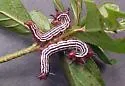
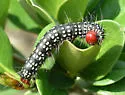
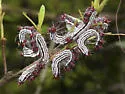
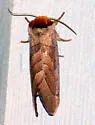
Photo credits: Contributed by john and jane balaban; Additional contributions by Beatriz Moisset , Robin McLeod , Tony-2 , Joshua Stuart Rose , Robert Lord Zimlich , dennepj10 , Robert H. Biagi
Frequently Asked Questions About Azalea Caterpillar Moth - Hodges#7905
What is Azalea Caterpillar Moth - Hodges#7905?
Azalea Caterpillar Moth - Hodges#7905 (Datana major) is a species in the family Notodontidae, within the order Lepidoptera.
How big is Azalea Caterpillar Moth - Hodges#7905?
wingspan 40-50 mm larva to 50 mm
How do you identify Azalea Caterpillar Moth - Hodges#7905?
Adult: forewing orangish-brown, darker brown toward costa (not tawny to reddish-brown, as in Drexel's Datana); hindwing solid orangish-brown [adapted from description by Charles Covell] D. major is not safely separable from D. drexelii except by examination of the male valves (Hugh McGuinness, pers. comm.) Both species have brown forewings, usually with orange shading along the costa. The reniform and orbicular spots are usually distinct, often quite bold. D. major averages larger and redder than D. drexelii . Genitalia: Larva: first instars are yellow with seven red longitudinal stripes and a black head. As the larva matures it becomes highly colored. Mature larvae are predominately black with a red last segment and eight broken yellow (occasionally white) lengthwise stripes. The head and legs are bright red. [adapted from description by G.W. Dekle and Thomas Fasulo, U. of Florida]
Where is Azalea Caterpillar Moth - Hodges#7905 found?
| Feature | Details |
|---|---|
| Habitat | bogs and swamps |
| Range | southeastern United States from Maryland to Florida, west to Arkansas and Kansas |
What does Azalea Caterpillar Moth - Hodges#7905 eat?
The diet of the Azalea Caterpillar Moth - Hodges#7905 includes larvae feed mainly on leaves of azalea ( Rhododendron spp.) but have also been recorded on apple, blueberry, Red Oak, and Bog Rosemary ( Andromeda polifoloa ).
When is Azalea Caterpillar Moth - Hodges#7905 active?
Azalea Caterpillar Moth - Hodges#7905: seasonal activity - adults fly from June to August larvae present July to October.
What is the life cycle of a Azalea Caterpillar Moth - Hodges#7905?
female lays masses of 80-100 eggs on underside of leaf in late spring or early summer; first instar larvae feed gregariously, skeletonizing leaves of hostplant; older larvae eat entire leaves; usually one generation per year, with partial second generation in the south; overwinters as a pupa in a cell in the soil