
Southern House Mosquito
Culex quinquefasciatus
This record describes Culex quinquefasciatus (species). Recorded family: Culicidae. Recorded order: Diptera.
Identification and Appearance
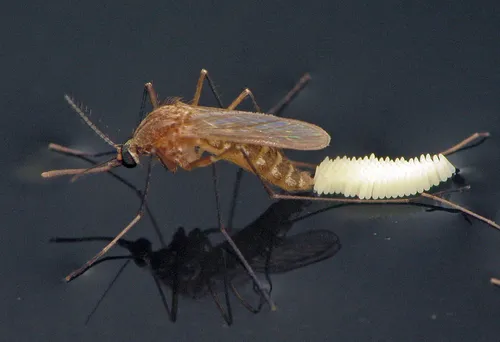
The distinguishing features of the Culex mosquitoes are: cross veins on narrow wings, blunt abdomen, short palpus, and no prespiracular or postspiracular setae (CDC 2005). Female: Medium-sized mosquito of brownish appearance; proboscis dark but often with some pale scaling midway on the underside; scutum with golden and bronzy narrow scales; wings all dark scaled; hind legs with femur pale almost to the tip except for dark scales along length dorsally, remainder of legs all dark scaled except for pale patch at tibial-tarsal joint; abdominal tergites dark scaled with pale basal bands constricted laterally and not merging with lateral patches except perhaps on terminal segments, sternites generally pale scaled but with a few to more dark scales scattered medially Florida Medical Entomology Laboratory A major domestic pest in many urban areas, particularly as indicated by indoor biting (although the similar Cx. molestus must be considered in some southern areas); it has been shown to be able to carry Murray Valley encephalitis (MVE) virus in laboratory studies, MVE virus has been isolated from the species in northern WA, it has yielded an isolate of Ross River (RR) virus during an outbreak in New Caledonia, but from a number of laboratory studies in Australia it appears to be a poor and unlikely vector of MVE, Kunjin, RR and other arboviruses; it is a vector (not particularly efficient) of dog heartworm (and human filariasis in more northern tropical regions), an important vector of fowl pox, and possibly involved in myxomatosis transmission in some areas. a primary vector in 2012 West Nile encephalitis epidemic in Dallas, Texas.
Wikipedia reference for Culex quinquefasciatus: https://en.wikipedia.org/wiki/Culex_quinquefasciatus.
Classification
Habitat and Range
Habitat
Oviposition occurs in waters ranging from waste water areas to bird baths, old tires, or any container that holds water. - UF
Geographic Range
CA-FL-DC-UT / Mex. - Map ( 3 ) ( 4 ) , now cosmopolitan
Seasonal Activity
Adults are generally active only during the warmer months.
Diet and Behavior
Diet: They usually attack humans towards the middle of the night indoors and outdoors, but are often more attracted to birds (e.g. poultry).
Life History
The larvae feed on biotic material in the water and require between five to eight days to complete their development at 30°C - UF
About Flies: the wider group
Order-level background for Diptera, the group containing Culex quinquefasciatus. Species-specific details appear above.
Group overview
Diptera includes over 150,000 described species of flies, mosquitoes, and midges. Mosquitoes are the deadliest animal on Earth (CDC). Malaria alone causes ~249 million cases and over 608,000 deaths annually, mostly children under 5 (WHO). Vector-borne diseases account for over 17% of all infectious diseases, causing 700,000+ deaths per year.
Ecological role of the group
Despite their disease impact, flies are critical decomposers and pollinators. Hoverflies alone pollinate hundreds of crop and wildflower species. Flies are also the primary food source for many birds, bats, and fish. Forensic entomology relies heavily on fly species for crime scene analysis.
Economic and practical significance of the group
In the U.S., vector-borne disease cases tripled between 2004-2016, with over 640,000 cases reported in that period (CDC). Tickborne diseases doubled from 22,000 to 48,000 annual reports. Globally, mosquito-borne diseases cost billions in healthcare and lost productivity.
Recorded sources for this group: WHO, CDC, PNAS. Imported estimates may describe particular regions or reporting periods.
Photos of Southern House Mosquito (2)
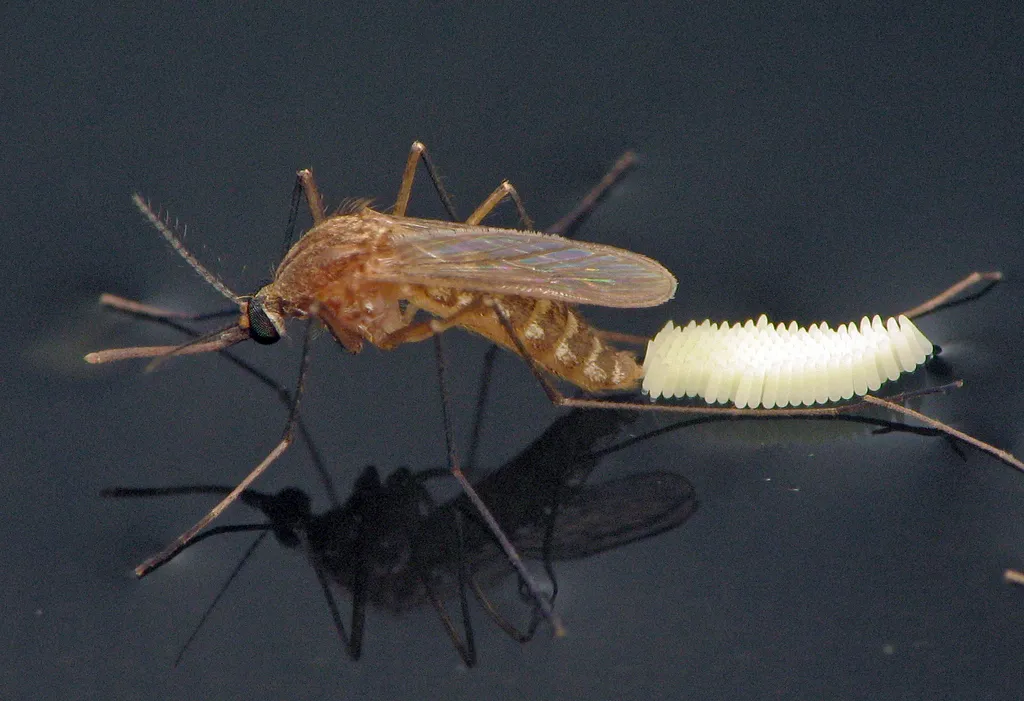
Photo credits: Contributed by Beatriz Moisset; Additional contributions by Mike Quinn
Frequently Asked Questions About Southern House Mosquito
What is Southern House Mosquito?
Southern House Mosquito (Culex quinquefasciatus) is a species in the family Culicidae, within the order Diptera.
How big is Southern House Mosquito?
3.96-4.25 mm length - UF
How do you identify Southern House Mosquito?
The distinguishing features of the Culex mosquitoes are: cross veins on narrow wings, blunt abdomen, short palpus, and no prespiracular or postspiracular setae (CDC 2005). Female: Medium-sized mosquito of brownish appearance; proboscis dark but often with some pale scaling midway on the underside; scutum with golden and bronzy narrow scales; wings all dark scaled; hind legs with femur pale almost to the tip except for dark scales along length dorsally, remainder of legs all dark scaled except for pale patch at tibial-tarsal joint; abdominal tergites dark scaled with pale basal bands constricted laterally and not merging with lateral patches except perhaps on terminal segments, sternites generally pale scaled but with a few to more dark scales scattered medially Florida Medical Entomology Laboratory
Where is Southern House Mosquito found?
| Feature | Details |
|---|---|
| Habitat | Oviposition occurs in waters ranging from waste water areas to bird baths, old tires, or any container that holds water. - UF |
| Range | CA-FL-DC-UT / Mex. - Map ( 3 ) ( 4 ) , now cosmopolitan |
What does Southern House Mosquito eat?
The diet of the Southern House Mosquito includes They usually attack humans towards the middle of the night indoors and outdoors, but are often more attracted to birds (e.g. poultry)..
When is Southern House Mosquito active?
Southern House Mosquito: seasonal activity - Adults are generally active only during the warmer months..
What is the life cycle of a Southern House Mosquito?
The larvae feed on biotic material in the water and require between five to eight days to complete their development at 30°C - UF