
Cryptocheilus pallidipenne
This record describes Cryptocheilus pallidipenne (species). Recorded family: Pompilidae. Recorded order: Hymenoptera.
Identification and Appearance
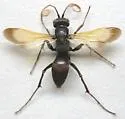
From the treatment in Townes : Black. Body pubescence dark gray; flagellum orange, its first segment infuscate basally; wings orange-yellow, the apical 0.21 ± of the forewing and the apical margin of the hind wing fuscous. Female: Forewing 8 to 10 mm. long; clypeus in side view rather strongly convex, in front view with the apex strongly and broadly arcuately concave; mandible (when not eroded) about 0.75 as long as the clypeus is wide, its apical tooth moderately broad. Male: Forewing 8 to 9 mm. long; clypeus in front view with its apex moderately concave; median notch of sixth sternite deeply U-shaped; subgenital plate tongue-shaped, somewhat convex but without a median ridge; apical margin of subgenital plate with a fringe of short stout hairs. You can read the original 1911 description by Banks at this link .
Classification
- Kingdom
- Animalia
- Phylum
- Arthropoda
- Class
- Insecta
- Order
- Hymenoptera (Ants, Bees, Wasps and Sawflies)
- Superfamily
- Pompiloidea
- Family
- Pompilidae (Spider Wasps)
- Subfamily
- Pepsinae
- Tribe
- Pepsini
- Genus
- Cryptocheilus
Imported taxonomy record. Source availability varies; see the source references and editorial policy below.
Habitat and Range
Geographic Range
Oregon, California, Arizona, and New Mexico ( Krombein )
Seasonal Activity
Adult collection records span from May to August.
About Flies: the wider group
Order-level background for Hymenoptera, the group containing Cryptocheilus pallidipenne. Species-specific details appear above.
Group overview
Hymenoptera includes over 150,000 described species of ants, bees, wasps, and sawflies. Earth harbors approximately 20 quadrillion (20×10^15) ants, with a combined biomass of ~12 megatons of dry carbon - exceeding the combined biomass of all wild birds and mammals (PNAS, 2022).
Ecological role of the group
About 35% of the world's food crops depend on animal pollinators. The chocolate industry, valued at over $100 billion, depends on pollinating flies and midges. Ants are the dominant soil engineers in most terrestrial ecosystems, turning more soil than earthworms in many habitats.
Economic and practical significance of the group
Pollinators contribute $235-577 billion worth of annual global food production (FAO). In the U.S., bee pollination alone benefits crops valued at $18 billion annually, and honey bees are responsible for $5.4 billion in agricultural productivity. Between April 2023-2024, 55.1% of managed honey bee colonies were lost. The U.S. bee population dropped from 5 million to 2.5 million.
Recorded sources for this group: FAO, USDA, EPA, PNAS (2022), US Fish & Wildlife Service. Imported estimates may describe particular regions or reporting periods.
Photos of Cryptocheilus pallidipenne (5)
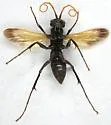
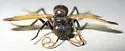
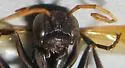
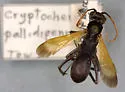
Photo credits: Contributed by Aaron Schusteff
Frequently Asked Questions About Cryptocheilus pallidipenne
What is Cryptocheilus pallidipenne?
Cryptocheilus pallidipenne is a species in the family Pompilidae, within the order Hymenoptera.
How do you identify Cryptocheilus pallidipenne?
From the treatment in Townes : Black. Body pubescence dark gray; flagellum orange, its first segment infuscate basally; wings orange-yellow, the apical 0.21 ± of the forewing and the apical margin of the hind wing fuscous. Female: Forewing 8 to 10 mm. long; clypeus in side view rather strongly convex, in front view with the apex strongly and broadly arcuately concave; mandible (when not eroded) about 0.75 as long as the clypeus is wide, its apical tooth moderately broad. Male: Forewing 8 to 9 mm. long; clypeus in front view with its apex moderately concave; median notch of sixth sternite deeply U-shaped; subgenital plate tongue-shaped, somewhat convex but without a median ridge; apical margin of subgenital plate with a fringe of short stout hairs.
Where is Cryptocheilus pallidipenne found?
Range: Oregon, California, Arizona, and New Mexico ( Krombein )
When is Cryptocheilus pallidipenne active?
Cryptocheilus pallidipenne: seasonal activity - Adult collection records span from May to August..