
Conophorus sackenii
This record describes Conophorus sackenii (species). Recorded family: Bombyliidae. Recorded order: Diptera.
Identification and Appearance
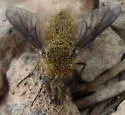
Tuft of metapleural hair; rather long first antennal segment (half the length of antenna or longer); halter knob usually black, opaque (rather than shiny) scutellum. Note: there's considerable variation in the amount and extent of black hair on head and body. Also, the tomentum varies in color (whitish to golden-yellow), as well as in density. Wing (with three submarginal cells) may vary in darkness from infuscated basally and hyaline toward the apex, to darker with all cells subhyaline. (based on key and description in Hall & Evenhuis, cited below)
Classification
- Kingdom
- Animalia
- Phylum
- Arthropoda
- Class
- Insecta
- Order
- Diptera (Flies)
- Superfamily
- Asiloidea
- Family
- Bombyliidae (Bee Flies)
- Subfamily
- Bombyliinae
- Tribe
- Conophorini
- Genus
- Conophorus
Imported taxonomy record. Source availability varies; see the source references and editorial policy below.
Habitat and Range
Geographic Range
Canada: Alberta, British Columbia, Saskatchewan; USA: CA, CO, ID, MT, UT, WA Considered a northern species, occurring principally from 35º N latitude northward. May also occur farther eastward (Hall & Evenhuis, ref. below). At least in CA it may occur south of 35ºN: on invertebrate list of Wright's Field, San Diego County, near Alpine, CA; altitude ~1840 feet
Additional species information
Species notes from the sources
Etymology: Conophorus sackenii Johnson & Maughan (1953). Named after Baron Osten-Sacken who had described this fly as Ploas sp. in 1877.
About Flies: the wider group
Order-level background for Diptera, the group containing Conophorus sackenii. Species-specific details appear above.
Group overview
Diptera includes over 150,000 described species of flies, mosquitoes, and midges. Mosquitoes are the deadliest animal on Earth (CDC). Malaria alone causes ~249 million cases and over 608,000 deaths annually, mostly children under 5 (WHO). Vector-borne diseases account for over 17% of all infectious diseases, causing 700,000+ deaths per year.
Ecological role of the group
Despite their disease impact, flies are critical decomposers and pollinators. Hoverflies alone pollinate hundreds of crop and wildflower species. Flies are also the primary food source for many birds, bats, and fish. Forensic entomology relies heavily on fly species for crime scene analysis.
Economic and practical significance of the group
In the U.S., vector-borne disease cases tripled between 2004-2016, with over 640,000 cases reported in that period (CDC). Tickborne diseases doubled from 22,000 to 48,000 annual reports. Globally, mosquito-borne diseases cost billions in healthcare and lost productivity.
Recorded sources for this group: WHO, CDC, PNAS. Imported estimates may describe particular regions or reporting periods.
Photos of Conophorus sackenii (5)
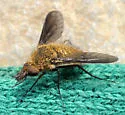
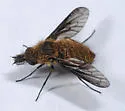
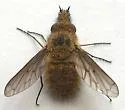
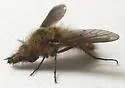
Photo credits: Contributed by Hartmut Wisch
Frequently Asked Questions About Conophorus sackenii
What is Conophorus sackenii?
Conophorus sackenii is a species in the family Bombyliidae, within the order Diptera.
How do you identify Conophorus sackenii?
Tuft of metapleural hair; rather long first antennal segment (half the length of antenna or longer); halter knob usually black, opaque (rather than shiny) scutellum. Note: there's considerable variation in the amount and extent of black hair on head and body. Also, the tomentum varies in color (whitish to golden-yellow), as well as in density. Wing (with three submarginal cells) may vary in darkness from infuscated basally and hyaline toward the apex, to darker with all cells subhyaline. (based on key and description in Hall & Evenhuis, cited below)
Where is Conophorus sackenii found?
Range: Canada: Alberta, British Columbia, Saskatchewan; USA: CA, CO, ID, MT, UT, WA Considered a northern species, occurring principally from 35º N latitude northward. May also occur farther eastward (Hall & Evenhuis, ref. below). At least in CA it may occur south of 35ºN: on invertebrate list of Wright's Field, San Diego County, near Alpine, CA; altitude ~1840 feet