
Colobopsis papago
This record describes Colobopsis papago (species). Recorded family: Formicidae. Recorded order: Hymenoptera.
Identification and Appearance
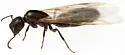
A dark Colobopsis with similar coloration on all female castes. Out of range of all other Colobopsis in our area other than Colobopsis cerberula , which it differs from by having a non-keeled clypeus on majors and queens, less numerous and less spatulate hairs on the cheeks of the head of majors and queens, shorter antennal scapes, and other traits detailed in Creighton's 1953 description. There is a Camponotus with a truncate head in the region that this species can be confused with ( Camponotus ulcerosus ). However this Camponotus has a entirely rounded back on the workers instead of humped on Colobopsis , and is larger, much more matte, and with fine white hairs all over its body among other differences The majors of C. papago , when disturbed, have a curious habit of exuding from the mouth a sticky, greyish fluid. This often spreads backward over the truncated portion of the head. If it is allowed to dry there it forms a crust that is almost impossible to remove. (Creighton 1953)
Classification
- Kingdom
- Animalia
- Phylum
- Arthropoda
- Class
- Insecta
- Order
- Hymenoptera (Ants, Bees, Wasps and Sawflies)
- Superfamily
- Formicoidea
- Family
- Formicidae (Ants)
- Subfamily
- Formicinae
- Tribe
- Camponotini
- Genus
- Colobopsis
Imported taxonomy record. Source availability varies; see the source references and editorial policy below.
Habitat and Range
Habitat
"This species nests in dead limbs of oaks ( Quercus emoryi , Q. oblongifolia ), or mesquites, and are difficult to find. They are most common in the stubs of broken branches, with a diameter of 4 cms or more, and point vertically (apparently catch more rainwater)." - Antwiki
Geographic Range
Southmost AZ and NM, south into adjacent Mexico.
Seasonal Activity
Creighton notes that the nuptial flights occur throughout the month of July, during the first half of the summer rainy season.
Diet and Behavior
Diet: Workers are likely nocturnal foragers.
Additional species information
Species notes from the sources
Etymology: Colobopsis papago Creighton 1953
About Flies: the wider group
Order-level background for Hymenoptera, the group containing Colobopsis papago. Species-specific details appear above.
Group overview
Hymenoptera includes over 150,000 described species of ants, bees, wasps, and sawflies. Earth harbors approximately 20 quadrillion (20×10^15) ants, with a combined biomass of ~12 megatons of dry carbon - exceeding the combined biomass of all wild birds and mammals (PNAS, 2022).
Ecological role of the group
About 35% of the world's food crops depend on animal pollinators. The chocolate industry, valued at over $100 billion, depends on pollinating flies and midges. Ants are the dominant soil engineers in most terrestrial ecosystems, turning more soil than earthworms in many habitats.
Economic and practical significance of the group
Pollinators contribute $235-577 billion worth of annual global food production (FAO). In the U.S., bee pollination alone benefits crops valued at $18 billion annually, and honey bees are responsible for $5.4 billion in agricultural productivity. Between April 2023-2024, 55.1% of managed honey bee colonies were lost. The U.S. bee population dropped from 5 million to 2.5 million.
Recorded sources for this group: FAO, USDA, EPA, PNAS (2022), US Fish & Wildlife Service. Imported estimates may describe particular regions or reporting periods.
Photos of Colobopsis papago (5)
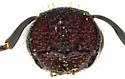
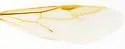
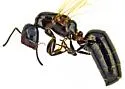
Photo credits: Contributed by Steven Wang
Frequently Asked Questions About Colobopsis papago
What is Colobopsis papago?
Colobopsis papago is a species in the family Formicidae, within the order Hymenoptera.
How do you identify Colobopsis papago?
A dark Colobopsis with similar coloration on all female castes. Out of range of all other Colobopsis in our area other than Colobopsis cerberula , which it differs from by having a non-keeled clypeus on majors and queens, less numerous and less spatulate hairs on the cheeks of the head of majors and queens, shorter antennal scapes, and other traits detailed in Creighton's 1953 description. There is a Camponotus with a truncate head in the region that this species can be confused with ( Camponotus ulcerosus ). However this Camponotus has a entirely rounded back on the workers instead of humped on Colobopsis , and is larger, much more matte, and with fine white hairs all over its body among other differences
Where is Colobopsis papago found?
| Feature | Details |
|---|---|
| Habitat | This species nests in dead limbs of oaks ( Quercus emoryi , Q. oblongifolia ), or mesquites, and are difficult to find. They are most common in the stubs of broken branches, with a diameter of 4 cms or more, and point vertically (apparently catch more rainwater). - Antwiki |
| Range | Southmost AZ and NM, south into adjacent Mexico. |
What does Colobopsis papago eat?
The diet of the Colobopsis papago includes Workers are likely nocturnal foragers..
When is Colobopsis papago active?
Colobopsis papago: seasonal activity - Creighton notes that the nuptial flights occur throughout the month of July, during the first half of the summer rainy season..