
New World Screwworm
Cochliomyia hominivorax
This record describes Cochliomyia hominivorax (species). Recorded family: Calliphoridae. Recorded order: Diptera.
Identification and Appearance
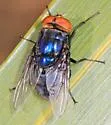
distinguished from the more common macellaria by parafrontal with black hair anteriorly outside the row of frontal bristles; basicosta of male normally black; female usually without proclinate fronto-orbitals. sterile male fly released during the 2016-2017 NWS outbreak in the FL Keys Det. John F. Carr, 2017
Classification
- Kingdom
- Animalia
- Phylum
- Arthropoda
- Class
- Insecta
- Order
- Diptera (Flies)
- Superfamily
- Oestroidea
- Family
- Calliphoridae (Blow Flies)
- Subfamily
- Chrysomyinae
- Genus
- Cochliomyia (Screwworm Flies)
Imported taxonomy record. Source availability varies; see the source references and editorial policy below.
Habitat and Range
Habitat
historically common in the s. Great Plains of TX - Map , current distribution along coastal lowlands of Mexico - CDC
Geographic Range
formerly common in s. Great Plains in TX / currently ne. Mex. to S. Amer. / W. Indies - Map , current distribution per USDA, updated at least weekly successfully eradicated from North and Central America, but in 2023, Panama and Costa Rica identified an outbreak of NWS. Since that time, all countries in Central America and Mexico, where NWS was previously controlled, have identified cases in animals and people. - CDC A reinfestation of the Florida Keys in 2016 took 350 employees and 188 million sterilized NWS pupae placed in 35 sites over 6 months to control, the infestation had spread to 13 Keys west of Marathon (Anonymous, 2017)
Diet and Behavior
Life History
NWS infestations begin when a female NWS fly is drawn to the odor of a wound or natural opening on a live, warm-blooded animal, where she lays her eggs. These openings can include wounds as small as a tick bite, nasal or eye openings, navel of a newborn or genitalia. One NWS female fly can lay up to 300 eggs at a time and may lay up to 3,000 eggs during her lifespan. Eggs hatch into larvae (maggots) that burrow into an opening to feed. After feeding, larvae drop to the ground, burrow into the soil and emerge as adult NWS flies. Adult NWS flies can fly long distances and the movement of infested livestock or wildlife can increase the rate of spread. Screwworms pose a serious threat to livestock, wildlife, pets, and humans. NWS myiasis occurs when NWS flies lay eggs in wounds or in other body cavities with mucus membranes, such as the nose, ears, eyes, or mouth. The eggs develop into parasitic larvae (maggots) that feed on and burrow into living flesh. Although they primarily affect livestock, such as cattle and horses, the flies can also lay eggs on people and other warm-blooded animals, both domestic and wildlife. Cases of NWS in people can be fatal if left untreated. - CDC
Additional species information
Species notes from the sources
Etymology: Cochliomyia hominivorax (Coquerel) "Screwworm" because rows of spines on mature larvae resemble a screw. "Primary" because it precedes the secondary screwworm in a multi-species infection.
About Flies: the wider group
Order-level background for Diptera, the group containing Cochliomyia hominivorax. Species-specific details appear above.
Group overview
Diptera includes over 150,000 described species of flies, mosquitoes, and midges. Mosquitoes are the deadliest animal on Earth (CDC). Malaria alone causes ~249 million cases and over 608,000 deaths annually, mostly children under 5 (WHO). Vector-borne diseases account for over 17% of all infectious diseases, causing 700,000+ deaths per year.
Ecological role of the group
Despite their disease impact, flies are critical decomposers and pollinators. Hoverflies alone pollinate hundreds of crop and wildflower species. Flies are also the primary food source for many birds, bats, and fish. Forensic entomology relies heavily on fly species for crime scene analysis.
Economic and practical significance of the group
In the U.S., vector-borne disease cases tripled between 2004-2016, with over 640,000 cases reported in that period (CDC). Tickborne diseases doubled from 22,000 to 48,000 annual reports. Globally, mosquito-borne diseases cost billions in healthcare and lost productivity.
Recorded sources for this group: WHO, CDC, PNAS. Imported estimates may describe particular regions or reporting periods.
Photos of New World Screwworm (5)
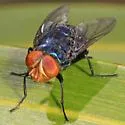
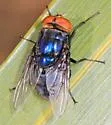
Photo credits: Contributed by John F. Carr; Additional contributions by Andrew Meeds , Mike Quinn
Frequently Asked Questions About New World Screwworm
What is New World Screwworm?
New World Screwworm (Cochliomyia hominivorax) is a species in the family Calliphoridae, within the order Diptera.
How do you identify New World Screwworm?
distinguished from the more common macellaria by parafrontal with black hair anteriorly outside the row of frontal bristles; basicosta of male normally black; female usually without proclinate fronto-orbitals. sterile male fly released during the 2016-2017 NWS outbreak in the FL Keys Det. John F. Carr, 2017
Where is New World Screwworm found?
| Feature | Details |
|---|---|
| Habitat | historically common in the s. Great Plains of TX - Map , current distribution along coastal lowlands of Mexico - CDC |
| Range | formerly common in s. Great Plains in TX / currently ne. Mex. to S. Amer. / W. Indies - Map , current distribution per USDA, updated at least weekly successfully eradicated from North and Central America, but in 2023, Panama and Costa Rica identified an outbreak of NWS. Since that time, all countries in Central America and Mexico, where NWS was previously controlled, have identified cases in animals and people. - CDC A reinfestation of the Florida Keys in 2016 took 350 employees and 188 million sterilized NWS pupae placed in 35 sites over 6 months to control, the infestation had spread to 13 Keys west of Marathon (Anonymous, 2017) |
What is the life cycle of a New World Screwworm?
NWS infestations begin when a female NWS fly is drawn to the odor of a wound or natural opening on a live, warm-blooded animal, where she lays her eggs. These openings can include wounds as small as a tick bite, nasal or eye openings, navel of a newborn or genitalia. One NWS female fly can lay up to 300 eggs at a time and may lay up to 3,000 eggs during her lifespan. Eggs hatch into larvae (maggots) that burrow into an opening to feed. After feeding, larvae drop to the ground, burrow into the soil and emerge as adult NWS flies. Adult NWS flies can fly long distances and the movement of infested livestock or wildlife can increase the rate of spread. Screwworms pose a serious threat to livestock, wildlife, pets, and humans. NWS myiasis occurs when NWS flies lay eggs in wounds or in other body cavities with mucus membranes, such as the nose, ears, eyes, or mouth. The eggs develop into parasitic larvae (maggots) that feed on and burrow into living flesh. Although they primarily affect livestock, such as cattle and horses, the flies can also lay eggs on people and other warm-blooded animals, both domestic and wildlife. Cases of NWS in people can be fatal if left untreated. - CDC