
Alkali Fly
Cirrula hians
This record describes Cirrula hians (species). Recorded family: Ephydridae. Recorded order: Diptera.
Identification and Appearance
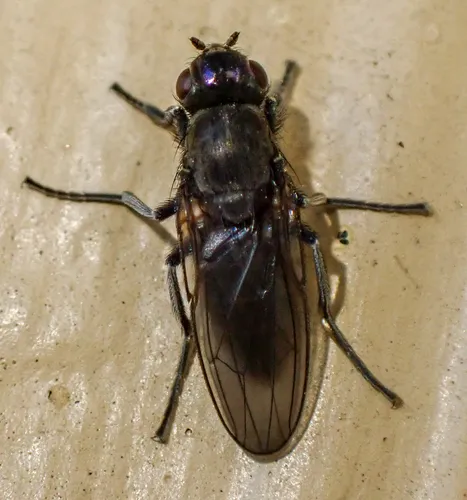
Three or four pairs of fronto-orbital bristles present, two presutural dorsocentral bristles present, two pairs of cruciate interfrontal bristles present, arista about equal in length as antennal segments 1-3 combined, one prescutellar acrostichal bristle distinct and present, and males with subapical ventral tuft of long hairs on the fore basitarsus (Mathis & Marinoni, 2016). This rather famous alkali fly has a large, ancient lake ( Mono Lake ), a native American tribe (the Kucadikadi ), and a California county (Mono county) named after it . It occurs in huge numbers along the shores of Mono Lake, where its larvae were collected as a food source and traded widely in pre-European contact times. It also occurs at other alkali lakes in the west, and was even recorded from Lake Texcoco near Mexico City, where it was also reportedly used historically as a food source. The accounts of Williston (1883) and Aldrich (1912) are of interest, the latter giving the most detailed early description of adults, larvae, biology, and historic use as a food source by Native Americans.
Wikipedia reference for Cirrula hians: https://en.wikipedia.org/wiki/Ephydra_hians.
Classification
- Kingdom
- Animalia
- Phylum
- Arthropoda
- Class
- Insecta
- Order
- Diptera (Flies)
- Superfamily
- Ephydroidea
- Family
- Ephydridae (Shore Flies)
- Subfamily
- Ephydrinae
- Tribe
- Ephydrini
- Genus
- Cirrula
Imported taxonomy record. Source availability varies; see the source references and editorial policy below.
Habitat and Range
Geographic Range
B.C. to Minn., s. to Calif., and Okla., Mexico.
About Flies: the wider group
Order-level background for Diptera, the group containing Cirrula hians. Species-specific details appear above.
Group overview
Diptera includes over 150,000 described species of flies, mosquitoes, and midges. Mosquitoes are the deadliest animal on Earth (CDC). Malaria alone causes ~249 million cases and over 608,000 deaths annually, mostly children under 5 (WHO). Vector-borne diseases account for over 17% of all infectious diseases, causing 700,000+ deaths per year.
Ecological role of the group
Despite their disease impact, flies are critical decomposers and pollinators. Hoverflies alone pollinate hundreds of crop and wildflower species. Flies are also the primary food source for many birds, bats, and fish. Forensic entomology relies heavily on fly species for crime scene analysis.
Economic and practical significance of the group
In the U.S., vector-borne disease cases tripled between 2004-2016, with over 640,000 cases reported in that period (CDC). Tickborne diseases doubled from 22,000 to 48,000 annual reports. Globally, mosquito-borne diseases cost billions in healthcare and lost productivity.
Recorded sources for this group: WHO, CDC, PNAS. Imported estimates may describe particular regions or reporting periods.
Photos of Alkali Fly (2)
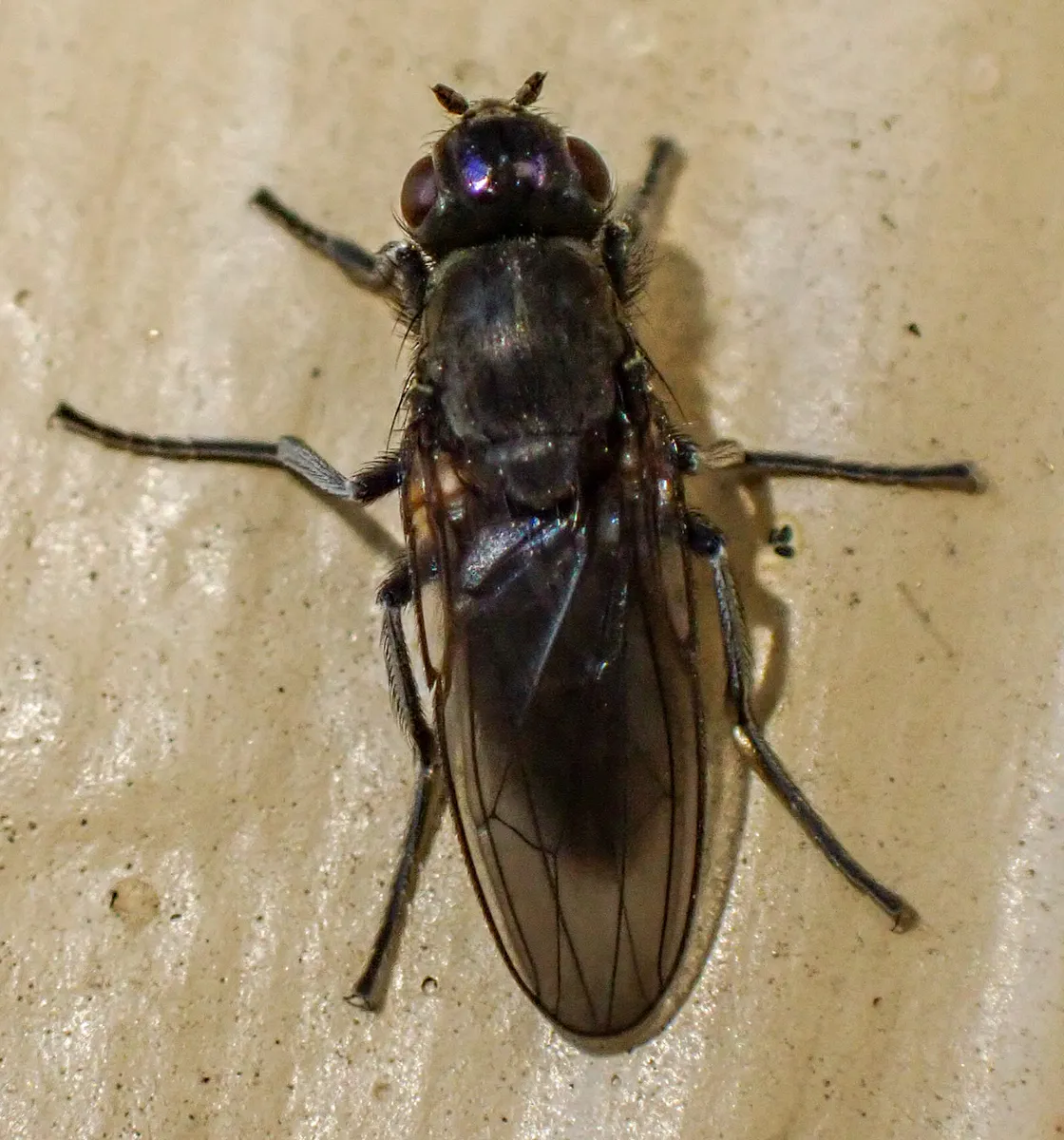
Photo credits: Contributed by Aaron Schusteff; Additional contributions by Vox Sciurorum , Arturo Santos
Frequently Asked Questions About Alkali Fly
What is Alkali Fly?
Alkali Fly (Cirrula hians) is a species in the family Ephydridae, within the order Diptera.
How do you identify Alkali Fly?
Three or four pairs of fronto-orbital bristles present, two presutural dorsocentral bristles present, two pairs of cruciate interfrontal bristles present, arista about equal in length as antennal segments 1-3 combined, one prescutellar acrostichal bristle distinct and present, and males with subapical ventral tuft of long hairs on the fore basitarsus (Mathis & Marinoni, 2016).
Where is Alkali Fly found?
Range: B.C. to Minn., s. to Calif., and Okla., Mexico.