
S-banded Tiger Beetle
Cicindelidia trifasciata
This record describes Cicindelidia trifasciata (species). Recorded family: Carabidae. Recorded order: Coleoptera.
Identification and Appearance
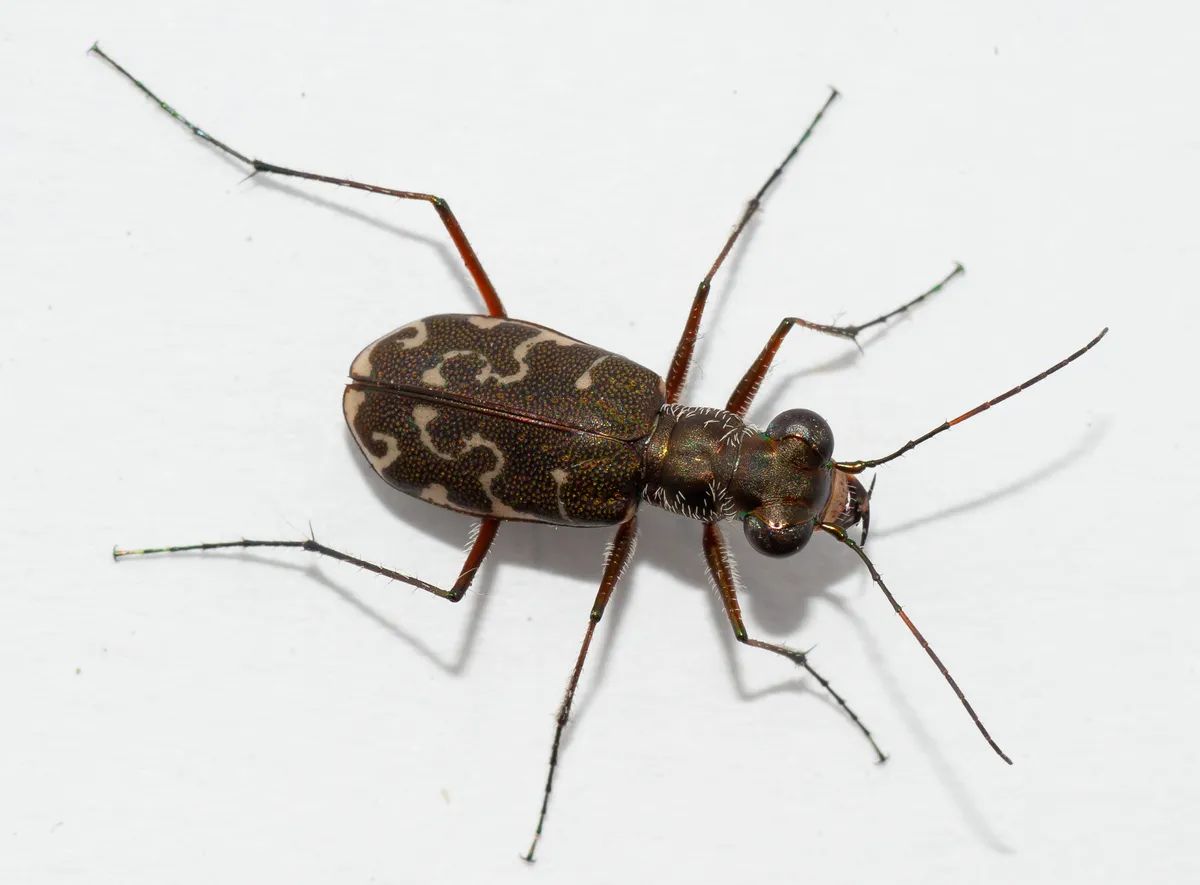
variably dark grayish-brown to light brown, sometimes with greenish tint; middle band curved in conspicuous S shape in well-marked specimens; lines tend to be thin and delicate in subspecies ascendens , and thicker/bolder in subspecies sigmoidea as in many tiger beetle species, the lines may be broken or reduced to spots in some individuals
Wikipedia reference for Cicindelidia trifasciata: https://en.wikipedia.org/wiki/Cicindela_trifasciata.
Classification
- Kingdom
- Animalia
- Phylum
- Arthropoda
- Class
- Insecta
- Order
- Coleoptera (Beetles)
- Suborder
- Adephaga
- Family
- Carabidae (Ground Beetles)
- Subfamily
- Cicindelinae
- Tribe
- Cicindelini
- Genus
- Cicindelidia (American Tiger Beetles)
Imported taxonomy record. Source availability varies; see the source references and editorial policy below.
Habitat and Range
Habitat
mudflats along coast, and edges of marshes and rivers inland
Geographic Range
subspecies C. t. ascendens : east coast of US from Long Island, New York to Florida and gulf coast of Texas into Mexico, plus scattered inland locations as far as Kansas subspecies C. t. sigmoidea : west coast of California, Baja peninsula, and Mexico, inland to Arizona (see distribution map ) several other subspecies occur through Central and South America to Chile
Seasonal Activity
adults from April to October but most numerous in summer
About Primitive Winged Insects: the wider group
Order-level background for Coleoptera, the group containing Cicindelidia trifasciata. Species-specific details appear above.
Group overview
Coleoptera is the largest order of insects with over 400,000 described species, representing ~25% of all known animal species and ~40% of all insects. In the U.S. alone, nearly 30,000 beetle species have been identified.
Ecological role of the group
Beetles are prominent decomposers, especially in forests, breaking down dead wood and recycling nutrients. As predators, they reduce populations of pest insects. Many species are also important pollinators of flowering plants.
Economic and practical significance of the group
Beetles have major economic significance: leaf beetles (Chrysomelidae) and weevils (Curculionoidea) are among the most destructive agricultural pests globally, costing billions annually, while predatory species like ladybugs provide natural pest control.
Recorded sources for this group: Britannica, Smithsonian, NCSU Entomology. Imported estimates may describe particular regions or reporting periods.
Photos of S-banded Tiger Beetle (2)
Photo credits: Contributed by Troy Bartlett; Additional contributions by Robin McLeod , Ben Coulter
Frequently Asked Questions About S-banded Tiger Beetle
What is S-banded Tiger Beetle?
S-banded Tiger Beetle (Cicindelidia trifasciata) is a species in the family Carabidae, within the order Coleoptera.
How big is S-banded Tiger Beetle?
body length 11-13 mm
How do you identify S-banded Tiger Beetle?
variably dark grayish-brown to light brown, sometimes with greenish tint; middle band curved in conspicuous S shape in well-marked specimens; lines tend to be thin and delicate in subspecies ascendens , and thicker/bolder in subspecies sigmoidea as in many tiger beetle species, the lines may be broken or reduced to spots in some individuals
Where is S-banded Tiger Beetle found?
| Feature | Details |
|---|---|
| Habitat | mudflats along coast, and edges of marshes and rivers inland |
| Range | subspecies C. t. ascendens : east coast of US from Long Island, New York to Florida and gulf coast of Texas into Mexico, plus scattered inland locations as far as Kansas subspecies C. t. sigmoidea : west coast of California, Baja peninsula, and Mexico, inland to Arizona (see distribution map ) several other subspecies occur through Central and South America to Chile |
When is S-banded Tiger Beetle active?
S-banded Tiger Beetle: seasonal activity - adults from April to October but most numerous in summer.