
Beautiful Tiger Beetle
Cicindela pulchra
This record describes Cicindela pulchra (species). Recorded family: Carabidae. Recorded order: Coleoptera.
Identification and Appearance

Most are metallic purple, but can be deep dull purple also. Maculation in Colorado can vary from a well defined middle band to no maculation at all. In Arizona/southern New Mexico the maculation is greatly expanded; these populations may be treated as subspecies C. pulchra dorothea . When frightened they will fly 10-15 feet and land on open soil; if pursued they can fly long distances and will land in grasses. I have witnessed them fly over 20-30 feet into the air and then fly several hundred yards to land in a completely new area. Earlier in the morning they can be found sunning themselves in open areas and will typically not fly but run to avoid capture, or they might fly a very short distance (5-8 feet) and land in grasses. The bright purple color of these beetles makes them easy to see when they are on open ground but if they run into shaded areas they can be very difficult to spot as the purple is a much darker shade when not in direct light. The above is from personal experience with these beetles in Colorado. Much of the above can be very different in other states or even habitats. For example, C. pulchra dorothea in Arizona will only emerge after rains during the monsoon season, making it more of a summer species there. ~ Jeff Owens
Classification
- Kingdom
- Animalia
- Phylum
- Arthropoda
- Class
- Insecta
- Order
- Coleoptera (Beetles)
- Suborder
- Adephaga
- Family
- Carabidae (Ground Beetles)
- Subfamily
- Cicindelinae
- Tribe
- Cicindelini
- Genus
- Cicindela (Temperate Tiger Beetles)
Imported taxonomy record. Source availability varies; see the source references and editorial policy below.
Habitat and Range
Habitat
Found in desert/semi-arid environments usually where grasses and plants are patchy. Adults will often congregate on the sides of dirt roads and cow paths in these areas. Larvae are found in these same open areas, often in hard packed clay soil that drains easily.
Geographic Range
mainly New Mexico, Colorado, and Kansas, plus portions of Wyoming, Nebraska, Oklahoma, Texas, Arizona ( see map )
Seasonal Activity
A spring/fall species in Colorado, first appearing in early May to early June, then again from late August to the first cold spell usually about late September.
Diet and Behavior
Diet: They will eat pretty much anything they can wrestle down. I have noticed them eating C. punctulata , ants, small ground beetles, nymphs of grasshoppers, and other small insects.
Life History
Overwinter as larvae with a 2 year life cycle. I find teneral adults in spring and have noted them mating in both spring and fall.
Additional species information
Species notes from the sources
Etymology: Cicindela pulchra Say 1823
About Primitive Winged Insects: the wider group
Order-level background for Coleoptera, the group containing Cicindela pulchra. Species-specific details appear above.
Group overview
Coleoptera is the largest order of insects with over 400,000 described species, representing ~25% of all known animal species and ~40% of all insects. In the U.S. alone, nearly 30,000 beetle species have been identified.
Ecological role of the group
Beetles are prominent decomposers, especially in forests, breaking down dead wood and recycling nutrients. As predators, they reduce populations of pest insects. Many species are also important pollinators of flowering plants.
Economic and practical significance of the group
Beetles have major economic significance: leaf beetles (Chrysomelidae) and weevils (Curculionoidea) are among the most destructive agricultural pests globally, costing billions annually, while predatory species like ladybugs provide natural pest control.
Recorded sources for this group: Britannica, Smithsonian, NCSU Entomology. Imported estimates may describe particular regions or reporting periods.
Photos of Beautiful Tiger Beetle (5)
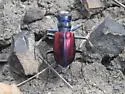
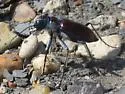
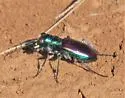
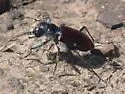
Photo credits: Contributed by tom murray; Additional contributions by Robin McLeod , Lynette Elliott , Mike Quinn , Aaron Schusteff
Frequently Asked Questions About Beautiful Tiger Beetle
What is Beautiful Tiger Beetle?
Beautiful Tiger Beetle (Cicindela pulchra) is a species in the family Carabidae, within the order Coleoptera.
How big is Beautiful Tiger Beetle?
15-18 mm
How do you identify Beautiful Tiger Beetle?
Most are metallic purple, but can be deep dull purple also. Maculation in Colorado can vary from a well defined middle band to no maculation at all. In Arizona/southern New Mexico the maculation is greatly expanded; these populations may be treated as subspecies C. pulchra dorothea .
Where is Beautiful Tiger Beetle found?
| Feature | Details |
|---|---|
| Habitat | Found in desert/semi-arid environments usually where grasses and plants are patchy. Adults will often congregate on the sides of dirt roads and cow paths in these areas. Larvae are found in these same open areas, often in hard packed clay soil that drains easily. |
| Range | mainly New Mexico, Colorado, and Kansas, plus portions of Wyoming, Nebraska, Oklahoma, Texas, Arizona ( see map ) |
What does Beautiful Tiger Beetle eat?
The diet of the Beautiful Tiger Beetle includes They will eat pretty much anything they can wrestle down. I have noticed them eating C. punctulata , ants, small ground beetles, nymphs of grasshoppers, and other small insects..
When is Beautiful Tiger Beetle active?
Beautiful Tiger Beetle: seasonal activity - A spring/fall species in Colorado, first appearing in early May to early June, then again from late August to the first cold spell usually about late September..
What is the life cycle of a Beautiful Tiger Beetle?
Overwinter as larvae with a 2 year life cycle. I find teneral adults in spring and have noted them mating in both spring and fall.