
Common Claybank Tiger Beetle
Cicindela limbalis
This record describes Cicindela limbalis (species). Recorded family: Carabidae. Recorded order: Coleoptera.
Identification and Appearance
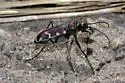
color of dorsal surface varies greatly, from brick red to metallic red to reddish-purple to reddish-green, and rarely dull green or brown; elytral markings highly variable: (humeral lunule complete, broken, or rarely absent; middle band complete and sharply angled or consisting only of a transverse dash; apical lunule complete or broken; marginal line always absent) many specimens have green on the outer and inner margins of the elytra, which is the basis of the common name, Green-margined Tiger Beetle
Classification
- Kingdom
- Animalia
- Phylum
- Arthropoda
- Class
- Insecta
- Order
- Coleoptera (Beetles)
- Suborder
- Adephaga
- Family
- Carabidae (Ground Beetles)
- Subfamily
- Cicindelinae
- Tribe
- Cicindelini
- Genus
- Cicindela (Temperate Tiger Beetles)
Imported taxonomy record. Source availability varies; see the source references and editorial policy below.
Habitat and Range
Habitat
usually steep, moist bare clay soil, including open hill tops, dirt roads, and especially river or stream banks ( US Geological Survey )
Geographic Range
central and mid-eastern North America (see range map )
Seasonal Activity
April through June, and again from late August through September
Diet and Behavior
Life History
3-year life cycle ( US Geological Survey )
Additional species information
Species notes from the sources
Etymology: LIMBALIS: a variation (?) of the Latin "limbus", meaning margin or border - possibly a reference to the thin green border on the elytra (the origin of the common name Green-margined Tiger Beetle)
About Primitive Winged Insects: the wider group
Order-level background for Coleoptera, the group containing Cicindela limbalis. Species-specific details appear above.
Group overview
Coleoptera is the largest order of insects with over 400,000 described species, representing ~25% of all known animal species and ~40% of all insects. In the U.S. alone, nearly 30,000 beetle species have been identified.
Ecological role of the group
Beetles are prominent decomposers, especially in forests, breaking down dead wood and recycling nutrients. As predators, they reduce populations of pest insects. Many species are also important pollinators of flowering plants.
Economic and practical significance of the group
Beetles have major economic significance: leaf beetles (Chrysomelidae) and weevils (Curculionoidea) are among the most destructive agricultural pests globally, costing billions annually, while predatory species like ladybugs provide natural pest control.
Recorded sources for this group: Britannica, Smithsonian, NCSU Entomology. Imported estimates may describe particular regions or reporting periods.
Photos of Common Claybank Tiger Beetle (5)
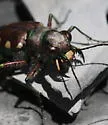
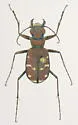
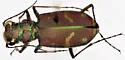
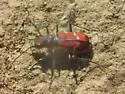
Photo credits: Contributed by Robin McLeod; Additional contributions by Ben Coulter , Nick Block
Frequently Asked Questions About Common Claybank Tiger Beetle
What is Common Claybank Tiger Beetle?
Common Claybank Tiger Beetle (Cicindela limbalis) is a species in the family Carabidae, within the order Coleoptera.
How big is Common Claybank Tiger Beetle?
body length 12-16 mm
How do you identify Common Claybank Tiger Beetle?
color of dorsal surface varies greatly, from brick red to metallic red to reddish-purple to reddish-green, and rarely dull green or brown; elytral markings highly variable: (humeral lunule complete, broken, or rarely absent; middle band complete and sharply angled or consisting only of a transverse dash; apical lunule complete or broken; marginal line always absent) many specimens have green on the outer and inner margins of the elytra, which is the basis of the common name, Green-margined Tiger Beetle
Where is Common Claybank Tiger Beetle found?
| Feature | Details |
|---|---|
| Habitat | usually steep, moist bare clay soil, including open hill tops, dirt roads, and especially river or stream banks ( US Geological Survey ) |
| Range | central and mid-eastern North America (see range map ) |
When is Common Claybank Tiger Beetle active?
Common Claybank Tiger Beetle: seasonal activity - April through June, and again from late August through September.
What is the life cycle of a Common Claybank Tiger Beetle?
3-year life cycle ( US Geological Survey )