
Chrysops hirsuticallus
This record describes Chrysops hirsuticallus (species). Recorded family: Tabanidae. Recorded order: Diptera.
Identification and Appearance
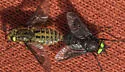
| Feature | Details |
|---|---|
| Female | Peculiar greenish-gray central California species with very reduced eye pattern in life; face and fron unusually hairy including sides of laterally attenuated frontal callosity; wing pattern unusual with strong halo along outer margin of abbreviated crossband and the apex beyond tinted though no definite apical spot is present. |
| Male | Entirely black, northern California species; eyes narrowly separated; no midfacial pollinose strip, face densely hirsute and black with two submedial dark yellow stripes, but tubercles not usually swollen; wings halyine along posterior border, and suggestions of a very narrow apical spot and of two subhyaline spots in the apices of the basal cells. (Philip, 1955) Larvae have been found in temporary pools filled by winter rains. Larvae develop over two winters. Adults fly mid April to mid June. |
Classification
Habitat and Range
Geographic Range
Central Valley of California and adjacent lower mountains of northern California.
Additional species information
Species notes from the sources
Etymology: "Named for the peculiar sparse hairs situated on the lateral edges of the frontal callosity in well-preserved females."
About Flies: the wider group
Order-level background for Diptera, the group containing Chrysops hirsuticallus. Species-specific details appear above.
Group overview
Diptera includes over 150,000 described species of flies, mosquitoes, and midges. Mosquitoes are the deadliest animal on Earth (CDC). Malaria alone causes ~249 million cases and over 608,000 deaths annually, mostly children under 5 (WHO). Vector-borne diseases account for over 17% of all infectious diseases, causing 700,000+ deaths per year.
Ecological role of the group
Despite their disease impact, flies are critical decomposers and pollinators. Hoverflies alone pollinate hundreds of crop and wildflower species. Flies are also the primary food source for many birds, bats, and fish. Forensic entomology relies heavily on fly species for crime scene analysis.
Economic and practical significance of the group
In the U.S., vector-borne disease cases tripled between 2004-2016, with over 640,000 cases reported in that period (CDC). Tickborne diseases doubled from 22,000 to 48,000 annual reports. Globally, mosquito-borne diseases cost billions in healthcare and lost productivity.
Recorded sources for this group: WHO, CDC, PNAS. Imported estimates may describe particular regions or reporting periods.
Photos of Chrysops hirsuticallus (3)
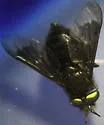
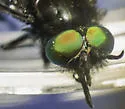
Photo credits: Contributed by John F. Carr
Frequently Asked Questions About Chrysops hirsuticallus
What is Chrysops hirsuticallus?
Chrysops hirsuticallus is a species in the family Tabanidae, within the order Diptera.
How do you identify Chrysops hirsuticallus?
| Feature | Details |
|---|---|
| Female | Peculiar greenish-gray central California species with very reduced eye pattern in life; face and fron unusually hairy including sides of laterally attenuated frontal callosity; wing pattern unusual with strong halo along outer margin of abbreviated crossband and the apex beyond tinted though no definite apical spot is present. |
| Male | Entirely black, northern California species; eyes narrowly separated; no midfacial pollinose strip, face densely hirsute and black with two submedial dark yellow stripes, but tubercles not usually swollen; wings halyine along posterior border, and suggestions of a very narrow apical spot and of two subhyaline spots in the apices of the basal cells. (Philip, 1955) |
Where is Chrysops hirsuticallus found?
Range: Central Valley of California and adjacent lower mountains of northern California.