
Chiricahua multidentata - Hodges#6641
Chiricahua multidentata
This record describes Chiricahua multidentata (species). Recorded family: Geometridae. Recorded order: Lepidoptera.
Identification and Appearance
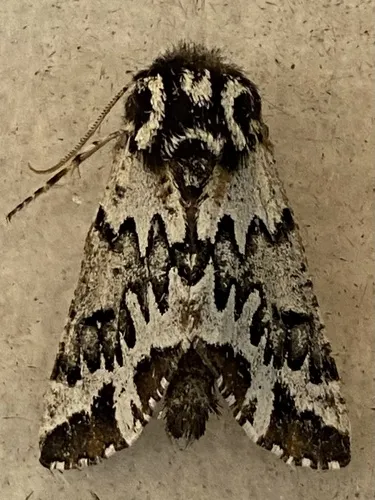
Adult - Generally, white with a broad, gray median area with irregular margins, and with a grayish black terminal area. More specifically, Forewings white, with scattered grayish brown and blackish brown scales on both sides of dark median area; basal line black, incomplete; t. a. line black or blackish brown, arising on costa one-fourth distance from base, strongly and evenly waved, meeting inner margin beyond middle; median area appearing gray, with variable amount of white scaling, occupying entire area between cross lines, including elongate, narrow, discal dash 2 mm. in length; t.p. line arising on costa three-fourths distance from base, strongly outwardly bowed in cells, converging posteriorly toward t. a. line; terminal area broadly blackish brown, interrupted in cell M3 and along veins; fringe checkered white and blackish brown. Hind wings pale grayish white, heavily and evenly covered with gayish brown scales; without maculation except for faint trace of extradiscal line and nebulous, dark discal spot; fringe checkered white and blackish brown.
Classification
- Kingdom
- Animalia
- Phylum
- Arthropoda
- Class
- Insecta
- Order
- Lepidoptera (Butterflies and Moths)
- Superfamily
- Geometroidea
- Family
- Geometridae (Geometrid Moths)
- Subfamily
- Ennominae
- Tribe
- Nacophorini
- Genus
- Chiricahua
Imported taxonomy record. Source availability varies; see the source references and editorial policy below.
Habitat and Range
Habitat
Thus far only known from high in the Chiricauhau mountains of Arizona above 9000ft.
Geographic Range
Chiricauhau Mountains of southeast Arizona. Type locality: Fly's Peak, Chiricahua Mountains, Cochise County, Arizona.
Seasonal Activity
Adults fly from mid-June to late July.
Additional species information
Species notes from the sources
Etymology: Specific epithet is Latin meaning "many-toothed" for the post-medial line "composed of nine very irregular teeth pointed inwardly."
About Butterflies and Moths: the wider group
Order-level background for Lepidoptera, the group containing Chiricahua multidentata. Species-specific details appear above.
Group overview
Lepidoptera includes approximately 180,000 described species of butterflies and moths. Moths outnumber butterflies roughly 10:1. The monarch butterfly's eastern population has declined by more than 80% since the mid-1990s, and the western population by over 95% since the 1980s. The IUCN lists the migratory monarch as Vulnerable.
Ecological role of the group
Butterflies and moths are essential indicators of ecosystem health. As caterpillars, they are a primary food source for birds - a single nest of blue tit chicks requires ~10,000 caterpillars. Adult moths pollinate many night-blooming plants.
Economic and practical significance of the group
Lepidoptera are critical pollinators. In Europe, grassland butterfly species have declined by almost 50% since the early 1990s. In the UK, three-quarters of butterflies are in decline. In the U.S., five butterfly species have gone extinct since 1950, with 29 listed as endangered.
Recorded sources for this group: IUCN Red List, Xerces Society, USFWS, PNAS, WWF. Imported estimates may describe particular regions or reporting periods.
Photos of Chiricahua multidentata - Hodges#6641 (2)
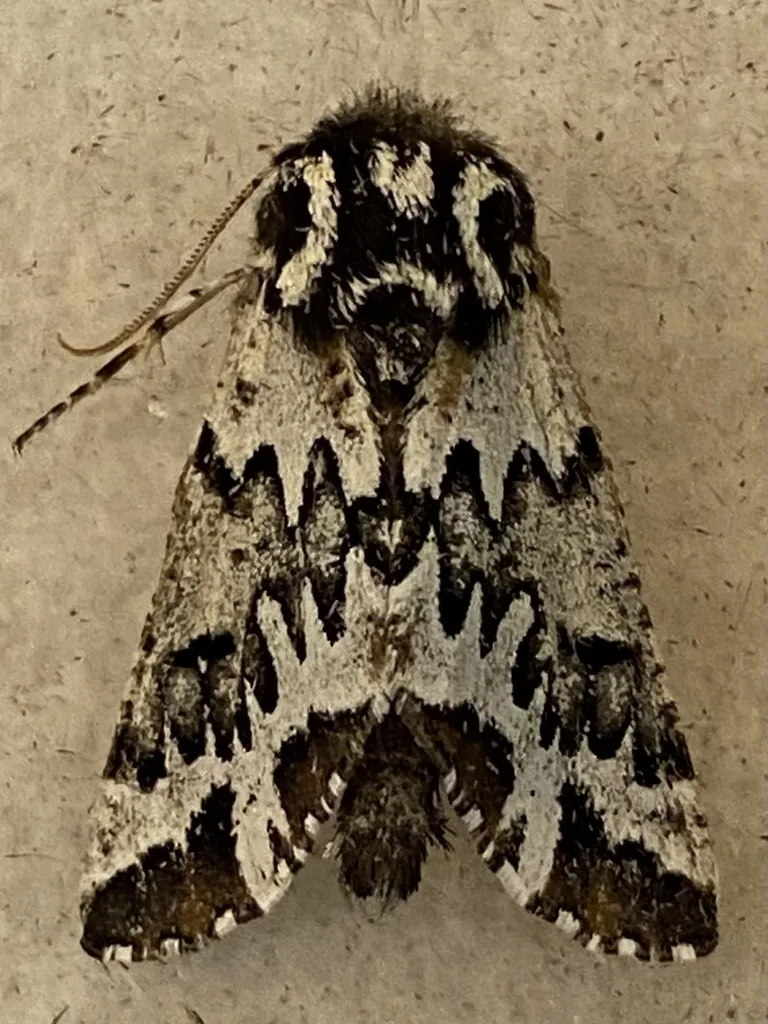
Photo credits: Contributed by Chris Grinter; Additional contributions by Randy Hardy
Frequently Asked Questions About Chiricahua multidentata - Hodges#6641
What is Chiricahua multidentata - Hodges#6641?
Chiricahua multidentata - Hodges#6641 (Chiricahua multidentata) is a species in the family Geometridae, within the order Lepidoptera.
How big is Chiricahua multidentata - Hodges#6641?
| Feature | Description |
|---|---|
| Forewing | Forewing length 17-18.5 mm. |
| Wingspan | Wingspan 35 mm. |
How do you identify Chiricahua multidentata - Hodges#6641?
Adult - Generally, white with a broad, gray median area with irregular margins, and with a grayish black terminal area. More specifically, Forewings white, with scattered grayish brown and blackish brown scales on both sides of dark median area; basal line black, incomplete; t. a. line black or blackish brown, arising on costa one-fourth distance from base, strongly and evenly waved, meeting inner margin beyond middle; median area appearing gray, with variable amount of white scaling, occupying entire area between cross lines, including elongate, narrow, discal dash 2 mm. in length; t.p. line arising on costa three-fourths distance from base, strongly outwardly bowed in cells, converging posteriorly toward t. a. line; terminal area broadly blackish brown, interrupted in cell M3 and along veins; fringe checkered white and blackish brown. Hind wings pale grayish white, heavily and evenly covered with gayish brown scales; without maculation except for faint trace of extradiscal line and nebulous, dark discal spot; fringe checkered white and blackish brown.
Where is Chiricahua multidentata - Hodges#6641 found?
| Feature | Details |
|---|---|
| Habitat | Thus far only known from high in the Chiricauhau mountains of Arizona above 9000ft. |
| Range | Chiricauhau Mountains of southeast Arizona. Type locality: Fly's Peak, Chiricahua Mountains, Cochise County, Arizona. |
When is Chiricahua multidentata - Hodges#6641 active?
Chiricahua multidentata - Hodges#6641: seasonal activity - Adults fly from mid-June to late July..