
Mediterranean Fruit Fly
Ceratitis capitata
This record describes Ceratitis capitata (species). Recorded family: Tephritidae. Recorded order: Diptera.
Identification and Appearance
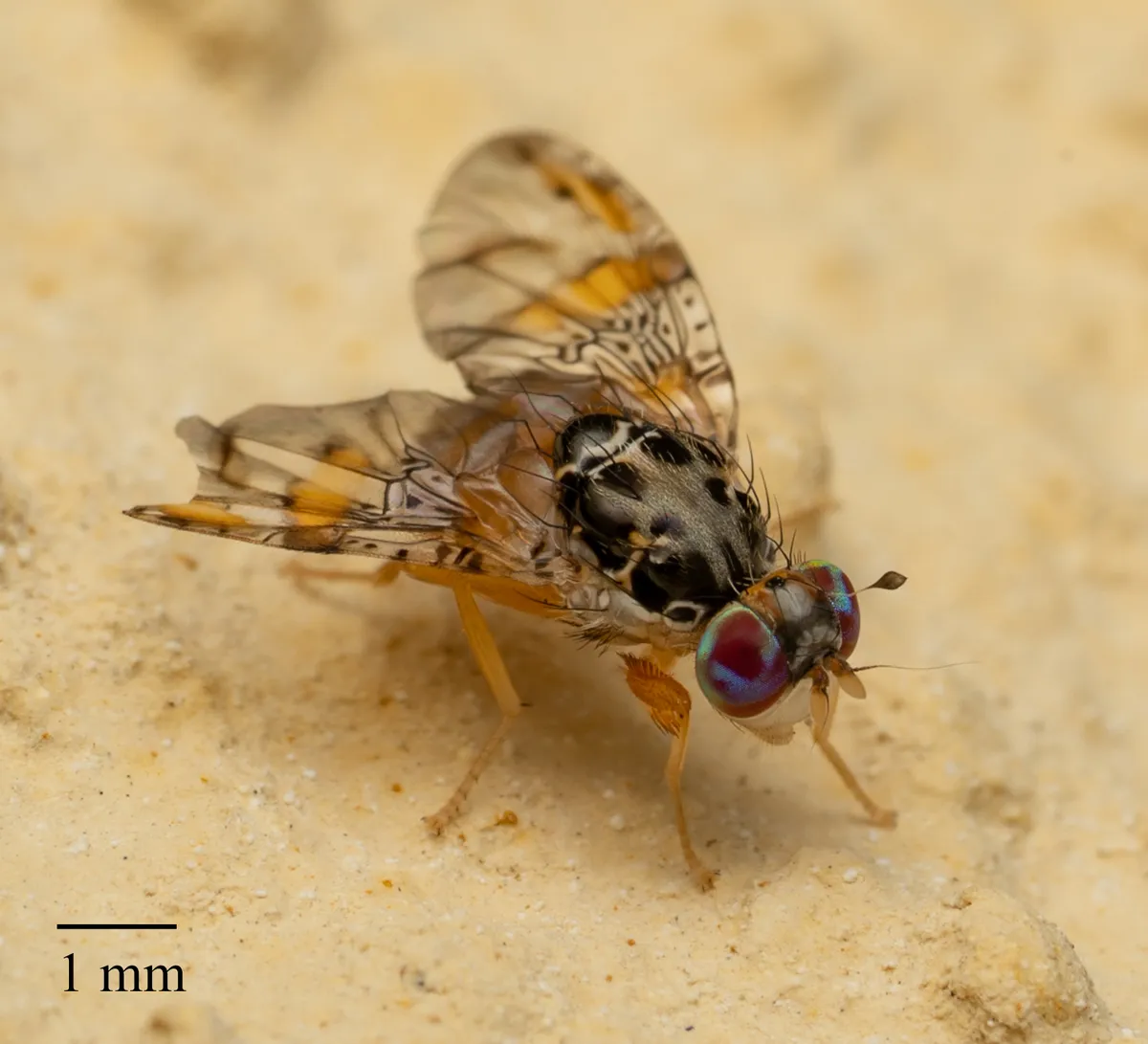
One of the world's most destructive fruit pests, and the most economically important fruit fly species. Each infestation detected in FL and CA triggered massive eradication and detection effort. In CA, large numbers of sterile males are released and are not uncommon in some places. A female would be a sign of an infestation, and should be reported immediately. Females have a visible ovipositor on the rear tip of the abdomen and lack the ornamented hairs on the male head seen in the photo below. These flies contain large amounts of nitrogen-fixing enterobacteria in the gut. Little research has been done on the nutritional contributions of this.
Wikipedia reference for Ceratitis capitata: http://en.wikipedia.org/wiki/Ceratitis_capitata.
Classification
- Kingdom
- Animalia
- Phylum
- Arthropoda
- Class
- Insecta
- Order
- Diptera (Flies)
- Superfamily
- Tephritoidea
- Family
- Tephritidae (Fruit Flies)
- Subfamily
- Dacinae
- Genus
- Ceratitis
Imported taxonomy record. Source availability varies; see the source references and editorial policy below.
Habitat and Range
Geographic Range
native to tropical e. Africa, adventive elsewhere, now spread throughout the world ; in our area, infestations have been reported in FL, CA, and TX. Sterile males are being released in FL (from Miami to Palm Beach) as a prophylactic measure to prevent the establishment of a wild Medfly population.
Diet and Behavior
Diet: larvae feed and develop on many deciduous, subtropical, and tropical fruits (citrus, peach, pear, apple) and some vegetables, sometimes tunneling through the pulp and eventually reducing it to a juicy inedible mass
About Flies: the wider group
Order-level background for Diptera, the group containing Ceratitis capitata. Species-specific details appear above.
Group overview
Diptera includes over 150,000 described species of flies, mosquitoes, and midges. Mosquitoes are the deadliest animal on Earth (CDC). Malaria alone causes ~249 million cases and over 608,000 deaths annually, mostly children under 5 (WHO). Vector-borne diseases account for over 17% of all infectious diseases, causing 700,000+ deaths per year.
Ecological role of the group
Despite their disease impact, flies are critical decomposers and pollinators. Hoverflies alone pollinate hundreds of crop and wildflower species. Flies are also the primary food source for many birds, bats, and fish. Forensic entomology relies heavily on fly species for crime scene analysis.
Economic and practical significance of the group
In the U.S., vector-borne disease cases tripled between 2004-2016, with over 640,000 cases reported in that period (CDC). Tickborne diseases doubled from 22,000 to 48,000 annual reports. Globally, mosquito-borne diseases cost billions in healthcare and lost productivity.
Recorded sources for this group: WHO, CDC, PNAS. Imported estimates may describe particular regions or reporting periods.
Photos of Mediterranean Fruit Fly (3)
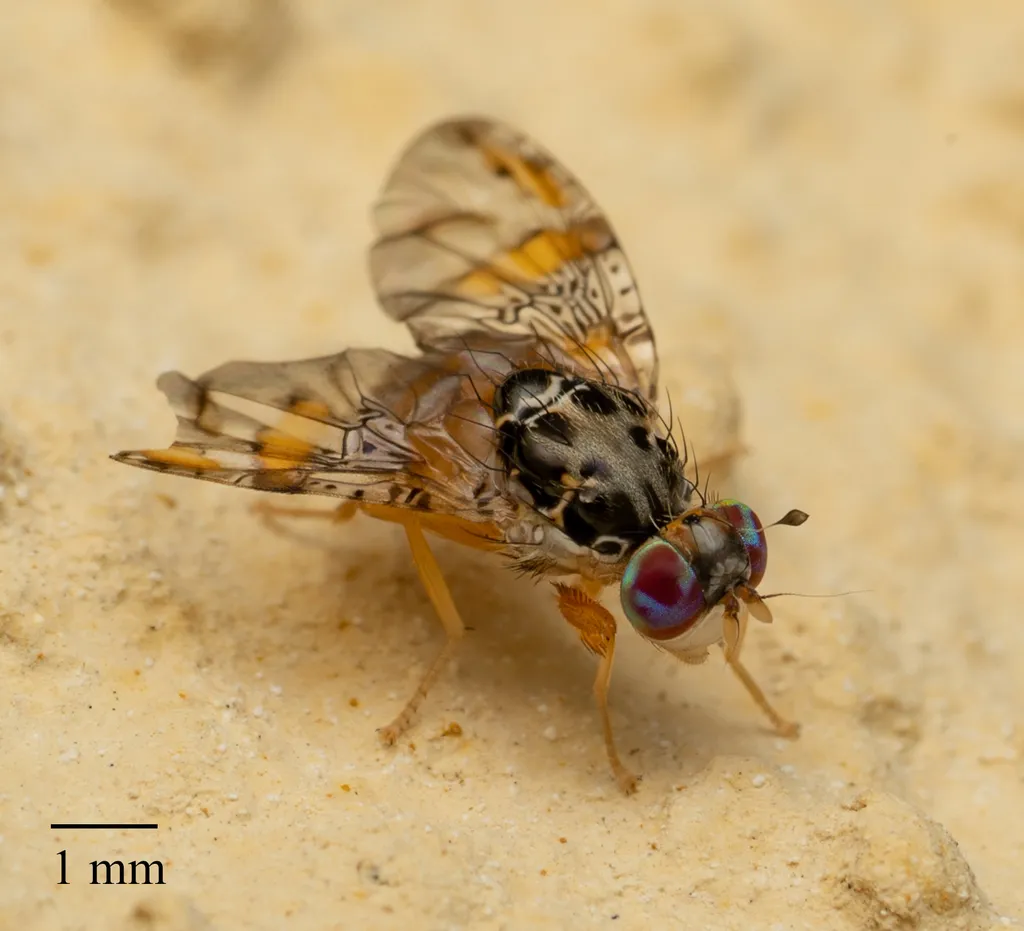
Photo credits: Contributed by Martin Hauser; Additional contributions by Beatriz Moisset , Robin McLeod , Chuck Entz , Vox Sciurorum , v belov , KenW , Robert H. Biagi , Arturo Santos
Frequently Asked Questions About Mediterranean Fruit Fly
What is Mediterranean Fruit Fly?
Mediterranean Fruit Fly (Ceratitis capitata) is a species in the family Tephritidae, within the order Diptera.
How big is Mediterranean Fruit Fly?
adult 4-5 mm, larva to ~8 mm
Where is Mediterranean Fruit Fly found?
Range: native to tropical e. Africa, adventive elsewhere, now spread throughout the world ; in our area, infestations have been reported in FL, CA, and TX. Sterile males are being released in FL (from Miami to Palm Beach) as a prophylactic measure to prevent the establishment of a wild Medfly population.
What does Mediterranean Fruit Fly eat?
The diet of the Mediterranean Fruit Fly includes larvae feed and develop on many deciduous, subtropical, and tropical fruits (citrus, peach, pear, apple) and some vegetables, sometimes tunneling through the pulp and eventually reducing it to a juicy inedible mass.