
Tropical Checkered-Skipper - Hodges#3968
Burnsius oileus
This record describes Burnsius oileus (species). Recorded family: Hesperiidae. Recorded order: Lepidoptera.
Identification and Appearance
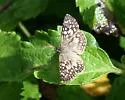
Above, white spot just beyond cell-end white bar present and enlarged and the forewing dark towards the apex (not checkered all the way to the tip) distinguishes this from Common/White Checkered Skippers where they overlap. Below, checkered pattern on wings is blurred. Male forewing has a mat of long blue-gray hairs; hindwing of both sexes has marginal and submarginal bands made up of equal-sized spots. Underside of hindwing is pale, often with a strong brown overlay; not much contrast between bands and ground color. (Nearctica.com) Discussion of taxonomy changes to Pyrgini on BugGuide: https://www.bugguide.net/node/view/2192845
Classification
- Kingdom
- Animalia
- Phylum
- Arthropoda
- Class
- Insecta
- Order
- Lepidoptera (Butterflies and Moths)
- Superfamily
- Papilionoidea
- Family
- Hesperiidae (Skippers)
- Subfamily
- Pyrginae
- Tribe
- Pyrgini
- Genus
- Burnsius (New World Checkered-Skippers)
Imported taxonomy record. Source availability varies; see the source references and editorial policy below.
Habitat and Range
Habitat
Open and disturbed areas such as pastures, brushy fields, wooded trails, thorn-scrub, and roadsides
Geographic Range
Southern, mostly coastal plain of southeastern states and west to southern Arizona, southward to Argentina.
Seasonal Activity
Yearlong in South Florida, Spring/Summer in the Northern part of its range
Diet and Behavior
Diet: Larva feed on plants of the Mallow family , including axocatzin (Sida rhombifolia), mallow (Malva), hollyhock (Althaea rosea), velvet-leaf (Abutilon), and malva loca (Malvastrum) Adults nectar at Sidas and small flowered composites such as Shepherd's needles
About Butterflies and Moths: the wider group
Order-level background for Lepidoptera, the group containing Burnsius oileus. Species-specific details appear above.
Group overview
Lepidoptera includes approximately 180,000 described species of butterflies and moths. Moths outnumber butterflies roughly 10:1. The monarch butterfly's eastern population has declined by more than 80% since the mid-1990s, and the western population by over 95% since the 1980s. The IUCN lists the migratory monarch as Vulnerable.
Ecological role of the group
Butterflies and moths are essential indicators of ecosystem health. As caterpillars, they are a primary food source for birds - a single nest of blue tit chicks requires ~10,000 caterpillars. Adult moths pollinate many night-blooming plants.
Economic and practical significance of the group
Lepidoptera are critical pollinators. In Europe, grassland butterfly species have declined by almost 50% since the early 1990s. In the UK, three-quarters of butterflies are in decline. In the U.S., five butterfly species have gone extinct since 1950, with 29 listed as endangered.
Recorded sources for this group: IUCN Red List, Xerces Society, USFWS, PNAS, WWF. Imported estimates may describe particular regions or reporting periods.
Photos of Tropical Checkered-Skipper - Hodges#3968 (5)
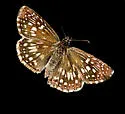
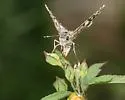
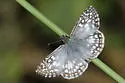
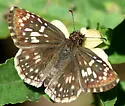
Photo credits: Contributed by Troy Bartlett; Additional contributions by cotinis , Hannah Nendick-Mason , Steve Nanz , Beatriz Moisset , Jason D. Roberts , Nick Block , David Ferguson
Frequently Asked Questions About Tropical Checkered-Skipper - Hodges#3968
What is Tropical Checkered-Skipper - Hodges#3968?
Tropical Checkered-Skipper - Hodges#3968 (Burnsius oileus) is a species in the family Hesperiidae, within the order Lepidoptera.
How big is Tropical Checkered-Skipper - Hodges#3968?
Wingspan 3.2-3.8cm (1¼-1½in)
How do you identify Tropical Checkered-Skipper - Hodges#3968?
Above, white spot just beyond cell-end white bar present and enlarged and the forewing dark towards the apex (not checkered all the way to the tip) distinguishes this from Common/White Checkered Skippers where they overlap. Below, checkered pattern on wings is blurred. Male forewing has a mat of long blue-gray hairs; hindwing of both sexes has marginal and submarginal bands made up of equal-sized spots. Underside of hindwing is pale, often with a strong brown overlay; not much contrast between bands and ground color. (Nearctica.com)
Where is Tropical Checkered-Skipper - Hodges#3968 found?
| Feature | Details |
|---|---|
| Habitat | Open and disturbed areas such as pastures, brushy fields, wooded trails, thorn-scrub, and roadsides |
| Range | Southern, mostly coastal plain of southeastern states and west to southern Arizona, southward to Argentina. |
What does Tropical Checkered-Skipper - Hodges#3968 eat?
The diet of the Tropical Checkered-Skipper - Hodges#3968 includes Larva feed on plants of the Mallow family , including axocatzin (Sida rhombifolia), mallow (Malva), hollyhock (Althaea rosea), velvet-leaf (Abutilon), and malva loca (Malvastrum) Adults nectar at Sidas and small flowered composites such as Shepherd's needles.
When is Tropical Checkered-Skipper - Hodges#3968 active?
Tropical Checkered-Skipper - Hodges#3968: seasonal activity - Yearlong in South Florida, Spring/Summer in the Northern part of its range.