
White Checkered-Skipper - Hodges#3967
Burnsius albezens
This record describes Burnsius albezens (species). Recorded family: Hesperiidae. Recorded order: Lepidoptera.
Identification and Appearance
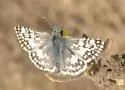
Adult: usually paler than Common Checkered-Skipper, and male often has complete black checks in wing fringes (rather than partial, as in P. communis ) - but read See Also section below. Upperside of male bluish-gray; female black. Both sexes have large white spots which form median bands across both wings. Male has costal fold enclosing scent scales on upperside of forewing. Underside of both wings dull white with dark gray bands. Discussion of taxonomy changes to Pyrgini on BugGuide: https://www.bugguide.net/node/view/2192845
Classification
- Kingdom
- Animalia
- Phylum
- Arthropoda
- Class
- Insecta
- Order
- Lepidoptera (Butterflies and Moths)
- Superfamily
- Papilionoidea
- Family
- Hesperiidae (Skippers)
- Subfamily
- Pyrginae
- Tribe
- Pyrgini
- Genus
- Burnsius (New World Checkered-Skippers)
Imported taxonomy record. Source availability varies; see the source references and editorial policy below.
Habitat and Range
Geographic Range
Southern California and Nevada, Arizona, New Mexico, southern Texas, and along the Gulf Coast (see Burns (2000) ); apparently spreading in the east (see Calhoun (2002) and comment by Randy Emmitt here ). There are confirmed records in western Tennessee. Occasionally strays to southwestern Utah and central Texas.
Seasonal Activity
All year in southern Texas; most of year elsewhere
Diet and Behavior
Diet: Larvae are believed to feed on plants in the mallow family, including globe mallows ( Sphaeralcea ), velvet-leaf ( Abutilon ), and poppy mallow ( Callirhoe ).
About Butterflies and Moths: the wider group
Order-level background for Lepidoptera, the group containing Burnsius albezens. Species-specific details appear above.
Group overview
Lepidoptera includes approximately 180,000 described species of butterflies and moths. Moths outnumber butterflies roughly 10:1. The monarch butterfly's eastern population has declined by more than 80% since the mid-1990s, and the western population by over 95% since the 1980s. The IUCN lists the migratory monarch as Vulnerable.
Ecological role of the group
Butterflies and moths are essential indicators of ecosystem health. As caterpillars, they are a primary food source for birds - a single nest of blue tit chicks requires ~10,000 caterpillars. Adult moths pollinate many night-blooming plants.
Economic and practical significance of the group
Lepidoptera are critical pollinators. In Europe, grassland butterfly species have declined by almost 50% since the early 1990s. In the UK, three-quarters of butterflies are in decline. In the U.S., five butterfly species have gone extinct since 1950, with 29 listed as endangered.
Recorded sources for this group: IUCN Red List, Xerces Society, USFWS, PNAS, WWF. Imported estimates may describe particular regions or reporting periods.
Photos of White Checkered-Skipper - Hodges#3967 (5)
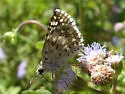
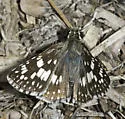
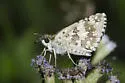
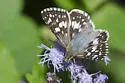
Photo credits: Contributed by john and jane balaban; Additional contributions by cotinis , Hannah Nendick-Mason , Steve Nanz , Robin McLeod , Nick Block , David Ferguson , Ken Childs
Frequently Asked Questions About White Checkered-Skipper - Hodges#3967
What is White Checkered-Skipper - Hodges#3967?
White Checkered-Skipper - Hodges#3967 (Burnsius albezens) is a species in the family Hesperiidae, within the order Lepidoptera.
How do you identify White Checkered-Skipper - Hodges#3967?
Adult: usually paler than Common Checkered-Skipper, and male often has complete black checks in wing fringes (rather than partial, as in P. communis ) - but read See Also section below. Upperside of male bluish-gray; female black. Both sexes have large white spots which form median bands across both wings. Male has costal fold enclosing scent scales on upperside of forewing. Underside of both wings dull white with dark gray bands.
Where is White Checkered-Skipper - Hodges#3967 found?
Range: Southern California and Nevada, Arizona, New Mexico, southern Texas, and along the Gulf Coast (see Burns (2000) ); apparently spreading in the east (see Calhoun (2002) and comment by Randy Emmitt here ). There are confirmed records in western Tennessee. Occasionally strays to southwestern Utah and central Texas.
What does White Checkered-Skipper - Hodges#3967 eat?
The diet of the White Checkered-Skipper - Hodges#3967 includes Larvae are believed to feed on plants in the mallow family, including globe mallows ( Sphaeralcea ), velvet-leaf ( Abutilon ), and poppy mallow ( Callirhoe )..
When is White Checkered-Skipper - Hodges#3967 active?
White Checkered-Skipper - Hodges#3967: seasonal activity - All year in southern Texas; most of year elsewhere.