
Bucculatrix cuneigera - Hodges#0499
Bucculatrix cuneigera
This record describes Bucculatrix cuneigera (species). Recorded family: Bucculatricidae. Recorded order: Lepidoptera.
Identification and Appearance
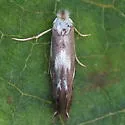
| Feature | Description |
|---|---|
| Additional details | Meyrick (1919) original description is available online in the print references. Identification: White thorax and brown wings. |
| Head | Head: White, shiny. Tuft of hair on top of head has brown center. Antenna: White eye-cap at antenna base. Segments pale yellowish to brownish. |
| Thorax | Thorax: Thorax white. |
| Forewing | Forewing: Dark brownish-gray with bright white marks. Four white marks across costal margin. At base is a long triangle with short side along wing margin. A stripe near wing center slants to middle of wing; another, slightly shorter stripe about equal distance away. The last mark is a white dash with a black spot at apex of wing tip; white continues onto fringe. On the inner wing margin a wide crescent mark at center and two triangle marks near wing tip. Wing tip is darkly feathered and protrudes up when moth is at rest. Rest of fringe is lighter brown. |
| Hindwing | Hindwing: Dark brownish-gray, fringe same. |
| Legs | Legs: Variable darker in front to light brown on underside. Feet lighter. |
| Abdomen | Abdomen: Abdomen dark brown-black. Tuft at tip pale, grayish-white. Types: Holotype as Bucculatrix cuneigera by Meyrick, 1916. Locality: Orillia, Ontario. In the British Museum. Holotype as Bucculatrix errans male by Braun, 1920. Locality: Cincinnati, Ohio. In author’s (Braun) collection which was given to the Philadelphia Academy of Sciences – now the Academy of Natural Sciences of Drexel University, Pennsylvania. |
Classification
- Kingdom
- Animalia
- Phylum
- Arthropoda
- Class
- Insecta
- Order
- Lepidoptera (Butterflies and Moths)
- Superfamily
- Gracillarioidea
- Family
- Bucculatricidae (Ribbed Cocoon-maker Moths)
- Genus
- Bucculatrix
Imported taxonomy record. Source availability varies; see the source references and editorial policy below.
Habitat and Range
Habitat
Deciduous or mixed forests with wood asters.
Geographic Range
U.S.A.: Ohio, N. Carolina, New York, Massachusetts, Maine. Canada: Nova Scotia, New Brunswick, Prince Edward Island, Quebec, Ontario.
Seasonal Activity
Very late May to July.
Diet and Behavior
Diet: Asters Symphyotrichum shortii in south, northern populations use other Wood Asters Symphyotrichum species.
Life History
Female lays eggs on aster leaves about June. Larvae are leaf-miners and remain inside leaf. In the fall, they form a rounded chamber inside the leaf to overwinter. In spring, the larvae mine into the tip of new growth and become stem borers, feeding down the stem about 20 mm. When fully grown, a hole is cut in the stem, and larva leaves the plant to pupate on nearby twigs and leaves. Larvae are yellowish-white with a darker yellowish head. Two black spots behind the head. Cocoon is white to pale yellow with 7 or 8 longitudinal ridges. Mortality is high, apparently due to lack of new shoots in spring.
About Butterflies and Moths: the wider group
Order-level background for Lepidoptera, the group containing Bucculatrix cuneigera. Species-specific details appear above.
Group overview
Lepidoptera includes approximately 180,000 described species of butterflies and moths. Moths outnumber butterflies roughly 10:1. The monarch butterfly's eastern population has declined by more than 80% since the mid-1990s, and the western population by over 95% since the 1980s. The IUCN lists the migratory monarch as Vulnerable.
Ecological role of the group
Butterflies and moths are essential indicators of ecosystem health. As caterpillars, they are a primary food source for birds - a single nest of blue tit chicks requires ~10,000 caterpillars. Adult moths pollinate many night-blooming plants.
Economic and practical significance of the group
Lepidoptera are critical pollinators. In Europe, grassland butterfly species have declined by almost 50% since the early 1990s. In the UK, three-quarters of butterflies are in decline. In the U.S., five butterfly species have gone extinct since 1950, with 29 listed as endangered.
Recorded sources for this group: IUCN Red List, Xerces Society, USFWS, PNAS, WWF. Imported estimates may describe particular regions or reporting periods.
Photos of Bucculatrix cuneigera - Hodges#0499 (5)
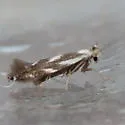
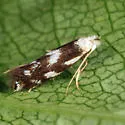
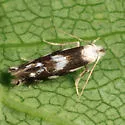
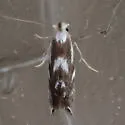
Photo credits: Contributed by Maury J. Heiman; Additional contributions by Tony-2 , lee_penner
Frequently Asked Questions About Bucculatrix cuneigera - Hodges#0499
What is Bucculatrix cuneigera - Hodges#0499?
Bucculatrix cuneigera - Hodges#0499 (Bucculatrix cuneigera) is a species in the family Bucculatricidae, within the order Lepidoptera.
How big is Bucculatrix cuneigera - Hodges#0499?
Meyrick listed the wingspan 9-10 mm. BOLD listed the wingspan 9-10.5 mm.
How do you identify Bucculatrix cuneigera - Hodges#0499?
| Feature | Description |
|---|---|
| Additional details | Meyrick (1919) original description is available online in the print references. Identification: White thorax and brown wings. |
| Head | Head: White, shiny. Tuft of hair on top of head has brown center. Antenna: White eye-cap at antenna base. Segments pale yellowish to brownish. |
| Thorax | Thorax: Thorax white. |
| Forewing | Forewing: Dark brownish-gray with bright white marks. Four white marks across costal margin. At base is a long triangle with short side along wing margin. A stripe near wing center slants to middle of wing; another, slightly shorter stripe about equal distance away. The last mark is a white dash with a black spot at apex of wing tip; white continues onto fringe. On the inner wing margin a wide crescent mark at center and two triangle marks near wing tip. Wing tip is darkly feathered and protrudes up when moth is at rest. Rest of fringe is lighter brown. |
| Hindwing | Hindwing: Dark brownish-gray, fringe same. |
| Legs | Legs: Variable darker in front to light brown on underside. Feet lighter. |
| Abdomen | Abdomen: Abdomen dark brown-black. Tuft at tip pale, grayish-white. |
Where is Bucculatrix cuneigera - Hodges#0499 found?
| Feature | Details |
|---|---|
| Habitat | Deciduous or mixed forests with wood asters. |
| Range | U.S.A.: Ohio, N. Carolina, New York, Massachusetts, Maine. Canada: Nova Scotia, New Brunswick, Prince Edward Island, Quebec, Ontario. |
What does Bucculatrix cuneigera - Hodges#0499 eat?
The diet of the Bucculatrix cuneigera - Hodges#0499 includes Asters Symphyotrichum shortii in south, northern populations use other Wood Asters Symphyotrichum species..
When is Bucculatrix cuneigera - Hodges#0499 active?
Bucculatrix cuneigera - Hodges#0499: seasonal activity - Very late May to July..
What is the life cycle of a Bucculatrix cuneigera - Hodges#0499?
Female lays eggs on aster leaves about June. Larvae are leaf-miners and remain inside leaf. In the fall, they form a rounded chamber inside the leaf to overwinter. In spring, the larvae mine into the tip of new growth and become stem borers, feeding down the stem about 20 mm. When fully grown, a hole is cut in the stem, and larva leaves the plant to pupate on nearby twigs and leaves. Larvae are yellowish-white with a darker yellowish head. Two black spots behind the head. Cocoon is white to pale yellow with 7 or 8 longitudinal ridges. Mortality is high, apparently due to lack of new shoots in spring.