
Bruchidius varius
This record describes Bruchidius varius (species). Recorded family: Chrysomelidae. Recorded order: Coleoptera.
Identification and Appearance
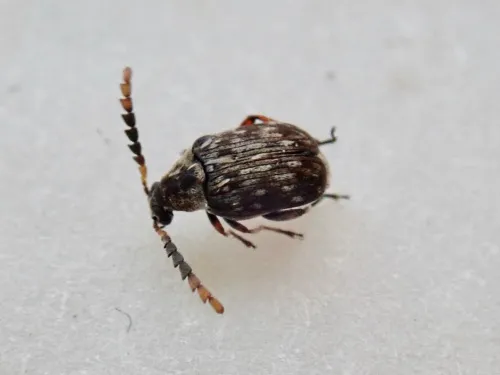
| Feature | Description |
|---|---|
| Additional details | 2.5 to 3.0 mm. |
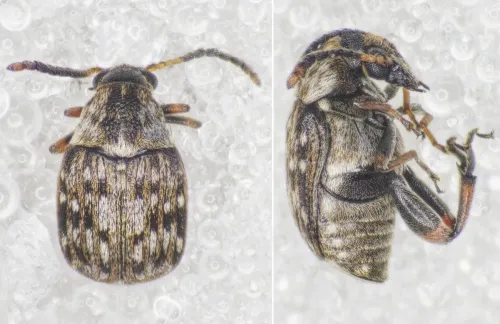
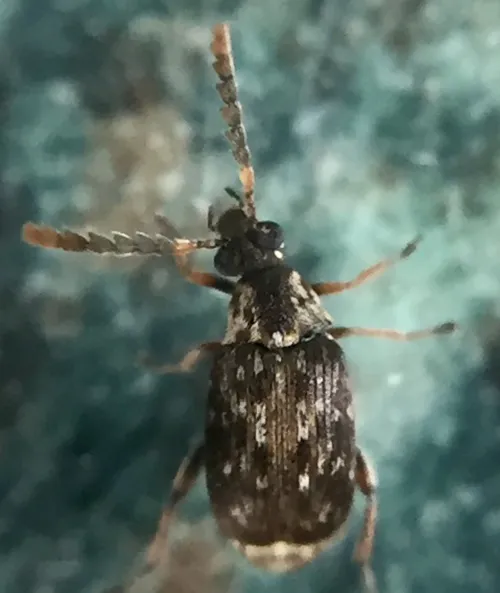
| Body | Body black with characteristic pattern of pale grey or golden brown scales. |
| Head | Head densely punctured and sparsely scaled, with a shiny raised longitudinal ridge between eyes. |
| Eyes | Eyes prominent, with a deep narrow incision which is visible from above. |
| Antennae | Antennae black with 2 to 3 apical segments red in male, only 1 or 2 in female, segments 1 to 4 variously red in both sexes. Segments 4 to 10 strongly serrate in the male, much less so in the female. |
| Pronotum | Pronotum conical, sides without borders or tubercles. Superficially similar to Bruchus rufipes which also has the middle tibiae orange as well as the front ones. However in Bruchidius varius the pronotum contracts very strongly from the base to behind the head, while in Bruchus it remains much broader for most of its length. Unless identified by a recognised expert, a photo is required. If the photo doesn't show the key ID features then in the comments box describe the size and identifying characters you have observed. There is a single generation each year with adults appearing after hibernation in April, new generation adults begin to appear in July and August and remain in the dry flower heads until they leave to find cover for hibernation. Eggs are laid at the bases of flowers from early May to June or July and hatch within a few days, larvae probably develop within clover seeds (Hodge, 1997) and growth is completed within 30 to 35 days. Added to the British list in 1997 (Hodge, 1997) from a single specimen found in East Sussex in 1994 it has spread rapidly through much of the southern half of Britain. No additional images available for this species. |
Classification
- Kingdom
- Animalia
- Phylum
- Arthropoda
- Class
- Insecta
- Order
- Coleoptera
- Family
- Chrysomelidae
- Genus
- Bruchidius
Imported taxonomy record. Source availability varies; see the source references and editorial policy below.
Habitat and Range
Habitat
Where Red Clover is found.
Seasonal Activity
April to September.
Diet and Behavior
Life History
There is a single generation each year with adults appearing after hibernation in April, new generation adults begin to appear in July and August and remain in the dry flower heads until they leave to find cover for hibernation. Eggs are laid at the bases of flowers from early May to June or July and hatch within a few days, larvae probably develop within clover seeds (Hodge, 1997) and growth is completed within 30 to 35 days.
Additional species information
Recorded status
Added to the British list in 1997 (Hodge, 1997) from a single specimen found in East Sussex in 1994 it has spread rapidly through much of the southern half of Britain.
About Primitive Winged Insects: the wider group
Order-level background for Coleoptera, the group containing Bruchidius varius. Species-specific details appear above.
Group overview
Coleoptera is the largest order of insects with over 400,000 described species, representing ~25% of all known animal species and ~40% of all insects. In the U.S. alone, nearly 30,000 beetle species have been identified.
Ecological role of the group
Beetles are prominent decomposers, especially in forests, breaking down dead wood and recycling nutrients. As predators, they reduce populations of pest insects. Many species are also important pollinators of flowering plants.
Economic and practical significance of the group
Beetles have major economic significance: leaf beetles (Chrysomelidae) and weevils (Curculionoidea) are among the most destructive agricultural pests globally, costing billions annually, while predatory species like ladybugs provide natural pest control.
Recorded sources for this group: Britannica, Smithsonian, NCSU Entomology. Imported estimates may describe particular regions or reporting periods.
Photos of Bruchidius varius (3)
Frequently Asked Questions About Bruchidius varius
What is Bruchidius varius?
Bruchidius varius is a species in the family Chrysomelidae, within the order Coleoptera.
Where is Bruchidius varius found?
Habitat: Where Red Clover is found.
When is Bruchidius varius active?
Bruchidius varius: seasonal activity - April to September..
What is the life cycle of a Bruchidius varius?
There is a single generation each year with adults appearing after hibernation in April, new generation adults begin to appear in July and August and remain in the dry flower heads until they leave to find cover for hibernation. Eggs are laid at the bases of flowers from early May to June or July and hatch within a few days, larvae probably develop within clover seeds (Hodge, 1997) and growth is completed within 30 to 35 days.