
Rusty-patched Bumble Bee
Bombus affinis
This record describes Bombus affinis (species). Recorded family: Apidae. Recorded order: Hymenoptera.
Identification and Appearance
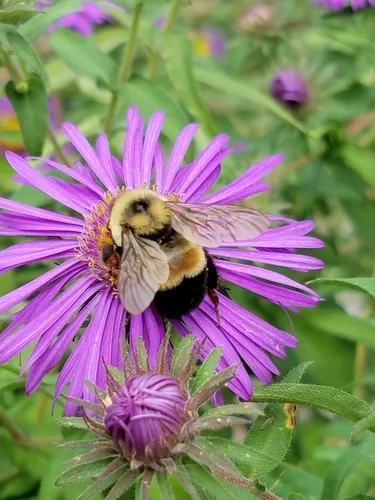
Queens have a similar color pattern to B. vagans , with a yellow thorax and yellow T1 and T2 but in affinis the face and malar is much shorter, the hairs of the face are all black, and the coat is shorter and more uniform in length. Workers and males are distinctive in having a well-defined black interalar band (as opposed to a black medial spot) and in having an rusty-orange patch across the base of T2. see detailed descriptions at discoverlife.org Declines of this species were first noted by John S. Ascher at Ithaca, New York, ca. 2001 when populations that were conspicuous in the late 1990s could not be located. At this and many other localities across its historic range affinis is no longer detected, but it has been shown to persist locally in the midwest and in New England. Abrupt and severe declines of this and other bumble bee species in this subgenus were widely reported soon after development of the commercial bumble bee industry and detection of high rates of parasitism in managed colonies. U.S. Fish and Wildlife Service (USFWS) announced on 21 Sep 2016 a proposal to list the Rusty-patched Bumble Bee as an endangered species under the Endangered Species Act (ESA). The ruling was finalized on 11 Jan 2017 when the USFWS gave the species endangered status under the ESA. - source **Listed as Critically Endangered by the IUCN Red List of Threatened Species **
Classification
- Kingdom
- Animalia
- Phylum
- Arthropoda
- Class
- Insecta
- Order
- Hymenoptera (Ants, Bees, Wasps and Sawflies)
- Superfamily
- Trigonaloidea
- Family
- Apidae (Cuckoo, Carpenter, Digger, Bumble, and Honey Bees)
- Subfamily
- Apinae
- Tribe
- Bombini
- Genus
- Bombus (Bumble Bees)
Imported taxonomy record. Source availability varies; see the source references and editorial policy below.
Habitat and Range
Geographic Range
MN to IN, plus a few remaining sites on east coast, see map per Xerces Society . Formerly Upper Midwest and Eastern North America: Ontario to New Brunswick, south to North Carolina. Historically known from more than 25 states.
Seasonal Activity
Jul-Oct (BG data)
Diet and Behavior
Diet: The Hosts section of its Discover Life species page lists known associations based on specimen records and images.
Additional species information
Species notes from the sources
Etymology: Bombus affinis Cresson, 1863 common name refers to the rust-colored patch on the abdomen.
About Flies: the wider group
Order-level background for Hymenoptera, the group containing Bombus affinis. Species-specific details appear above.
Group overview
Hymenoptera includes over 150,000 described species of ants, bees, wasps, and sawflies. Earth harbors approximately 20 quadrillion (20×10^15) ants, with a combined biomass of ~12 megatons of dry carbon - exceeding the combined biomass of all wild birds and mammals (PNAS, 2022).
Ecological role of the group
About 35% of the world's food crops depend on animal pollinators. The chocolate industry, valued at over $100 billion, depends on pollinating flies and midges. Ants are the dominant soil engineers in most terrestrial ecosystems, turning more soil than earthworms in many habitats.
Economic and practical significance of the group
Pollinators contribute $235-577 billion worth of annual global food production (FAO). In the U.S., bee pollination alone benefits crops valued at $18 billion annually, and honey bees are responsible for $5.4 billion in agricultural productivity. Between April 2023-2024, 55.1% of managed honey bee colonies were lost. The U.S. bee population dropped from 5 million to 2.5 million.
Recorded sources for this group: FAO, USDA, EPA, PNAS (2022), US Fish & Wildlife Service. Imported estimates may describe particular regions or reporting periods.
Photos of Rusty-patched Bumble Bee (2)
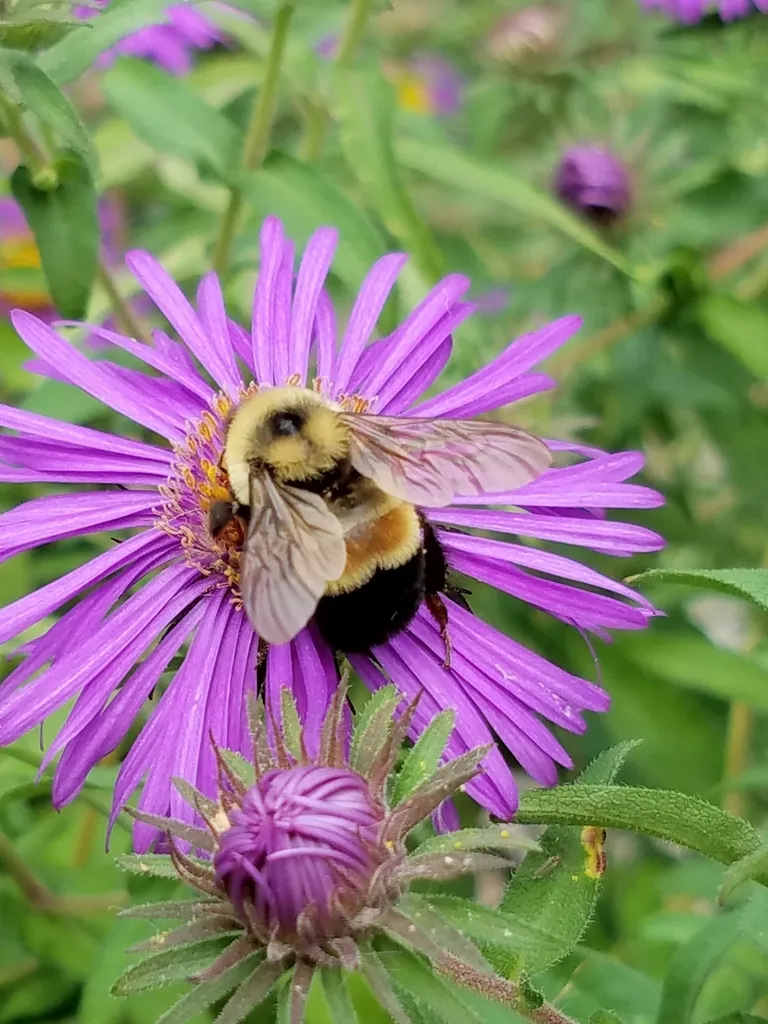
Photo credits: Contributed by Matthew Roth; Additional contributions by Beatriz Moisset , Robin McLeod , Mike Quinn , John S. Ascher , Nathaniel Green
Frequently Asked Questions About Rusty-patched Bumble Bee
What is Rusty-patched Bumble Bee?
Rusty-patched Bumble Bee (Bombus affinis) is a species in the family Apidae, within the order Hymenoptera.
How big is Rusty-patched Bumble Bee?
queen: body length 21-22 mm male: 13-17.5 mm worker: 11-16 mm
How do you identify Rusty-patched Bumble Bee?
Queens have a similar color pattern to B. vagans , with a yellow thorax and yellow T1 and T2 but in affinis the face and malar is much shorter, the hairs of the face are all black, and the coat is shorter and more uniform in length. Workers and males are distinctive in having a well-defined black interalar band (as opposed to a black medial spot) and in having an rusty-orange patch across the base of T2. see detailed descriptions at discoverlife.org
Where is Rusty-patched Bumble Bee found?
Range: MN to IN, plus a few remaining sites on east coast, see map per Xerces Society . Formerly Upper Midwest and Eastern North America: Ontario to New Brunswick, south to North Carolina. Historically known from more than 25 states.
What does Rusty-patched Bumble Bee eat?
The diet of the Rusty-patched Bumble Bee includes The Hosts section of its Discover Life species page lists known associations based on specimen records and images..
When is Rusty-patched Bumble Bee active?
Rusty-patched Bumble Bee: seasonal activity - Jul-Oct (BG data).