
Girdled Lordithon
Bobitobus cinctus
This record describes Bobitobus cinctus (species). Recorded family: Staphylinidae. Recorded order: Coleoptera.
Identification and Appearance
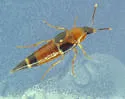
body shaped like an elongate football (from the midpoint, tapering continuously to a point, anteriorly and posteriorly); elytra short, about 1/4 body length, widest at posterior margin - which is widest part of body; pronotum narrower than elytra; head narrower than pronotum; abdomen long, about 1/2 body length, with numerous short hairs basal antennal segments slender and pale, distal segments broader and dark except for apical segment, which is pale; head black; pronotum mostly black with some orange along posterior margin; elytra black with two curving yellowish-orange bands that meet posteriorly at the medial suture (viewed from above, the two bands are reminiscent of ram's horns); abdomen orangish-red on basal half, similarly colored on distal half except for black band on each side of yellowish-orange band near apex Guide page creation based on Donald Chandler's identification of this image . The proposed common name is based on the meaning of the species epithet. Two other North American rove beetles have the same species epithet ( Quedius cinctus and Astenus cinctus ), so the name Girdled Rove Beetle could be confusing.
Classification
- Kingdom
- Animalia
- Phylum
- Arthropoda
- Class
- Insecta
- Order
- Coleoptera (Beetles)
- Suborder
- Polyphaga
- Superfamily
- Staphylinoidea
- Family
- Staphylinidae (Rove Beetles)
- Subfamily
- Mycetoporinae
- Genus
- Bobitobus
Imported taxonomy record. Source availability varies; see the source references and editorial policy below.
Habitat and Range
Habitat
forest leaf litter and fungi
Geographic Range
Internet records from northeastern United States and Ontario (NC, NY, ON, MI, IL, and possibly Wisconsin)
Seasonal Activity
spring and summer?
Diet and Behavior
Diet: presumably predaceous on small arthropods, similar to other members of the family
Additional species information
Species notes from the sources
Etymology: CINCTUS: from the Latin "cinctura" (a girdle), from "cingere" (to surround; to gird); probably refers to the pale curving bands on the elytra [the names of two other Lordithon species, lunulatus and trinotatus , refer to markings on the elytra]
About Primitive Winged Insects: the wider group
Order-level background for Coleoptera, the group containing Bobitobus cinctus. Species-specific details appear above.
Group overview
Coleoptera is the largest order of insects with over 400,000 described species, representing ~25% of all known animal species and ~40% of all insects. In the U.S. alone, nearly 30,000 beetle species have been identified.
Ecological role of the group
Beetles are prominent decomposers, especially in forests, breaking down dead wood and recycling nutrients. As predators, they reduce populations of pest insects. Many species are also important pollinators of flowering plants.
Economic and practical significance of the group
Beetles have major economic significance: leaf beetles (Chrysomelidae) and weevils (Curculionoidea) are among the most destructive agricultural pests globally, costing billions annually, while predatory species like ladybugs provide natural pest control.
Recorded sources for this group: Britannica, Smithsonian, NCSU Entomology. Imported estimates may describe particular regions or reporting periods.
Photos of Girdled Lordithon (5)
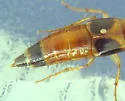
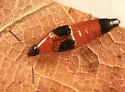
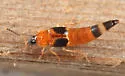
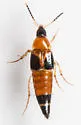
Photo credits: Contributed by Robin McLeod; Additional contributions by cotinis , Bbarnd
Frequently Asked Questions About Girdled Lordithon
What is Girdled Lordithon?
Girdled Lordithon (Bobitobus cinctus) is a species in the family Staphylinidae, within the order Coleoptera.
How big is Girdled Lordithon?
length about 5-7 mm
How do you identify Girdled Lordithon?
body shaped like an elongate football (from the midpoint, tapering continuously to a point, anteriorly and posteriorly); elytra short, about 1/4 body length, widest at posterior margin - which is widest part of body; pronotum narrower than elytra; head narrower than pronotum; abdomen long, about 1/2 body length, with numerous short hairs basal antennal segments slender and pale, distal segments broader and dark except for apical segment, which is pale; head black; pronotum mostly black with some orange along posterior margin; elytra black with two curving yellowish-orange bands that meet posteriorly at the medial suture (viewed from above, the two bands are reminiscent of ram's horns); abdomen orangish-red on basal half, similarly colored on distal half except for black band on each side of yellowish-orange band near apex
Where is Girdled Lordithon found?
| Feature | Details |
|---|---|
| Habitat | forest leaf litter and fungi |
| Range | Internet records from northeastern United States and Ontario (NC, NY, ON, MI, IL, and possibly Wisconsin) |
What does Girdled Lordithon eat?
The diet of the Girdled Lordithon includes presumably predaceous on small arthropods, similar to other members of the family.
When is Girdled Lordithon active?
Girdled Lordithon: seasonal activity - spring and summer?.