
Attalus nigripes
This record describes Attalus nigripes (species). Recorded family: Melyridae. Recorded order: Coleoptera.
Identification and Appearance
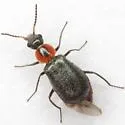
2-2.5 mm, pubescence sparse [see type ]; thorax rufous, with variable dark discal area (last couplet in: ) - all Dets. M. A. Quinn (c.TX, c.TX, AZ, w.TX) In his original description of this species, Horn states: body beneath and legs black and in his 1872 key he repeats: legs entirely black. These statements are correct so far as concerns the females, but most of the males have the anterior two pairs of legs yellow, except for the tarsi and knees, and the last three abdominal segments yellow in part. The males show a modification of the fourth and fifth sternites which is quite distinctive and which has not been previously noted to my knowledge. The central third of the fourth segment is black and ends posteriorly in a roughened, elevated ridge that slightly overhangs the true posterior border of the segment. The remainder of the sternite is yellow, except for the anterior angles. The fifth segment presents a similar structure, but the ridge here does not reach the posterior edge of the segment, the black central area has a median carina and both ridge and posterior border of the segment have an acute median emargination. The terminal segment, both sternite and tergite, is larger and thicker than usual in the genus and the sternite is made up of two lateral mandibuliform lobes, with concave median edges, leaving an unusually large genital aperture. The fifth and sixth sternites, with the exception of the black median lobe of the fifth, are entirely yellow. Lectotype Locality: Colorado
Classification
- Kingdom
- Animalia
- Phylum
- Arthropoda
- Class
- Insecta
- Order
- Coleoptera (Beetles)
- Suborder
- Polyphaga
- Superfamily
- Cleroidea
- Family
- Melyridae (Soft-winged Flower Beetles)
- Subfamily
- Malachiinae
- Tribe
- Malachiini
- Genus
- Attalus
Imported taxonomy record. Source availability varies; see the source references and editorial policy below.
Habitat and Range
Geographic Range
sw.US (AZ-TX-OK-s.UT) / n. Mex. (SON) - iNat
Diet and Behavior
Life History
10 spmns coll'ed Apr-June during 2 yrs of c. TX (w. Travis Co.) arboreal surveys, w/ no plant preference ( 3 ) uncommon at lights, most observations on var. flwrs ( 4 )
Additional species information
Species notes from the sources
Etymology: Attalus nigripes Horn, 1870
About Primitive Winged Insects: the wider group
Order-level background for Coleoptera, the group containing Attalus nigripes. Species-specific details appear above.
Group overview
Coleoptera is the largest order of insects with over 400,000 described species, representing ~25% of all known animal species and ~40% of all insects. In the U.S. alone, nearly 30,000 beetle species have been identified.
Ecological role of the group
Beetles are prominent decomposers, especially in forests, breaking down dead wood and recycling nutrients. As predators, they reduce populations of pest insects. Many species are also important pollinators of flowering plants.
Economic and practical significance of the group
Beetles have major economic significance: leaf beetles (Chrysomelidae) and weevils (Curculionoidea) are among the most destructive agricultural pests globally, costing billions annually, while predatory species like ladybugs provide natural pest control.
Recorded sources for this group: Britannica, Smithsonian, NCSU Entomology. Imported estimates may describe particular regions or reporting periods.
Photos of Attalus nigripes (5)
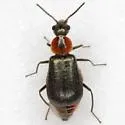
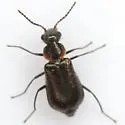
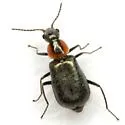
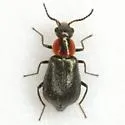
Photo credits: Contributed by Mike Quinn
Frequently Asked Questions About Attalus nigripes
What is Attalus nigripes?
Attalus nigripes is a species in the family Melyridae, within the order Coleoptera.
How big is Attalus nigripes?
2-2.5 mm
How do you identify Attalus nigripes?
2-2.5 mm, pubescence sparse [see type ]; thorax rufous, with variable dark discal area (last couplet in: ) - all Dets. M. A. Quinn (c.TX, c.TX, AZ, w.TX) In his original description of this species, Horn states: body beneath and legs black and in his 1872 key he repeats: legs entirely black. These statements are correct so far as concerns the females, but most of the males have the anterior two pairs of legs yellow, except for the tarsi and knees, and the last three abdominal segments yellow in part. The males show a modification of the fourth and fifth sternites which is quite distinctive and which has not been previously noted to my knowledge. The central third of the fourth segment is black and ends posteriorly in a roughened, elevated ridge that slightly overhangs the true posterior border of the segment. The remainder of the sternite is yellow, except for the anterior angles. The fifth segment presents a similar structure, but the ridge here does not reach the posterior edge of the segment, the black central area has a median carina and both ridge and posterior border of the segment have an acute median emargination. The terminal segment, both sternite and tergite, is larger and thicker than usual in the genus and the sternite is made up of two lateral mandibuliform lobes, with concave median edges, leaving an unusually large genital aperture. The fifth and sixth sternites, with the exception of the black median lobe of the fifth, are entirely yellow.
Where is Attalus nigripes found?
Range: sw.US (AZ-TX-OK-s.UT) / n. Mex. (SON) - iNat
What is the life cycle of a Attalus nigripes?
10 spmns coll'ed Apr-June during 2 yrs of c. TX (w. Travis Co.) arboreal surveys, w/ no plant preference ( 3 ) uncommon at lights, most observations on var. flwrs ( 4 )