
Cherry Fruitworm Moth - Hodges#3428
Aspila packardi
This record describes Aspila packardi (species). Recorded family: Tortricidae. Recorded order: Lepidoptera.
Identification and Appearance
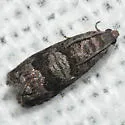
Adult : range in color from light to dark. Light individuals have silvery striae and darker contrasting fasciae, while dark individuals lack a well-defined FW pattern. Males have a conspicuous patch of dark sex scales on the dorsal surface of the HW. Larva : Late instar larvae are approximately 8-9 mm in length with a pale-reddish abdomen. The head is yellowish brown with darker mottling. The prothoracic and anal shields are brown. Pinacular are moderately large. An anal comb is present with 4-6 teeth. Larvae may appear similar to those of many other species. Cydia pomonella larvae can be separated from G. packardi by the absence of an anal fork and their larger size. Larvae of G. molesta are similar but generally larger. Larvae of G. packardi and G. prunivora are very similar, although the pinacula on the 8th and 9th abdominal segment are more prominent in G. packardi , and the abdomen of G. prunivora is more reddish, especially in preserved specimens. Genitalia: ♀ ♂ Represented by two BINs ( BOLD:AAA8742 and BOLD:AAA8743 ) with more than 3% sequence divergence between them; both barcode closer to Grapholita libertina ( BOLD:ACC7713 ) than to each other.
Classification
- Kingdom
- Animalia
- Phylum
- Arthropoda
- Class
- Insecta
- Order
- Lepidoptera (Butterflies and Moths)
- Superfamily
- Tortricoidea
- Family
- Tortricidae (Tortricid Moths)
- Subfamily
- Olethreutinae
- Tribe
- Grapholitini
- Genus
- Aspila
Imported taxonomy record. Source availability varies; see the source references and editorial policy below.
Habitat and Range
Geographic Range
Widely distributed in eastern North America. It is also present in the Pacific Northwest (Washington and British Columbia) and likely other fruit-growing regions of the West. Type locality: Texas
Seasonal Activity
2-3 generations per year.
Diet and Behavior
Diet: Larvae feed on many common fruit crops in the families Rosaceae and Ericaceae . It is possible that hawthorn ( Crataegus ) is the native host.
Life History
Females lay eggs singly on terminal shoot leaves. Larvae feed inside the shoots or fruit; Chapman and Lienk found considerable variation in feeding records suggesting that larvae behave differently on different hosts or that a species complex is involved. Overwintering occurs on the host in a cocoon and pupation occurs the following spring.
Additional species information
Species notes from the sources
Etymology: Specific epithet in honor of A.S. Packard (1839-1905) "who made so many contributions to my work on North American microlepidoptera."
About Butterflies and Moths: the wider group
Order-level background for Lepidoptera, the group containing Aspila packardi. Species-specific details appear above.
Group overview
Lepidoptera includes approximately 180,000 described species of butterflies and moths. Moths outnumber butterflies roughly 10:1. The monarch butterfly's eastern population has declined by more than 80% since the mid-1990s, and the western population by over 95% since the 1980s. The IUCN lists the migratory monarch as Vulnerable.
Ecological role of the group
Butterflies and moths are essential indicators of ecosystem health. As caterpillars, they are a primary food source for birds - a single nest of blue tit chicks requires ~10,000 caterpillars. Adult moths pollinate many night-blooming plants.
Economic and practical significance of the group
Lepidoptera are critical pollinators. In Europe, grassland butterfly species have declined by almost 50% since the early 1990s. In the UK, three-quarters of butterflies are in decline. In the U.S., five butterfly species have gone extinct since 1950, with 29 listed as endangered.
Recorded sources for this group: IUCN Red List, Xerces Society, USFWS, PNAS, WWF. Imported estimates may describe particular regions or reporting periods.
Photos of Cherry Fruitworm Moth - Hodges#3428 (5)
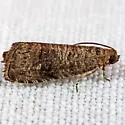
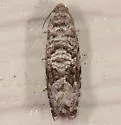
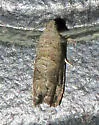
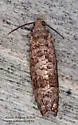
Photo credits: Contributed by tom murray; Additional contributions by Tony-2 , Nick Block , Robert Lord Zimlich , Chuck Sexton , Randy Hardy , Blocky , Robert H. Biagi , Steve Morris
Frequently Asked Questions About Cherry Fruitworm Moth - Hodges#3428
What is Cherry Fruitworm Moth - Hodges#3428?
Cherry Fruitworm Moth - Hodges#3428 (Aspila packardi) is a species in the family Tortricidae, within the order Lepidoptera.
How big is Cherry Fruitworm Moth - Hodges#3428?
FWL ≈ 3.5-5mm Wingspan 8-10.5 mm.
How do you identify Cherry Fruitworm Moth - Hodges#3428?
Adult : range in color from light to dark. Light individuals have silvery striae and darker contrasting fasciae, while dark individuals lack a well-defined FW pattern. Males have a conspicuous patch of dark sex scales on the dorsal surface of the HW. Larva : Late instar larvae are approximately 8-9 mm in length with a pale-reddish abdomen. The head is yellowish brown with darker mottling. The prothoracic and anal shields are brown. Pinacular are moderately large. An anal comb is present with 4-6 teeth. Larvae may appear similar to those of many other species. Cydia pomonella larvae can be separated from G. packardi by the absence of an anal fork and their larger size. Larvae of G. molesta are similar but generally larger. Larvae of G. packardi and G. prunivora are very similar, although the pinacula on the 8th and 9th abdominal segment are more prominent in G. packardi , and the abdomen of G. prunivora is more reddish, especially in preserved specimens. Genitalia: ♀ ♂
Where is Cherry Fruitworm Moth - Hodges#3428 found?
Range: Widely distributed in eastern North America. It is also present in the Pacific Northwest (Washington and British Columbia) and likely other fruit-growing regions of the West. Type locality: Texas
What does Cherry Fruitworm Moth - Hodges#3428 eat?
The diet of the Cherry Fruitworm Moth - Hodges#3428 includes Larvae feed on many common fruit crops in the families Rosaceae and Ericaceae . It is possible that hawthorn ( Crataegus ) is the native host..
When is Cherry Fruitworm Moth - Hodges#3428 active?
Cherry Fruitworm Moth - Hodges#3428: seasonal activity - 2-3 generations per year..
What is the life cycle of a Cherry Fruitworm Moth - Hodges#3428?
Females lay eggs singly on terminal shoot leaves. Larvae feed inside the shoots or fruit; Chapman and Lienk found considerable variation in feeding records suggesting that larvae behave differently on different hosts or that a species complex is involved. Overwintering occurs on the host in a cocoon and pupation occurs the following spring.