
Asilus sericeus
This record describes Asilus sericeus (species). Recorded family: Asilidae. Recorded order: Diptera.
Identification and Appearance
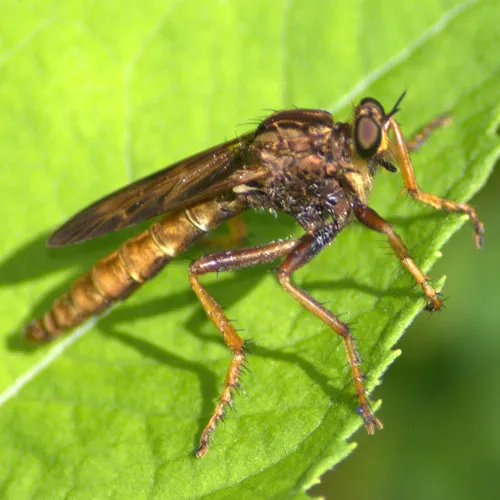
| Feature | Details |
|---|---|
| Head | Covered with golden pile, including behind the eyes. Row of brownish bristles across back of head. Mustache (mystax) has a thin layer of very long brownish-yellow bristles. Antenna: Base segments more brownish-yellow. Segment 3 long, black, with bristle at tip. |
| Thorax | Brownish-yellowish pile with wide dark stripe down center. Thorax sides more reddish-brown, no pile. Wings: Light reddish-brown, cells along inner margin and wing tip dusky; veins wide, light reddish-brown. Halteres yellow. |
| Legs | Thighs (femora) reddish-brown, may have dark streak. Shins (tibiae) and feet pale yellowish. Last few segments of feet darker. Toes yellow. Only a few thin, short spines on legs. |
| Abdomen | Long, slightly tapering. Variable color, depending on light conditions. First 4 segments dark brown, lower margin golden. Last few segments lighter brown, barely marked on lower margin. Male tip spoon-shaped. Female tip long and sharply pointed, reddish-brown. Types: Holotype as Asilus sericeus by Say, 1823. Type Locality: Pennsylvania. Type lost. Holotype as Asilus herminius female by Walker, 1849. Type Locality: Massachusetts. In the British Museum of Natural History, London, England. |
Classification
Habitat and Range
Habitat
Wet meadows, especially with fern; fields, etc. with flowers.
Geographic Range
e. NA (ME-FL to ON-ND-TX)
Seasonal Activity
Jun-Aug ( 3 ) ( 4 ) ; one report November in Michigan.
Diet and Behavior
Diet: Often preys on nectar-seeking insects such as butterflies, catching them in mid-air. Not known to feed on bees and wasps like other robber flies. Larvae feed on smaller, ground-dwelling insects. Mistakenly reported feeding on roots of rhubarb.
Life History
Larvae 18 – 20 mm long; grub-like, white, tinted yellowish. Head is brown with 2 small hooks. Lives about 16 cm underground. Pupates in late May, moving to surface to emerge by mid June.
Additional species information
Species notes from the sources
Etymology: Asilus sericeus Say 1823
About Flies: the wider group
Order-level background for Diptera, the group containing Asilus sericeus. Species-specific details appear above.
Group overview
Diptera includes over 150,000 described species of flies, mosquitoes, and midges. Mosquitoes are the deadliest animal on Earth (CDC). Malaria alone causes ~249 million cases and over 608,000 deaths annually, mostly children under 5 (WHO). Vector-borne diseases account for over 17% of all infectious diseases, causing 700,000+ deaths per year.
Ecological role of the group
Despite their disease impact, flies are critical decomposers and pollinators. Hoverflies alone pollinate hundreds of crop and wildflower species. Flies are also the primary food source for many birds, bats, and fish. Forensic entomology relies heavily on fly species for crime scene analysis.
Economic and practical significance of the group
In the U.S., vector-borne disease cases tripled between 2004-2016, with over 640,000 cases reported in that period (CDC). Tickborne diseases doubled from 22,000 to 48,000 annual reports. Globally, mosquito-borne diseases cost billions in healthcare and lost productivity.
Recorded sources for this group: WHO, CDC, PNAS. Imported estimates may describe particular regions or reporting periods.
Photos of Asilus sericeus (2)
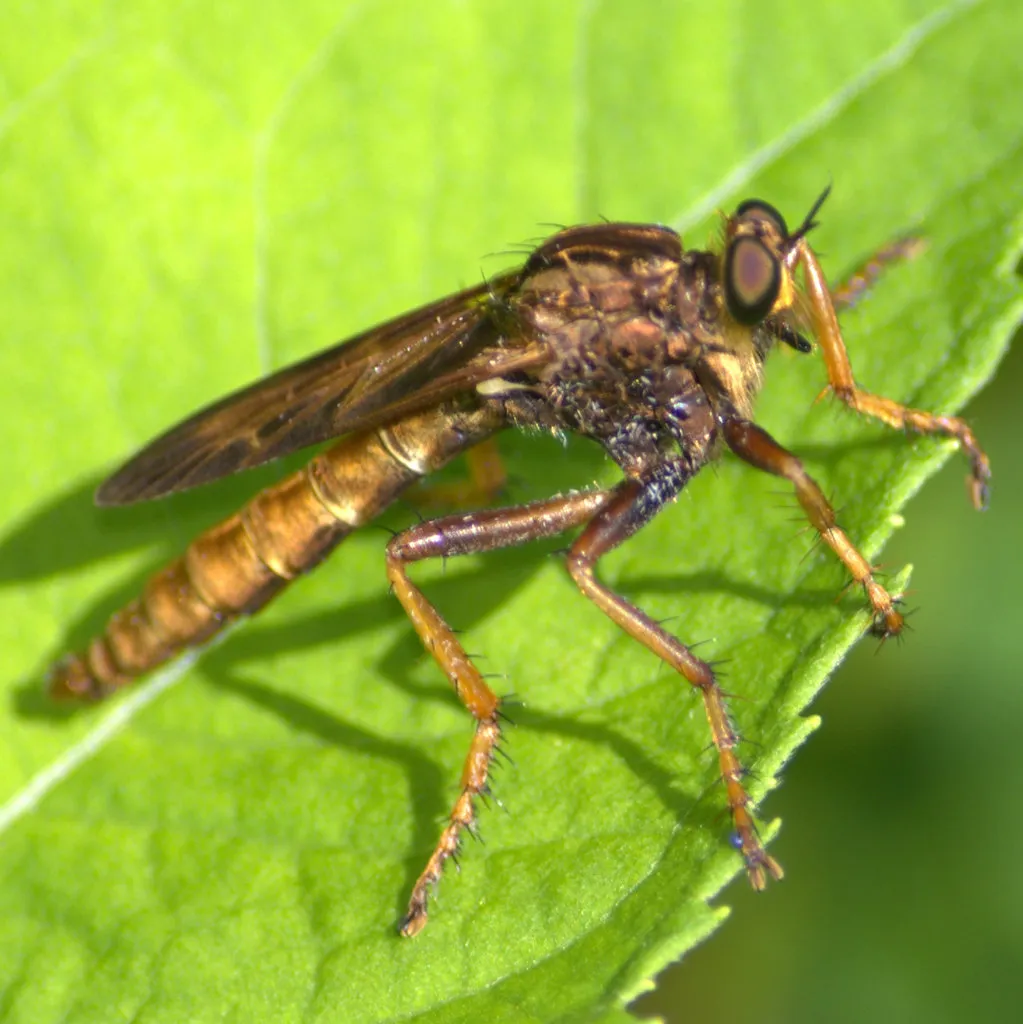
Photo credits: Contributed by Cotinis; Additional contributions by Robin McLeod , v belov , lee_penner
Frequently Asked Questions About Asilus sericeus
What is Asilus sericeus?
Asilus sericeus is a species in the family Asilidae, within the order Diptera.
How big is Asilus sericeus?
20-28 mm
How do you identify Asilus sericeus?
| Feature | Details |
|---|---|
| Head | Covered with golden pile, including behind the eyes. Row of brownish bristles across back of head. Mustache (mystax) has a thin layer of very long brownish-yellow bristles. Antenna: Base segments more brownish-yellow. Segment 3 long, black, with bristle at tip. |
| Thorax | Brownish-yellowish pile with wide dark stripe down center. Thorax sides more reddish-brown, no pile. Wings: Light reddish-brown, cells along inner margin and wing tip dusky; veins wide, light reddish-brown. Halteres yellow. |
| Legs | Thighs (femora) reddish-brown, may have dark streak. Shins (tibiae) and feet pale yellowish. Last few segments of feet darker. Toes yellow. Only a few thin, short spines on legs. |
| Abdomen | Long, slightly tapering. Variable color, depending on light conditions. First 4 segments dark brown, lower margin golden. Last few segments lighter brown, barely marked on lower margin. Male tip spoon-shaped. Female tip long and sharply pointed, reddish-brown. |
Where is Asilus sericeus found?
| Feature | Details |
|---|---|
| Habitat | Wet meadows, especially with fern; fields, etc. with flowers. |
| Range | e. NA (ME-FL to ON-ND-TX) |
What does Asilus sericeus eat?
The diet of the Asilus sericeus includes Often preys on nectar-seeking insects such as butterflies, catching them in mid-air. Not known to feed on bees and wasps like other robber flies. Larvae feed on smaller, ground-dwelling insects. Mistakenly reported feeding on roots of rhubarb..
When is Asilus sericeus active?
Asilus sericeus: seasonal activity - Jun-Aug ( 3 ) ( 4 ) ; one report November in Michigan..
What is the life cycle of a Asilus sericeus?
Larvae 18 – 20 mm long; grub-like, white, tinted yellowish. Head is brown with 2 small hooks. Lives about 16 cm underground. Pupates in late May, moving to surface to emerge by mid June.