
Ugly-nest Caterpillar Moth - Hodges#3661
Archips cerasivorana
This record describes Archips cerasivorana (species). Recorded family: Tortricidae. Recorded order: Lepidoptera.
Identification and Appearance
Adult - bright to pale ocherous orange crossed by broken, transverse lines of shining, dark rose rust prominent only on the costa. Hindwing ocherous yellow. Larva - body brownish or greenish-yellow; head shiny dark brown; lacks an anal fork (present in some other species of Archips ).
Classification
- Kingdom
- Animalia
- Phylum
- Arthropoda
- Class
- Insecta
- Order
- Lepidoptera (Butterflies and Moths)
- Superfamily
- Tortricoidea
- Family
- Tortricidae (Tortricid Moths)
- Subfamily
- Tortricinae
- Tribe
- Archipini
- Genus
- Archips
Imported taxonomy record. Source availability varies; see the source references and editorial policy below.
Habitat and Range
Geographic Range
Powell and Opler states range from northeast to British Columbia, Montana, Colorado and northern California. Type locality. New York.
Seasonal Activity
Adults fly from July to September. Larvae from May to July.
Diet and Behavior
Diet: Larvae feed gregariously on leaves of chokecherry ( Prunus virginiana ) and occasionally feed upon other members of the Rose family (Rosaceae), willow ( Salix ), aspen ( Populus ), and birch ( Betula ).
Life History
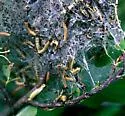
Eggs are laid in fall in masses on bark of shrubs and young trees near the ground; eggs overwinter and hatch the next spring in May and June; larvae tie leaves together, forming a nest or web within which they live and feed; size of nest increases as larvae become larger, and Chokecherry trees may become completely covered; most larvae develop to pupal stage by mid-July; pupation occurs within the nest, and adults emerge from its outer wall; one generation per year. [adapted from text by Canadian Forest Service] Larvae spin unsightly webs on host plants (often noticeable along roadsides) but do little damage in most years, and are of minor economic importance. Larvae; larva; woven nest on cherry; larvae in nest; nest; adult; mated pair
Additional species information
Species notes from the sources
Etymology: Specific epithet from Latin cerasus + vorus meaning "cherry-eater."
About Butterflies and Moths: the wider group
Order-level background for Lepidoptera, the group containing Archips cerasivorana. Species-specific details appear above.
Group overview
Lepidoptera includes approximately 180,000 described species of butterflies and moths. Moths outnumber butterflies roughly 10:1. The monarch butterfly's eastern population has declined by more than 80% since the mid-1990s, and the western population by over 95% since the 1980s. The IUCN lists the migratory monarch as Vulnerable.
Ecological role of the group
Butterflies and moths are essential indicators of ecosystem health. As caterpillars, they are a primary food source for birds - a single nest of blue tit chicks requires ~10,000 caterpillars. Adult moths pollinate many night-blooming plants.
Economic and practical significance of the group
Lepidoptera are critical pollinators. In Europe, grassland butterfly species have declined by almost 50% since the early 1990s. In the UK, three-quarters of butterflies are in decline. In the U.S., five butterfly species have gone extinct since 1950, with 29 listed as endangered.
Recorded sources for this group: IUCN Red List, Xerces Society, USFWS, PNAS, WWF. Imported estimates may describe particular regions or reporting periods.
Photos of Ugly-nest Caterpillar Moth - Hodges#3661 (5)
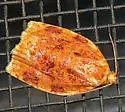
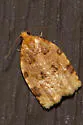
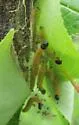
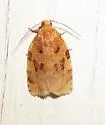
Photo credits: Contributed by Robin McLeod; Additional contributions by marcie oconnor , Randy Hardy , Jason Dombroskie , Fyn Kynd
Frequently Asked Questions About Ugly-nest Caterpillar Moth - Hodges#3661
What is Ugly-nest Caterpillar Moth - Hodges#3661?
Ugly-nest Caterpillar Moth - Hodges#3661 (Archips cerasivorana) is a species in the family Tortricidae, within the order Lepidoptera.
How big is Ugly-nest Caterpillar Moth - Hodges#3661?
| Feature | Description |
|---|---|
| Forewing | Forewing length 10-12.5 mm. |
| Wingspan | Wingspan 20-25 mm. Larvae to 20 mm. |
How do you identify Ugly-nest Caterpillar Moth - Hodges#3661?
Adult - bright to pale ocherous orange crossed by broken, transverse lines of shining, dark rose rust prominent only on the costa. Hindwing ocherous yellow. Larva - body brownish or greenish-yellow; head shiny dark brown; lacks an anal fork (present in some other species of Archips ).
Where is Ugly-nest Caterpillar Moth - Hodges#3661 found?
Range: Powell and Opler states range from northeast to British Columbia, Montana, Colorado and northern California. Type locality. New York.
What does Ugly-nest Caterpillar Moth - Hodges#3661 eat?
The diet of the Ugly-nest Caterpillar Moth - Hodges#3661 includes Larvae feed gregariously on leaves of chokecherry ( Prunus virginiana ) and occasionally feed upon other members of the Rose family (Rosaceae), willow ( Salix ), aspen ( Populus ), and birch ( Betula )..
When is Ugly-nest Caterpillar Moth - Hodges#3661 active?
Ugly-nest Caterpillar Moth - Hodges#3661: seasonal activity - Adults fly from July to September. Larvae from May to July..
What is the life cycle of a Ugly-nest Caterpillar Moth - Hodges#3661?
Eggs are laid in fall in masses on bark of shrubs and young trees near the ground; eggs overwinter and hatch the next spring in May and June; larvae tie leaves together, forming a nest or web within which they live and feed; size of nest increases as larvae become larger, and Chokecherry trees may become completely covered; most larvae develop to pupal stage by mid-July; pupation occurs within the nest, and adults emerge from its outer wall; one generation per year. [adapted from text by Canadian Forest Service] Larvae spin unsightly webs on host plants (often noticeable along roadsides) but do little damage in most years, and are of minor economic importance. Larvae; larva; woven nest on cherry; larvae in nest; nest; adult; mated pair