
Aphilanthops frigidus
This record describes Aphilanthops frigidus (species). Recorded family: Crabronidae. Recorded order: Hymenoptera.
Identification and Appearance
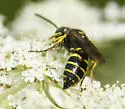
| Feature | Description |
|---|---|
| Additional details | Males and females similar. Marks, stripes and spots can be either yellow or white. |
| Head | Head: Black with 3 wide yellow stripes: one each along inner eye margin, and one median stripe. Median stripe progressively narrows beyond antenna bases. (Female median stripe does not reach to antenna bases.) Lower margin of clypeus has 3 teeth on male, 5 on female. Back of eyes sometimes have a partial yellow stripe along margin. Mandibles yellow, tips reddish. Antenna: Base (scape) black on top side with a yellow ring, slightly swollen yellow on underside of male; female dark on underside. Segments black on top side, reddish-yellow on underside. |
| Thorax | Thorax: Black. Collar thin, yellow, slightly interrupted or indented at center. Segment 1 (scutum) black, may have long transverse yellow stripe on lower margin; may be absent. An oblong yellow spot before wing knob (tegulae). Segment 2 (scutellum) may have a small yellow spot at center, sometimes absent. Segment 3 (propodeum) has yellow triangular spots at each side. |
| Thorax | Thorax side tubercle black, may have a small yellow spot. A large yellow crescent between tubercle and wing base. |
| Wings | Wings: Wing knobs (tegulae) black with a yellow spot. |
| Wings | Wings tinted dusky, veins pale reddish-brown. |
| Legs | Legs: Thighs (femora) black with yellow tips, yellow on underside. Shins (tibiae) yellow. Feet progressively darker. Females have rakes or combs on front shins and feet for digging. |
| Abdomen | Abdomen: Black with yellow/white stripes. Stripes on female are wider than on male. Segment 1 has an oval to triangular mark at each side; wider than other stripes. Segment 2 stripe slightly narrower, interrupted at center. Segments 3 to 5 on female, to 6 on male have thin stripes, all interrupted or narrowed at center. Tip black to reddish with white hair tuft on male. Underside also striped. Parasite: Miltogrammid Fly Senotainia trilineata lays live larvae on winged ant prey while in flight to the nest. Types: Holotype as Philanthus frigidus male by Smith, 1856. Locality: Nova Scotia collected by Lieut. Redman. In British Museum of Natural History, London, England. Lectotype designated by Bohart, 1966. Holotype as Aphilanthops bakeri male by Dunning, 1896, Baker #1631 &1636. Locality: Colorado. In National Museum of Natural History, Smithsonian. Lectotype male in Academy of Natural Sciences, Philadelphia, Pennsylvania. Holotype as Nomada (Holonomada) dawsoni male by Swenk, 1912. Locality: Harrison, Sioux County, Nebraska; collected by Dawson. In University of Nebraska, Lincoln. |
Classification
- Kingdom
- Animalia
- Phylum
- Arthropoda
- Class
- Insecta
- Order
- Hymenoptera (Ants, Bees, Wasps and Sawflies)
- Superfamily
- Trigonaloidea
- Family
- Crabronidae (Square-headed Wasps, Sand Wasps, and Allies)
- Subfamily
- Philanthinae
- Tribe
- Aphilanthopini
- Genus
- Aphilanthops
Imported taxonomy record. Source availability varies; see the source references and editorial policy below.
Habitat and Range
Habitat
Sandy soils in meadows, vacant lots and forest edges with ants.
Geographic Range
Northern U.S. across to east coast, down to Virginia; west coast down to New Mexico. Transcontinental in southern Canada.
Seasonal Activity
Late June to mid-August on east coast and southern U.S. July to August in northern U.S. and Canada.
Diet and Behavior
Diet: Prey on winged queen ants in the genus Formica An example:
Life History
Nests are dug in sandy, pebbly soil to a depth of 45 cm. Sometimes form aggregate colonies of 25 to 60 females, especially on sandy slopes with entrances as close as 2 cm apart. Winged queen ants are captured when wandering on the ground, stung and carried to nests with ant antenna between wasp mandibles and rest of body held between the legs. In the nest tunnel, wings are removed and ants are stored near entrance in a cell until individual egg cells are dug. Storage is necessary due to the short flight cycle of winged ants. Females possibly can lay only one egg per day (Evans, 1962). Usually 2 to 3 ants are used in each cell. One generation per year.
About Flies: the wider group
Order-level background for Hymenoptera, the group containing Aphilanthops frigidus. Species-specific details appear above.
Group overview
Hymenoptera includes over 150,000 described species of ants, bees, wasps, and sawflies. Earth harbors approximately 20 quadrillion (20×10^15) ants, with a combined biomass of ~12 megatons of dry carbon - exceeding the combined biomass of all wild birds and mammals (PNAS, 2022).
Ecological role of the group
About 35% of the world's food crops depend on animal pollinators. The chocolate industry, valued at over $100 billion, depends on pollinating flies and midges. Ants are the dominant soil engineers in most terrestrial ecosystems, turning more soil than earthworms in many habitats.
Economic and practical significance of the group
Pollinators contribute $235-577 billion worth of annual global food production (FAO). In the U.S., bee pollination alone benefits crops valued at $18 billion annually, and honey bees are responsible for $5.4 billion in agricultural productivity. Between April 2023-2024, 55.1% of managed honey bee colonies were lost. The U.S. bee population dropped from 5 million to 2.5 million.
Recorded sources for this group: FAO, USDA, EPA, PNAS (2022), US Fish & Wildlife Service. Imported estimates may describe particular regions or reporting periods.
Photos of Aphilanthops frigidus (5)
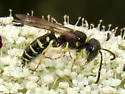
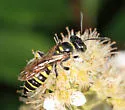
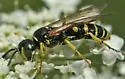
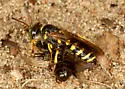
Photo credits: Contributed by Eric R. Eaton; Additional contributions by John S. Ascher , metrioptera , lee_penner , PaleoJon
Frequently Asked Questions About Aphilanthops frigidus
What is Aphilanthops frigidus?
Aphilanthops frigidus is a species in the family Crabronidae, within the order Hymenoptera.
How big is Aphilanthops frigidus?
Female 11 to 15 mm. long Male 9 to 11 mm. long
How do you identify Aphilanthops frigidus?
| Feature | Description |
|---|---|
| Additional details | Males and females similar. Marks, stripes and spots can be either yellow or white. |
| Head | Head: Black with 3 wide yellow stripes: one each along inner eye margin, and one median stripe. Median stripe progressively narrows beyond antenna bases. (Female median stripe does not reach to antenna bases.) Lower margin of clypeus has 3 teeth on male, 5 on female. Back of eyes sometimes have a partial yellow stripe along margin. Mandibles yellow, tips reddish. Antenna: Base (scape) black on top side with a yellow ring, slightly swollen yellow on underside of male; female dark on underside. Segments black on top side, reddish-yellow on underside. |
| Thorax | Thorax: Black. Collar thin, yellow, slightly interrupted or indented at center. Segment 1 (scutum) black, may have long transverse yellow stripe on lower margin; may be absent. An oblong yellow spot before wing knob (tegulae). Segment 2 (scutellum) may have a small yellow spot at center, sometimes absent. Segment 3 (propodeum) has yellow triangular spots at each side. |
| Thorax | Thorax side tubercle black, may have a small yellow spot. A large yellow crescent between tubercle and wing base. |
| Wings | Wings: Wing knobs (tegulae) black with a yellow spot. |
| Wings | Wings tinted dusky, veins pale reddish-brown. |
| Legs | Legs: Thighs (femora) black with yellow tips, yellow on underside. Shins (tibiae) yellow. Feet progressively darker. Females have rakes or combs on front shins and feet for digging. |
| Abdomen | Abdomen: Black with yellow/white stripes. Stripes on female are wider than on male. Segment 1 has an oval to triangular mark at each side; wider than other stripes. Segment 2 stripe slightly narrower, interrupted at center. Segments 3 to 5 on female, to 6 on male have thin stripes, all interrupted or narrowed at center. Tip black to reddish with white hair tuft on male. Underside also striped. |
Where is Aphilanthops frigidus found?
| Feature | Details |
|---|---|
| Habitat | Sandy soils in meadows, vacant lots and forest edges with ants. |
| Range | Northern U.S. across to east coast, down to Virginia; west coast down to New Mexico. Transcontinental in southern Canada. |
What does Aphilanthops frigidus eat?
The diet of the Aphilanthops frigidus includes Prey on winged queen ants in the genus Formica An example:.
When is Aphilanthops frigidus active?
Aphilanthops frigidus: seasonal activity - Late June to mid-August on east coast and southern U.S. July to August in northern U.S. and Canada..
What is the life cycle of a Aphilanthops frigidus?
Nests are dug in sandy, pebbly soil to a depth of 45 cm. Sometimes form aggregate colonies of 25 to 60 females, especially on sandy slopes with entrances as close as 2 cm apart. Winged queen ants are captured when wandering on the ground, stung and carried to nests with ant antenna between wasp mandibles and rest of body held between the legs. In the nest tunnel, wings are removed and ants are stored near entrance in a cell until individual egg cells are dug. Storage is necessary due to the short flight cycle of winged ants. Females possibly can lay only one egg per day (Evans, 1962). Usually 2 to 3 ants are used in each cell. One generation per year.