
Ancylis virididorsana - Hodges#3388.4
Ancylis virididorsana
This record describes Ancylis virididorsana (species). Recorded family: Tortricidae. Recorded order: Lepidoptera.
Identification and Appearance
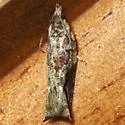
| Feature | Description |
|---|---|
| Additional details | This taxon has a large oval dark brown dorsal patch. The patch and adjacent areas of the forewings often show olive-green overtones (iridescence) when fresh, thus the informal common name of Olive Ancylis. - Chuck Sexton A very distinctive species. Palpi clay-yellow, head rust-yellow, thorax greenish, shoulder coverts clay-yellow, as are the abdomen and legs. |
| Forewing | Forewing reddish-clay-yellow with a large, irregularly triangular green inner marginal patch, with its tip reaching over the subdorsal, and a rust-red and green mixed marginal area; towards the base, the inner marginal patch is indented towards the front edge. In front of the edge there are fine rust-red cross-streaks. Front edge whitish, with rust-red cross-streaks. Marginal line white, fringes rust-red. |
| Hindwing | Hindwing brownish-grey. Front edge white, from the same towards the edge an elongated metallic grey-blue shiny spot, two such smaller spots in cells 2 and 3. Marginal line brown, fringes white, mixed reddish-yellow. Below, the forewings are uniformly reddish-yellow, the hindwings white-yellow with metallic blue-grey shiny cross-streaks. 4-5.2mm. - 2 specimens. - Möschler (1891) (Google tranlation) Temporary grouping. A specimen identified as Ancylis virididorsana (a Caribbean species) was collected in Long Key, FL, in May 2024 (Hribar 2024), and that is apparently the correct name for the additional examples documented along the Gulf Coast. Additional records in Texas on iNaturalist can be viewed here . Also see BOLD:AAM5791 , the BIN group for DNA barcoded specimens of Ancylis virididorsana , which contains specimens from Texas. Typical virididorsana has a large green dorsal patch. There appears to be a northern form with browner forewing dorsal patch and more diffuse green in the ground color of the post medial area (see Description above), possibly representing a subspecies or undescribed species. The original description of the hind wing of virididorsana does not seem to match that of US specimens. More work is needed. -- Updated by Steve Nanz, 29 March 2024 |
Classification
- Kingdom
- Animalia
- Phylum
- Arthropoda
- Class
- Insecta
- Order
- Lepidoptera (Butterflies and Moths)
- Superfamily
- Tortricoidea
- Family
- Tortricidae (Tortricid Moths)
- Subfamily
- Olethreutinae
- Tribe
- Enarmoniini
- Genus
- Ancylis
Imported taxonomy record. Source availability varies; see the source references and editorial policy below.
Habitat and Range
Geographic Range
Texas, Louisiana, Alabama. Type locality: Puerto Rico.
Seasonal Activity
Multiple flights in central Texas (April-July, September-October, December-January).
Diet and Behavior
Diet: Adults have been raised from larvae feeding on rattan vine ( Berchemia scandens ) in east Texas.
Additional species information
Species notes from the sources
Etymology: Ancylis virididorsana (Möschler, 1891) is now recognized within the North American fauna, from Florida Keys (J. Hayden) and Texas (Hayden & Nanz). (Gilligan & Brown in Pohl & Nanz (eds.) 2023).
About Butterflies and Moths: the wider group
Order-level background for Lepidoptera, the group containing Ancylis virididorsana. Species-specific details appear above.
Group overview
Lepidoptera includes approximately 180,000 described species of butterflies and moths. Moths outnumber butterflies roughly 10:1. The monarch butterfly's eastern population has declined by more than 80% since the mid-1990s, and the western population by over 95% since the 1980s. The IUCN lists the migratory monarch as Vulnerable.
Ecological role of the group
Butterflies and moths are essential indicators of ecosystem health. As caterpillars, they are a primary food source for birds - a single nest of blue tit chicks requires ~10,000 caterpillars. Adult moths pollinate many night-blooming plants.
Economic and practical significance of the group
Lepidoptera are critical pollinators. In Europe, grassland butterfly species have declined by almost 50% since the early 1990s. In the UK, three-quarters of butterflies are in decline. In the U.S., five butterfly species have gone extinct since 1950, with 29 listed as endangered.
Recorded sources for this group: IUCN Red List, Xerces Society, USFWS, PNAS, WWF. Imported estimates may describe particular regions or reporting periods.
Photos of Ancylis virididorsana - Hodges#3388.4 (5)
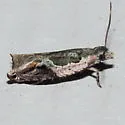
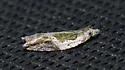
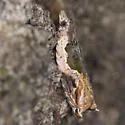
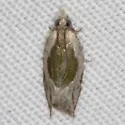
Photo credits: Contributed by Maury J. Heiman; Additional contributions by Steve Nanz , Chuck Sexton , Steve Morris
Frequently Asked Questions About Ancylis virididorsana - Hodges#3388.4
What is Ancylis virididorsana - Hodges#3388.4?
Ancylis virididorsana - Hodges#3388.4 (Ancylis virididorsana) is a species in the family Tortricidae, within the order Lepidoptera.
How do you identify Ancylis virididorsana - Hodges#3388.4?
| Feature | Description |
|---|---|
| Additional details | This taxon has a large oval dark brown dorsal patch. The patch and adjacent areas of the forewings often show olive-green overtones (iridescence) when fresh, thus the informal common name of Olive Ancylis. - Chuck Sexton A very distinctive species. Palpi clay-yellow, head rust-yellow, thorax greenish, shoulder coverts clay-yellow, as are the abdomen and legs. |
| Forewing | Forewing reddish-clay-yellow with a large, irregularly triangular green inner marginal patch, with its tip reaching over the subdorsal, and a rust-red and green mixed marginal area; towards the base, the inner marginal patch is indented towards the front edge. In front of the edge there are fine rust-red cross-streaks. Front edge whitish, with rust-red cross-streaks. Marginal line white, fringes rust-red. |
| Hindwing | Hindwing brownish-grey. Front edge white, from the same towards the edge an elongated metallic grey-blue shiny spot, two such smaller spots in cells 2 and 3. Marginal line brown, fringes white, mixed reddish-yellow. Below, the forewings are uniformly reddish-yellow, the hindwings white-yellow with metallic blue-grey shiny cross-streaks. 4-5.2mm. - 2 specimens. - Möschler (1891) (Google tranlation) |
Where is Ancylis virididorsana - Hodges#3388.4 found?
Range: Texas, Louisiana, Alabama. Type locality: Puerto Rico.
What does Ancylis virididorsana - Hodges#3388.4 eat?
The diet of the Ancylis virididorsana - Hodges#3388.4 includes Adults have been raised from larvae feeding on rattan vine ( Berchemia scandens ) in east Texas..
When is Ancylis virididorsana - Hodges#3388.4 active?
Ancylis virididorsana - Hodges#3388.4: seasonal activity - Multiple flights in central Texas (April-July, September-October, December-January)..