Aleiodes
This record describes Aleiodes (genus). Recorded family: Braconidae. Recorded order: Hymenoptera.
Identification and Appearance
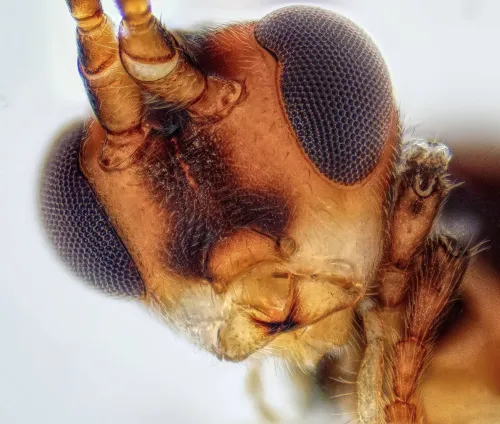
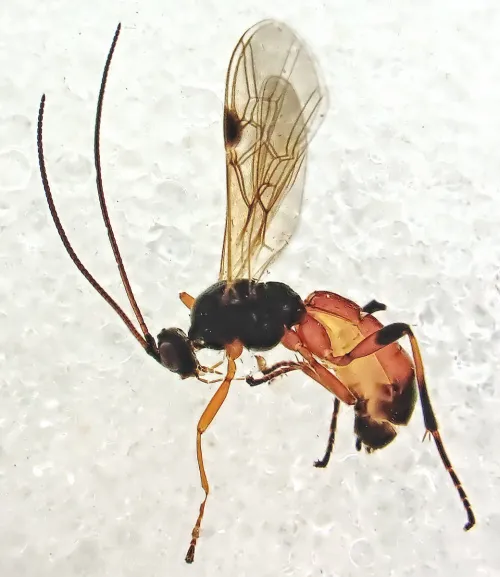
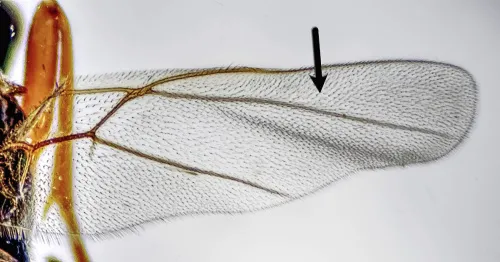
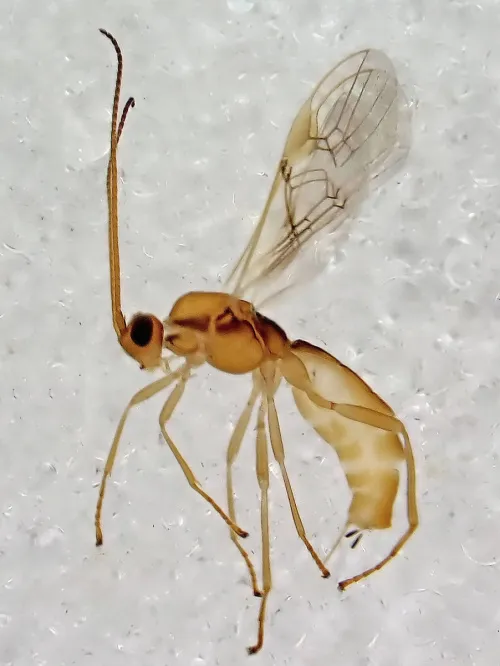
Propodeum with a long median carina (ridge) dorsally; females are distinguished by a short ovipositor (sheaths are usually no longer than the hind basitarsus), making them distinct from other Braconidae; forewing with two (plus apical third) submarginal cells, second submarginal cell often longer than high. Cyclostome mouth, a circular opening formed by a dorso-ventrally short clypeus and a concave labrum, bordered below by the mandibles. The first three abdominal segments are heavily sculptured, often with longitudinal ridges. There are thousands of species worldwide with about 40 UK species identified so far. Very difficult to identify beyond species group: Aleiodes apicalis group : Recognised by having the APICAL HALF OF THE HIND WING MARGINAL CELL DISTINCTLY GRADUALLY WIDENED (measuring at least 1.6x its width near the hamuli). If the marginal cell is parallel-sided, they display robust tarsal claws with a coarse, often blackish pecten. They also possess a wide, distinct, SMOOTH TRIANGULAR AREA MEDIO-BASALLY ON THE SECOND METASOMAL TERGITE, and an occipital carina that is usually reduced ventrally (failing to reach the hypostomal carina). Aleiodes circumscriptus and Aleiodes bicolor groups : APICAL HALF OF THE HIND WING MARGINAL CELL IN THESE GROUPS IS PARALLEL-SIDED OR ONLY WEAKLY WIDENED (less than 1.8x its width near the hamuli). The second tergite lacks a distinct triangular area medio-basally. The occipital carina is complete ventrally (reaching the hypostomal carina), and the mesopleuron is usually extensively coriaceous or finely granulate. Aleiodes gastritor complex : These species are incredibly similar and difficult to separate, but they are highly differentiated by their biology and strict host-plant or host-species specialisation. Unless identified by a recognised expert, a photo is required and the specimen should be examined with a microscope. In the comments box, state the key or ID method used and describe the size and identifying characters. The females deposits eggs in caterpillars of various species. The eggs hatch and the wasp larva feeds on the caterpillar leaving a hardened skin, or mummy. The wasp pupates within the mummy and eventually the adult breaks out, leaving a small hole in the husk of the caterpillar. Under recorded due to identification difficulty.
Classification
- Kingdom
- Animalia
- Phylum
- Arthropoda
- Class
- Insecta
- Order
- Hymenoptera (Ants, Bees, Wasps and Sawflies)
- Superfamily
- Ichneumonoidea
- Family
- Braconidae (Braconid Wasps)
- Subfamily
- Rogadinae
- Genus
- Aleiodes (Common Mummy Wasps)
Imported taxonomy record. Source availability varies; see the source references and editorial policy below.
Diet and Behavior
Life History
The females deposits eggs in caterpillars of various species. The eggs hatch and the wasp larva feeds on the caterpillar leaving a hardened skin, or mummy. The wasp pupates within the mummy and eventually the adult breaks out, leaving a small hole in the husk of the caterpillar.
Additional species information
Recorded status
Common and widespread.
About Flies: the wider group
Order-level background for Hymenoptera, the group containing Aleiodes. Species-specific details appear above.
Group overview
Hymenoptera includes over 150,000 described species of ants, bees, wasps, and sawflies. Earth harbors approximately 20 quadrillion (20×10^15) ants, with a combined biomass of ~12 megatons of dry carbon - exceeding the combined biomass of all wild birds and mammals (PNAS, 2022).
Ecological role of the group
About 35% of the world's food crops depend on animal pollinators. The chocolate industry, valued at over $100 billion, depends on pollinating flies and midges. Ants are the dominant soil engineers in most terrestrial ecosystems, turning more soil than earthworms in many habitats.
Economic and practical significance of the group
Pollinators contribute $235-577 billion worth of annual global food production (FAO). In the U.S., bee pollination alone benefits crops valued at $18 billion annually, and honey bees are responsible for $5.4 billion in agricultural productivity. Between April 2023-2024, 55.1% of managed honey bee colonies were lost. The U.S. bee population dropped from 5 million to 2.5 million.
Recorded sources for this group: FAO, USDA, EPA, PNAS (2022), US Fish & Wildlife Service. Imported estimates may describe particular regions or reporting periods.