
Large Gray Dagger - Hodges#9202
Acronicta insita
This record describes Acronicta insita (species). Recorded family: Noctuidae. Recorded order: Lepidoptera.
Identification and Appearance
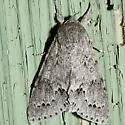
Adult : Powdery gray FW with darker markings and whitish HW. FW with the normal markings somewhat broken and blurred, the outer part of the PM and a partial reniform spot most prominent. The orbicular spot is a small, hollow ring. There is no basal dash. The anal dagger mark is blurred but obvious. The male hindwings are white with grey scales along the veins. The female is larger and is more heavily dusted with grey on the hindwings. Antennae in both sexes are simple. Larva : body covered with stiff orange or brown hair dorsally, and pale yellowish or white hair laterally, with several much longer black hairs and white hairs concentrated near the front and back (may also have three dense dorsal tufts of long black hair on abdominal segments 1, 3, and 8) Large, pale, poorly marked adults of western populations were previously considered a separate species ( Acronicta hesperida ).
Classification
- Kingdom
- Animalia
- Phylum
- Arthropoda
- Class
- Insecta
- Order
- Lepidoptera (Butterflies and Moths)
- Superfamily
- Noctuoidea
- Family
- Noctuidae (Owlet Moths)
- Subfamily
- Acronictinae
- Genus
- Acronicta (Dagger Moths)
Imported taxonomy record. Source availability varies; see the source references and editorial policy below.
Habitat and Range
Habitat
deciduous and mixedwood forest
Geographic Range
all of United States and southern Canada (Newfoundland to Florida, west through Texas to California, north to British Columbia)
Seasonal Activity
adults may be active from April to September but normally have a more restricted flight season (May to August, or just June and July, depending on location) larvae present from July to October
Diet and Behavior
Diet: larvae feed on alder, birch, poplar, hawthorn, willow
Life History
one generation per year; overwinters as a pupa in leaves or debris protected in tough oval cocoon of coarse silk and hair Life cycle images: 1.larva 2.adult
About Butterflies and Moths: the wider group
Order-level background for Lepidoptera, the group containing Acronicta insita. Species-specific details appear above.
Group overview
Lepidoptera includes approximately 180,000 described species of butterflies and moths. Moths outnumber butterflies roughly 10:1. The monarch butterfly's eastern population has declined by more than 80% since the mid-1990s, and the western population by over 95% since the 1980s. The IUCN lists the migratory monarch as Vulnerable.
Ecological role of the group
Butterflies and moths are essential indicators of ecosystem health. As caterpillars, they are a primary food source for birds - a single nest of blue tit chicks requires ~10,000 caterpillars. Adult moths pollinate many night-blooming plants.
Economic and practical significance of the group
Lepidoptera are critical pollinators. In Europe, grassland butterfly species have declined by almost 50% since the early 1990s. In the UK, three-quarters of butterflies are in decline. In the U.S., five butterfly species have gone extinct since 1950, with 29 listed as endangered.
Recorded sources for this group: IUCN Red List, Xerces Society, USFWS, PNAS, WWF. Imported estimates may describe particular regions or reporting periods.
Photos of Large Gray Dagger - Hodges#9202 (5)
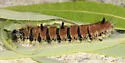
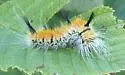
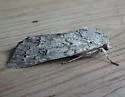
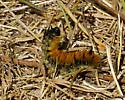
Photo credits: Contributed by Robin McLeod; Additional contributions by Tony-2 , Robert Lord Zimlich , marcie oconnor , Randy Hardy , Blocky
Frequently Asked Questions About Large Gray Dagger - Hodges#9202
What is Large Gray Dagger - Hodges#9202?
Large Gray Dagger - Hodges#9202 (Acronicta insita) is a species in the family Noctuidae, within the order Lepidoptera.
How big is Large Gray Dagger - Hodges#9202?
wingspan 45-55 mm
How do you identify Large Gray Dagger - Hodges#9202?
Adult : Powdery gray FW with darker markings and whitish HW. FW with the normal markings somewhat broken and blurred, the outer part of the PM and a partial reniform spot most prominent. The orbicular spot is a small, hollow ring. There is no basal dash. The anal dagger mark is blurred but obvious. The male hindwings are white with grey scales along the veins. The female is larger and is more heavily dusted with grey on the hindwings. Antennae in both sexes are simple. Larva : body covered with stiff orange or brown hair dorsally, and pale yellowish or white hair laterally, with several much longer black hairs and white hairs concentrated near the front and back (may also have three dense dorsal tufts of long black hair on abdominal segments 1, 3, and 8)
Where is Large Gray Dagger - Hodges#9202 found?
| Feature | Details |
|---|---|
| Habitat | deciduous and mixedwood forest |
| Range | all of United States and southern Canada (Newfoundland to Florida, west through Texas to California, north to British Columbia) |
What does Large Gray Dagger - Hodges#9202 eat?
The diet of the Large Gray Dagger - Hodges#9202 includes larvae feed on alder, birch, poplar, hawthorn, willow.
When is Large Gray Dagger - Hodges#9202 active?
Large Gray Dagger - Hodges#9202: seasonal activity - adults may be active from April to September but normally have a more restricted flight season (May to August, or just June and July, depending on location) larvae present from July to October.
What is the life cycle of a Large Gray Dagger - Hodges#9202?
one generation per year; overwinters as a pupa in leaves or debris protected in tough oval cocoon of coarse silk and hair Life cycle images: 1.larva 2.adult