
Red-shouldered Bostrichid
Xylobiops basilaris
This record describes Xylobiops basilaris (species). Recorded family: Bostrichidae. Recorded order: Coleoptera.
Identification and Appearance
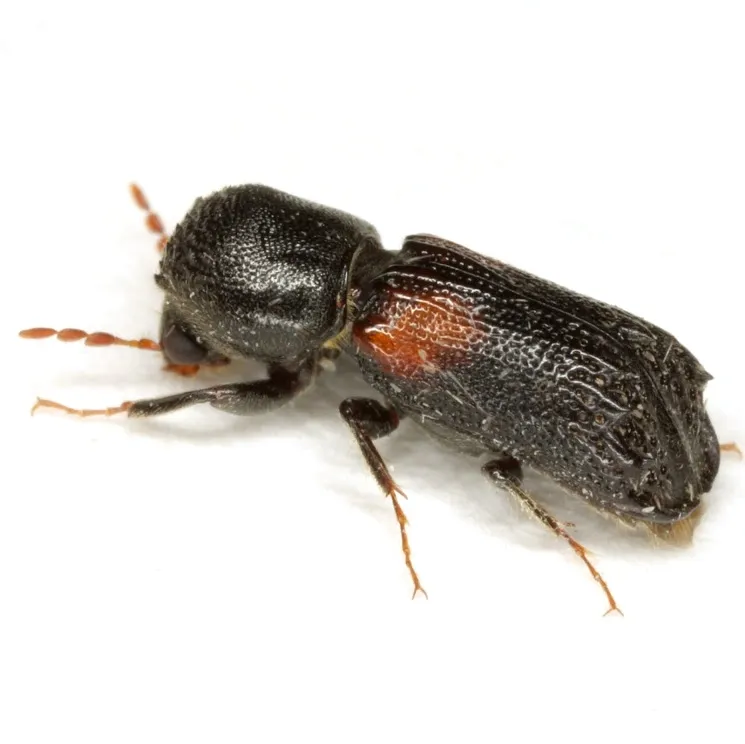
Forest Images - Dorsal elytra without distinct pubescence, and the yellow and black or brown areas conspicuously separated; inner two pairs of tubercles along anterior margins of apical declivity of elytra acute or spinose at apices and coarsely punctured between tubercles, the surface of declivity coarsely, evenly punctured in female, with a few very coarse, deep punctures in male; front of head unarmed. Det. M. A. Quinn, 2013
Wikipedia reference for Xylobiops basilaris: http://en.wikipedia.org/wiki/Xylobiops_basilaris.
Classification
- Kingdom
- Animalia
- Phylum
- Arthropoda
- Class
- Insecta
- Order
- Coleoptera (Beetles)
- Suborder
- Polyphaga
- Superfamily
- Bostrichoidea
- Family
- Bostrichidae (Horned Powder-post Beetles)
- Subfamily
- Bostrichinae
- Tribe
- Xyloperthini
- Genus
- Xylobiops
Imported taxonomy record. Source availability varies; see the source references and editorial policy below.
Habitat and Range
Habitat
Deciduous forests
Geographic Range
e. NA to w. TX (QC-FL to ON-NE-TX) / Mex. - Map
Diet and Behavior
Diet: hosts: wide variety of hardwoods, favors hickories ( Carya ) and persimmon ( Diospyros virginiana ); larvae feed mostly in sapwood and to some extent in heartwood, adults often bore into healthy twigs for food and shelter has been reared from oak, ash, persimmon, hickory, mulberry, bamboo, elm, apple, honeylocust, redbud, black locust, pecan, pear, prickly ash, tamarack, poison sumac, grape, poison ivy, and Eucalyptus.
Life History
Adults bore into the sapwood across the grain just under the bark surface in sapwood. Tunnels may girdle limbs and trunks of small diameter. Eggs are deposited at intervals along the sides of tunnels. Larvae bore along the grain. They spend winter in galleries, mostly as mature larvae, but sometimes as pupae or adults. Adults commonly spend the fall, winter, and spring in galleries within twigs and branches. A generation can develop in 1 year under optimum conditions, but sometimes takes longer.
Additional species information
Species notes from the sources
Etymology: Xylobiops basilaris ( Say 1823)
About Primitive Winged Insects: the wider group
Order-level background for Coleoptera, the group containing Xylobiops basilaris. Species-specific details appear above.
Group overview
Coleoptera is the largest order of insects with over 400,000 described species, representing ~25% of all known animal species and ~40% of all insects. In the U.S. alone, nearly 30,000 beetle species have been identified.
Ecological role of the group
Beetles are prominent decomposers, especially in forests, breaking down dead wood and recycling nutrients. As predators, they reduce populations of pest insects. Many species are also important pollinators of flowering plants.
Economic and practical significance of the group
Beetles have major economic significance: leaf beetles (Chrysomelidae) and weevils (Curculionoidea) are among the most destructive agricultural pests globally, costing billions annually, while predatory species like ladybugs provide natural pest control.
Recorded sources for this group: Britannica, Smithsonian, NCSU Entomology. Imported estimates may describe particular regions or reporting periods.
Photos of Red-shouldered Bostrichid (3)
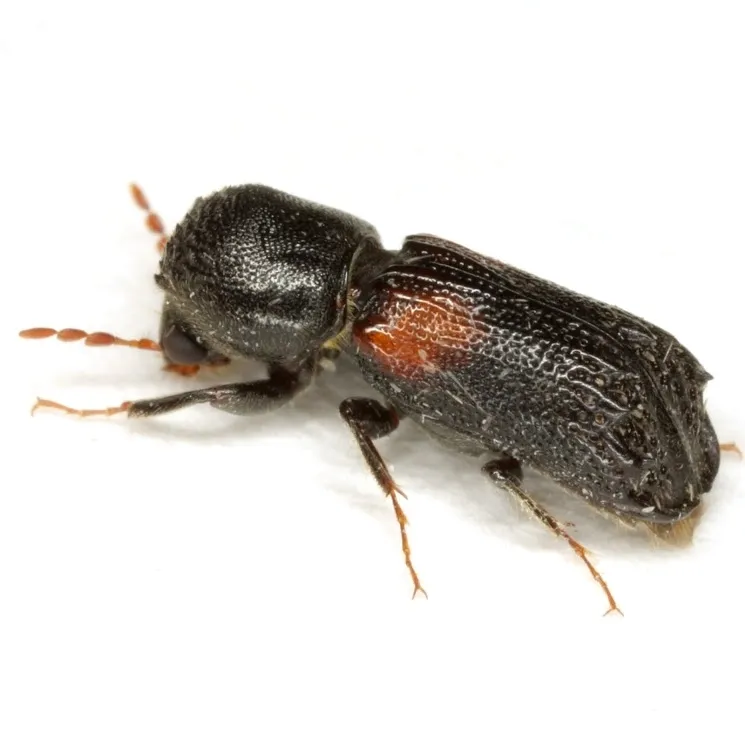
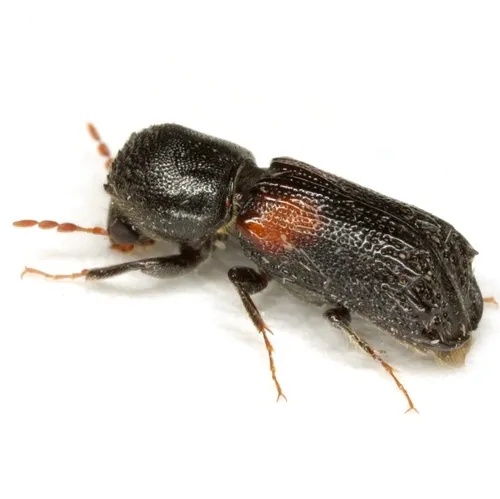
Photo credits: Contributed by Phillip Harpootlian; Additional contributions by cotinis , Mike Quinn , nebbeetle , v belov , onegunah
Frequently Asked Questions About Red-shouldered Bostrichid
What is Red-shouldered Bostrichid?
Red-shouldered Bostrichid (Xylobiops basilaris) is a species in the family Bostrichidae, within the order Coleoptera.
How big is Red-shouldered Bostrichid?
4-7 mm
How do you identify Red-shouldered Bostrichid?
Forest Images - Dorsal elytra without distinct pubescence, and the yellow and black or brown areas conspicuously separated; inner two pairs of tubercles along anterior margins of apical declivity of elytra acute or spinose at apices and coarsely punctured between tubercles, the surface of declivity coarsely, evenly punctured in female, with a few very coarse, deep punctures in male; front of head unarmed. Det. M. A. Quinn, 2013
Where is Red-shouldered Bostrichid found?
| Feature | Details |
|---|---|
| Habitat | Deciduous forests |
| Range | e. NA to w. TX (QC-FL to ON-NE-TX) / Mex. - Map |
What does Red-shouldered Bostrichid eat?
The diet of the Red-shouldered Bostrichid includes hosts: wide variety of hardwoods, favors hickories ( Carya ) and persimmon ( Diospyros virginiana ); larvae feed mostly in sapwood and to some extent in heartwood, adults often bore into healthy twigs for food and shelter has been reared from oak, ash, persimmon, hickory, mulberry, bamboo, elm, apple, honeylocust, redbud, black locust, pecan, pear, prickly ash, tamarack, poison sumac, grape, poison ivy, and Eucalyptus..
What is the life cycle of a Red-shouldered Bostrichid?
Adults bore into the sapwood across the grain just under the bark surface in sapwood. Tunnels may girdle limbs and trunks of small diameter. Eggs are deposited at intervals along the sides of tunnels. Larvae bore along the grain. They spend winter in galleries, mostly as mature larvae, but sometimes as pupae or adults. Adults commonly spend the fall, winter, and spring in galleries within twigs and branches. A generation can develop in 1 year under optimum conditions, but sometimes takes longer.