
Xanthochroa erythrocephala
This record describes Xanthochroa erythrocephala (species). Recorded family: Oedemeridae. Recorded order: Coleoptera.
Identification and Appearance
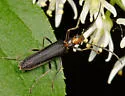
Form slender, totally black, the front and occiput always and the middle of thorax sometimes yellow. (emphasis added) Elytra without testaceous sutural markings; thorax black with central orange stripe Type Locality: Georgia
Classification
- Kingdom
- Animalia
- Phylum
- Arthropoda
- Class
- Insecta
- Order
- Coleoptera (Beetles)
- Suborder
- Polyphaga
- Superfamily
- Tenebrionoidea
- Family
- Oedemeridae (False Blister Beetles)
- Subfamily
- Oedemerinae
- Tribe
- Nacerdini
- Genus
- Xanthochroa
Imported taxonomy record. Source availability varies; see the source references and editorial policy below.
Habitat and Range
Geographic Range
VA‒n.FL to KS‒e.TX - Map ( 4 ) ( 5 ) ( 3 ) ( 6 ) ( 7 ) ,
Diet and Behavior
Diet: known host is silky dogwood ( Cornus amomum , Cornaceae) ( 3 ) (which may explain why the beetle doesn't range further s. in FL)
Additional species information
Species notes from the sources
Etymology: Xanthochroa erythrocephala (Germar 1824)
About Primitive Winged Insects: the wider group
Order-level background for Coleoptera, the group containing Xanthochroa erythrocephala. Species-specific details appear above.
Group overview
Coleoptera is the largest order of insects with over 400,000 described species, representing ~25% of all known animal species and ~40% of all insects. In the U.S. alone, nearly 30,000 beetle species have been identified.
Ecological role of the group
Beetles are prominent decomposers, especially in forests, breaking down dead wood and recycling nutrients. As predators, they reduce populations of pest insects. Many species are also important pollinators of flowering plants.
Economic and practical significance of the group
Beetles have major economic significance: leaf beetles (Chrysomelidae) and weevils (Curculionoidea) are among the most destructive agricultural pests globally, costing billions annually, while predatory species like ladybugs provide natural pest control.
Recorded sources for this group: Britannica, Smithsonian, NCSU Entomology. Imported estimates may describe particular regions or reporting periods.
Photos of Xanthochroa erythrocephala (5)
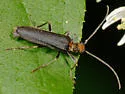
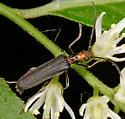
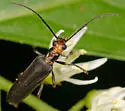
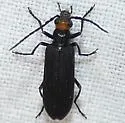
Photo credits: Contributed by v belov; Additional contributions by Mike Quinn
Frequently Asked Questions About Xanthochroa erythrocephala
What is Xanthochroa erythrocephala?
Xanthochroa erythrocephala is a species in the family Oedemeridae, within the order Coleoptera.
How big is Xanthochroa erythrocephala?
4.5-8 mm
How do you identify Xanthochroa erythrocephala?
Form slender, totally black, the front and occiput always and the middle of thorax sometimes yellow. (emphasis added) Elytra without testaceous sutural markings; thorax black with central orange stripe
Where is Xanthochroa erythrocephala found?
Range: VA‒n.FL to KS‒e.TX - Map ( 4 ) ( 5 ) ( 3 ) ( 6 ) ( 7 ) ,
What does Xanthochroa erythrocephala eat?
The diet of the Xanthochroa erythrocephala includes known host is silky dogwood ( Cornus amomum , Cornaceae) ( 3 ) (which may explain why the beetle doesn't range further s. in FL).