
Wandering Pond Snail
Ampullaceana balthica
This record describes Ampullaceana balthica (species). Recorded family: Lymnaeidae.
Identification and Appearance
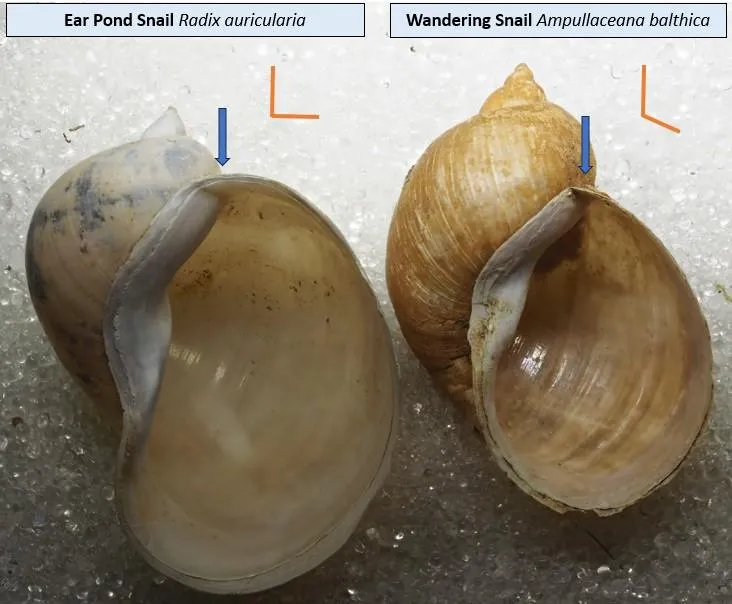
The wandering snail has a tall-spired, brownish shell with a very large opening, but the colour is often obscured by a covering of greyish or brownish encrustation. The body of the snail is translucent grey-brown. The Ear Pond Snail also has a large mouth opening which is more than half the height of the shell. Whilst large specimens of the Ear Pond Snail usually have a flared last whorl which is distinctive, smaller specimens look very similar to the Wandering Snail. However they can be separated by looking at the angle of the aperture lip where it projects from the main shell. In the Ear Pond Snail this is more or less a right angle, whereas in the Wandering Snail it slopes downwards. See ID Aids below. The Amber Snail Succinea putris also has a large aperture which is more than half the height of the shell, but this is a smaller snail and lacks a sharply pointed spire. Both snails have a large mouth opening which is more than half the height of the shell. Whilst large specimens of the Ear Pond Snail usually have a flared last whorl which is distinctive, smaller specimens look very similar to the Wandering Snail. However they can be separated by looking at the angle of the aperture lip where it projects from the main shell. In the Ear Pond Snail this is more or less a right angle, whereas in the Wandering Snail it slopes downwards. It will colonise weedy garden ponds. It is the pond snail most likely to be seen out of the water, climbing on to emergent vegetation or on to mud on the bank. It does not travel far from the water, always staying in very damp situations. Eggs, in strips of clear jelly, are laid on water plants in the Summer. Plant and detritus feeder on pond plants, algae and plant detritus in water. Very common and widespread throughout Britain.
Classification
- Kingdom
- Animalia
- Phylum
- Arthropoda
- Family
- Lymnaeidae
- Genus
- Ampullaceana
Imported taxonomy record. Source availability varies; see the source references and editorial policy below.
Habitat and Range
Habitat
It will colonise weedy garden ponds. It is the pond snail most likely to be seen out of the water, climbing on to emergent vegetation or on to mud on the bank. It does not travel far from the water, always staying in very damp situations.
Diet and Behavior
Life History
Eggs, in strips of clear jelly, are laid on water plants in the Summer. Plant and detritus feeder on pond plants, algae and plant detritus in water.
Additional species information
Recorded status
Very common and widespread throughout Britain.
Frequently Asked Questions About Wandering Pond Snail
What is Wandering Pond Snail?
Wandering Pond Snail (Ampullaceana balthica) is a species in the family Lymnaeidae.
Where is Wandering Pond Snail found?
Habitat: It will colonise weedy garden ponds. It is the pond snail most likely to be seen out of the water, climbing on to emergent vegetation or on to mud on the bank. It does not travel far from the water, always staying in very damp situations.
What is the life cycle of a Wandering Pond Snail?
Eggs, in strips of clear jelly, are laid on water plants in the Summer. Plant and detritus feeder on pond plants, algae and plant detritus in water.