
Trissolcus euschisti
This record describes Trissolcus euschisti (species). Recorded family: Scelionidae. Recorded order: Hymenoptera.
Identification and Appearance
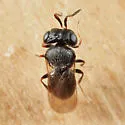
The species in the picture is a female Trissolcus euschisti , a fairly common species in the U.S., Canada, and extending south into Mexico and Central America. They are egg parasitoids of stink bugs and related groups: they lay their egg inside the egg of the stink bug. The wasp larva that hatches then feeds on the contents of the egg, pupates inside of it, and then chews its way out as an adult. A female wasp often will stay with the host egg mass after she's parasitized every stink bug egg. She'll chase away any other parasitic wasps that might come to investigate the mass. They're usually pretty calm when they're guarding the egg mass, and it takes quite a bit of disturbance to get them to fly away. (Norm Johnson, pers. comm.)
Classification
- Kingdom
- Animalia
- Phylum
- Arthropoda
- Class
- Insecta
- Order
- Hymenoptera (Ants, Bees, Wasps and Sawflies)
- Superfamily
- Platygastroidea
- Family
- Scelionidae
- Subfamily
- Telenominae
- Genus
- Trissolcus
Imported taxonomy record. Source availability varies; see the source references and editorial policy below.
Diet and Behavior
Diet: Parasitizes eggs of stink bugs, including the brown stink bug ( Euschistus servus , green stink bug ( Chinavia hilaris ), and two-spotted stink bug ( Perillus bioculatus ).
Additional species information
Species notes from the sources
Etymology: Trissolcus euschisti (Ashmead) named after the pentatomid genus Euschistus
About Flies: the wider group
Order-level background for Hymenoptera, the group containing Trissolcus euschisti. Species-specific details appear above.
Group overview
Hymenoptera includes over 150,000 described species of ants, bees, wasps, and sawflies. Earth harbors approximately 20 quadrillion (20×10^15) ants, with a combined biomass of ~12 megatons of dry carbon - exceeding the combined biomass of all wild birds and mammals (PNAS, 2022).
Ecological role of the group
About 35% of the world's food crops depend on animal pollinators. The chocolate industry, valued at over $100 billion, depends on pollinating flies and midges. Ants are the dominant soil engineers in most terrestrial ecosystems, turning more soil than earthworms in many habitats.
Economic and practical significance of the group
Pollinators contribute $235-577 billion worth of annual global food production (FAO). In the U.S., bee pollination alone benefits crops valued at $18 billion annually, and honey bees are responsible for $5.4 billion in agricultural productivity. Between April 2023-2024, 55.1% of managed honey bee colonies were lost. The U.S. bee population dropped from 5 million to 2.5 million.
Recorded sources for this group: FAO, USDA, EPA, PNAS (2022), US Fish & Wildlife Service. Imported estimates may describe particular regions or reporting periods.
Photos of Trissolcus euschisti (5)
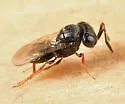
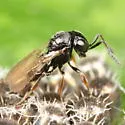
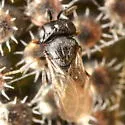
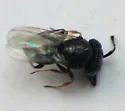
Photo credits: Contributed by tom murray; Additional contributions by Beatriz Moisset , ceiseman , v belov