
Trichadenotecnum majus
This record describes Trichadenotecnum majus (species). Recorded family: Psocidae. Recorded order: Psocodea.
Identification and Appearance
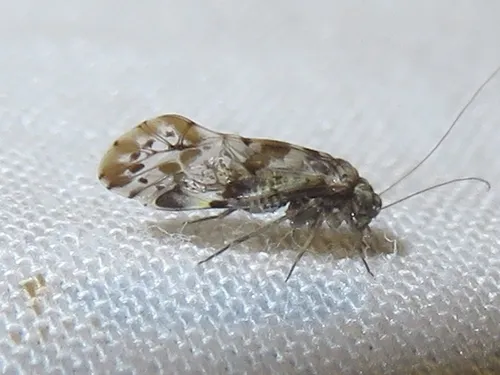
Six dark gray dots that form a backwards C in the last quarter of the wing, and the absence of fine black dots all over the wings suggests a female of this species. Can be found on sugar maples
Wikipedia reference for Trichadenotecnum majus: https://en.wikipedia.org/wiki/Trichadenotecnum_majus.
Classification
- Kingdom
- Animalia
- Phylum
- Arthropoda
- Class
- Insecta
- Order
- Psocodea (Barklice, Booklice, and Parasitic Lice)
- Suborder
- Psocomorpha
- Family
- Psocidae (Common Barklice)
- Subfamily
- Psocinae
- Tribe
- Ptyctini
- Genus
- Trichadenotecnum
Imported taxonomy record. Source availability varies; see the source references and editorial policy below.
Habitat and Range
Geographic Range
ne. US and adjacent Canada. Widespread in Europe, possibly introduced from there to NA
Additional species information
Species notes from the sources
Etymology: Trichadenotecnum majus (Kolbe 1880)
About Barklice, Booklice, and Parasitic Lice: the wider group
Order-level background for Psocodea, the group containing Trichadenotecnum majus. Species-specific details appear above.
Group overview
Psocodea includes ~11,000 described species of booklice, barklice, and parasitic lice. Booklice (Psocoptera) are among the most common household insects, thriving in humid environments where they feed on mold and fungi.
Ecological role of the group
Barklice are important decomposers that feed on algae, lichens, and fungi on tree bark. They help recycle nutrients in forest ecosystems. Parasitic lice have co-evolved with their hosts for millions of years, providing insights into host evolutionary history.
Economic and practical significance of the group
Head lice (Pediculus humanus capitis) affect an estimated 6-12 million children aged 3-11 in the U.S. annually (CDC). The U.S. lice treatment market is valued at over $1 billion per year.
Recorded sources for this group: CDC, dermatology research, entomology textbooks. Imported estimates may describe particular regions or reporting periods.
Photos of Trichadenotecnum majus (3)
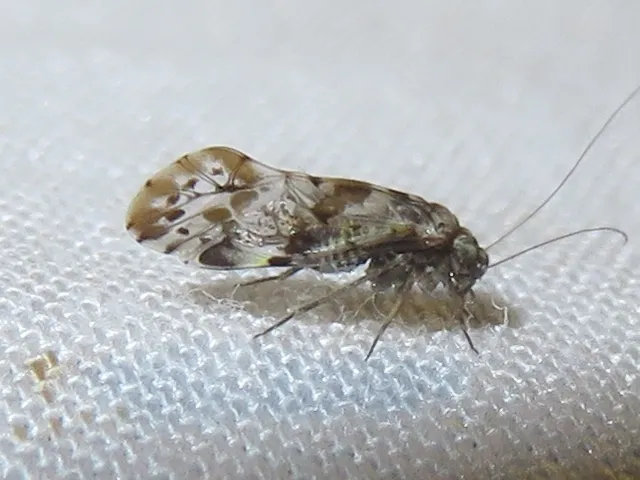
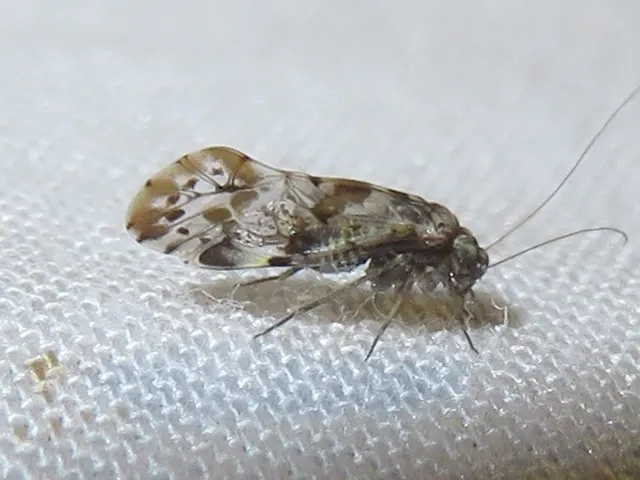
Photo credits: Contributed by tom murray; Additional contributions by Vox Sciurorum , v belov
Frequently Asked Questions About Trichadenotecnum majus
What is Trichadenotecnum majus?
Trichadenotecnum majus is a species in the family Psocidae, within the order Psocodea.
How do you identify Trichadenotecnum majus?
Six dark gray dots that form a backwards C in the last quarter of the wing, and the absence of fine black dots all over the wings suggests a female of this species.
Where is Trichadenotecnum majus found?
Range: ne. US and adjacent Canada. Widespread in Europe, possibly introduced from there to NA