
Range Crane Fly
Tipula simplex
This record describes Tipula simplex (species). Recorded family: Tipulidae. Recorded order: Diptera.
Identification and Appearance
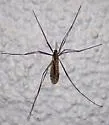
See also the Handbook of Forage and Rangeland Insects, which presumably has much more current information: https://www.entsoc.org/Pubs/Books/Handbooks/forage .
Classification
Habitat and Range
Habitat
"In California, the suitable habitat appears to be the unirrigated pastures of the central valley of California, below the oak-woodland zone ".
Geographic Range
"It has a known California distribution from northern Santa Cruz County, north to Marin County, and east to Sacramento County. A second, discontinuous population is found in the Yokohl Valley of Tulare County (Alexander 1967). During the winter of 1977-78, a third discontinuous population was recorded in Tehama County, which was confirmed by the authors (Fig. I). Unconfirmed reports indicate that the range crane fly may also occur in Oregon, east of the Cascade Mountains ".
Seasonal Activity
"The adults of the range crane fly emerge in late winter or early spring, depending upon the winter temperature. Copulation occurs almost immediately, and may last for 24 hours. The eggs are laid within 3 days in the soil and immediately enter a dormant period (diapause). Diapause is broken by the onset of rain in September or October, but the embryos undergo a second dormancy period (quiescence), and finish development and hatch after the onset of the second series of rains (Hartman and Hynes 1977) ".
Diet and Behavior
Life History
"Crane fly larvae feed on decaying matter in the soil, cowpads which are at least one season old, and roots of range forage plants. Infrequently (about once every 6 years in Tulare County), the larvae reach such high concentrations that they destroy all forage, denude hills, and cause adverse effects on the watershed (Fig. 2) ".
About Flies: the wider group
Order-level background for Diptera, the group containing Tipula simplex. Species-specific details appear above.
Group overview
Diptera includes over 150,000 described species of flies, mosquitoes, and midges. Mosquitoes are the deadliest animal on Earth (CDC). Malaria alone causes ~249 million cases and over 608,000 deaths annually, mostly children under 5 (WHO). Vector-borne diseases account for over 17% of all infectious diseases, causing 700,000+ deaths per year.
Ecological role of the group
Despite their disease impact, flies are critical decomposers and pollinators. Hoverflies alone pollinate hundreds of crop and wildflower species. Flies are also the primary food source for many birds, bats, and fish. Forensic entomology relies heavily on fly species for crime scene analysis.
Economic and practical significance of the group
In the U.S., vector-borne disease cases tripled between 2004-2016, with over 640,000 cases reported in that period (CDC). Tickborne diseases doubled from 22,000 to 48,000 annual reports. Globally, mosquito-borne diseases cost billions in healthcare and lost productivity.
Recorded sources for this group: WHO, CDC, PNAS. Imported estimates may describe particular regions or reporting periods.
Photos of Range Crane Fly (5)
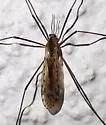
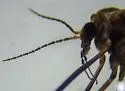

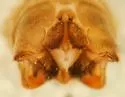
Photo credits: Contributed by Ken Schneider
Frequently Asked Questions About Range Crane Fly
What is Range Crane Fly?
Range Crane Fly (Tipula simplex) is a species in the family Tipulidae, within the order Diptera.
How big is Range Crane Fly?
Wing length of male 11-12 mm . The adult female is essentially wingless (wing of female greatly reduced, subequal in length to the halteres ).
Where is Range Crane Fly found?
| Feature | Details |
|---|---|
| Habitat | In California, the suitable habitat appears to be the unirrigated pastures of the central valley of California, below the oak-woodland zone . |
| Range | It has a known California distribution from northern Santa Cruz County, north to Marin County, and east to Sacramento County. A second, discontinuous population is found in the Yokohl Valley of Tulare County (Alexander 1967). During the winter of 1977-78, a third discontinuous population was recorded in Tehama County, which was confirmed by the authors (Fig. I). Unconfirmed reports indicate that the range crane fly may also occur in Oregon, east of the Cascade Mountains . |
When is Range Crane Fly active?
Range Crane Fly: seasonal activity - The adults of the range crane fly emerge in late winter or early spring, depending upon the winter temperature. Copulation occurs almost immediately, and may last for 24 hours. The eggs are laid within 3 days in the soil and immediately enter a dormant period (diapause). Diapause is broken by the onset of rain in September or October, but the embryos undergo a second dormancy period (quiescence), and finish development and hatch after the onset of the second series of rains (Hartman and Hynes 1977) ..
What is the life cycle of a Range Crane Fly?
Crane fly larvae feed on decaying matter in the soil, cowpads which are at least one season old, and roots of range forage plants. Infrequently (about once every 6 years in Tulare County), the larvae reach such high concentrations that they destroy all forage, denude hills, and cause adverse effects on the watershed (Fig. 2) .