
Eratigena agrestis
This record describes Eratigena agrestis (species). Recorded family: Agelenidae. Recorded order: Araneae.
Identification and Appearance
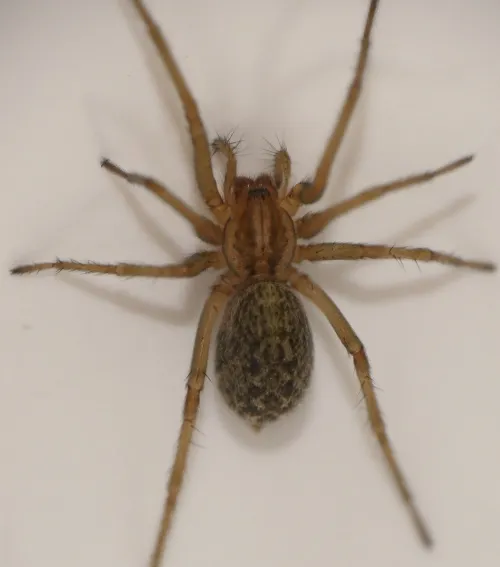
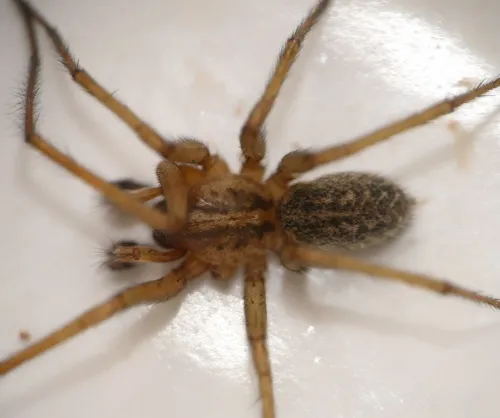
They usually have a brown cephalothorax with diffuse, indistinct darker brown markings on the legs and abdomen. The underside of the abdomen has a characteristic yellow marking with no spots. The genus Tegenaria has recently been split: Tegenaria spp. have banded legs, Eratigena spp. have plain legs. Beyond this distinction, species can only be identified by examination of the genitals of mature specimens. This species can only be confirmed by examination of the genitals of mature specimens. Tegenaria agrestis in Britain is usually found among sparse grassy vegetation and under stones, particularly on waste ground (e.g. in the centre of cities) and alongside railway tracks. Adults of both sexes are found mainly in late summer and autumn. The sheet web extends from the retreat and is supported by vegetation. The egg-sac is a multi-layered structure, one layer of which is often composed of mud and other debris. First recorded in Britain from Wilverley Plain, Hampshire in 1949, this species has colonised northwards over the last half century (Merrett 1979). It now has a wide but patchy Distribution: through much of England and Wales, and is colonising Scotland (e.g. Stewart 1987). There were 10 known sites for this species as of 1996. 1052 British records for this species to 2018
Classification
- Kingdom
- Animalia
- Phylum
- Arthropoda
- Class
- Arachnida
- Order
- Araneae (Spiders)
- Family
- Agelenidae (Funnel Weavers)
- Subfamily
- Ageleninae
- Genus
- Tegenaria
Imported taxonomy record. Source availability varies; see the source references and editorial policy below.
Habitat and Range
Habitat
Tegenaria agrestis in Britain is usually found among sparse grassy vegetation and under stones, particularly on waste ground (e.g. in the centre of cities) and alongside railway tracks.
Seasonal Activity
Adults of both sexes are found mainly in late summer and autumn.
Diet and Behavior
Life History
The sheet web extends from the retreat and is supported by vegetation. The egg-sac is a multi-layered structure, one layer of which is often composed of mud and other debris.
Additional species information
Recorded status
First recorded in Britain from Wilverley Plain, Hampshire in 1949, this species has colonised northwards over the last half century (Merrett 1979). It now has a wide but patchy Distribution: through much of England and Wales, and is colonising Scotland (e.g. Stewart 1987).
About Spiders: the wider group
Order-level background for Araneae, the group containing Eratigena agrestis. Species-specific details appear above.
Group overview
As of 2023, 51,673 spider species in 136 families have been recorded, though an estimated 150,000 species exist. Spiders rank 7th in total species diversity among all organism orders. Only 0.5% of spider species pose any risk to human health.
Ecological role of the group
Spider venom contains complex peptides with diverse pharmacological activities, making them valuable for drug development research. Spiders produce up to 7 types of silk from specialized glands. Spider silk genes have been inserted into mammals and plants for biotech applications.
Economic and practical significance of the group
The global spider community kills an estimated 400-800 million tons of prey annually (2017 study). Spiders provide billions of dollars in natural pest control for agriculture. Spider silk is 5× stronger than steel of the same diameter, driving a biomaterials research industry.
Recorded sources for this group: World Spider Catalog, PNAS, Nature, ScienceDirect. Imported estimates may describe particular regions or reporting periods.
Photos of Eratigena agrestis (2)
Frequently Asked Questions About Eratigena agrestis
What is Eratigena agrestis?
Eratigena agrestis is a species in the family Agelenidae, within the order Araneae.
Where is Eratigena agrestis found?
Habitat: Tegenaria agrestis in Britain is usually found among sparse grassy vegetation and under stones, particularly on waste ground (e.g. in the centre of cities) and alongside railway tracks.
When is Eratigena agrestis active?
Eratigena agrestis: seasonal activity - Adults of both sexes are found mainly in late summer and autumn..
What is the life cycle of a Eratigena agrestis?
The sheet web extends from the retreat and is supported by vegetation. The egg-sac is a multi-layered structure, one layer of which is often composed of mud and other debris.