
itch mite
Sarcoptes scabiei
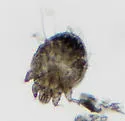
This record describes Sarcoptes scabiei (species). Recorded family: Sarcoptidae. Recorded order: Astigmata.
Identification and Appearance
Classification
- Kingdom
- Animalia
- Phylum
- Arthropoda
- Class
- Arachnida
- Order
- Astigmata (Astigs)
- Suborder
- Psoroptidia
- Superfamily
- Analgoidea
- Family
- Sarcoptidae
- Genus
- Sarcoptes
Imported taxonomy record. Source availability varies; see the source references and editorial policy below.
Habitat and Range
Habitat
Mammalian skin; hosts include humans, dogs, non-human primates, ungulates, and marsupials
Geographic Range
cosmopolitan
Diet and Behavior
Life History
The following pertains to the human host: Sarcoptes scabiei has five developmental stages: egg, larva, two nymphal stages, and adult. All stages reside on the human host. Adult, unmated females reside in their nymphal molting pouches until fertilized by a male. Impregnated females then leave the molting pouch and wander on the surface of the skin until they find a suitable site at which to make a permanent burrow. Females mate only once and remain fertile the rest of their lives (roughly 1-2 months). The mated females burrow into the superficial layer of the skin (stratum corneum), laying 2-3 eggs per day. There is only one female per burrow. After about 3-10 days, larvae hatch and migrate to the surface of the skin and form shallow molting pouches. Within these pouches, the larval mites undergo two nymphal stages before becoming adults. The process from egg to adult is roughly one week in duration. Adult males leave their molting pouches to find and mate with a female.
About Astigs: the wider group
Order-level background for Astigmata, the group containing Sarcoptes scabiei. Species-specific details appear above.
Group overview
Astigmata includes ~6,000 described species of mites, including dust mites, scabies mites, and cheese mites. House dust mites (Dermatophagoides) are present in virtually every human dwelling.
Ecological role of the group
Astigmatid mites are important decomposers of organic matter and recyclers of nutrients. Many species are phoretic - hitching rides on insects to reach new food sources like decaying material, stored grain, and animal nests.
Economic and practical significance of the group
Dust mites are the primary trigger for allergic asthma - affecting ~300 million people worldwide (WHO). The scabies mite causes an estimated 200 million cases of scabies globally. The global allergy treatment market partly driven by dust mites exceeds $25 billion.
Recorded sources for this group: WHO, allergy research, medical acarology. Imported estimates may describe particular regions or reporting periods.
Photos of itch mite (5)
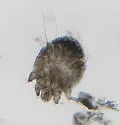
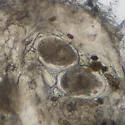
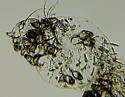
Photo credits: Contributed by Ray Fisher; Additional contributions by bmathison1972
Frequently Asked Questions About itch mite
How big is itch mite?
adult females: 350-450 micrometers; adult males: 250-350 micrometers
Where is itch mite found?
| Feature | Details |
|---|---|
| Habitat | Mammalian skin; hosts include humans, dogs, non-human primates, ungulates, and marsupials |
| Range | cosmopolitan |
What is the life cycle of a itch mite?
The following pertains to the human host: Sarcoptes scabiei has five developmental stages: egg, larva, two nymphal stages, and adult. All stages reside on the human host. Adult, unmated females reside in their nymphal molting pouches until fertilized by a male. Impregnated females then leave the molting pouch and wander on the surface of the skin until they find a suitable site at which to make a permanent burrow. Females mate only once and remain fertile the rest of their lives (roughly 1-2 months). The mated females burrow into the superficial layer of the skin (stratum corneum), laying 2-3 eggs per day. There is only one female per burrow. After about 3-10 days, larvae hatch and migrate to the surface of the skin and form shallow molting pouches. Within these pouches, the larval mites undergo two nymphal stages before becoming adults. The process from egg to adult is roughly one week in duration. Adult males leave their molting pouches to find and mate with a female.