
Sapyga centrata
This record describes Sapyga centrata (species). Recorded family: Sapygidae. Recorded order: Hymenoptera.
Identification and Appearance
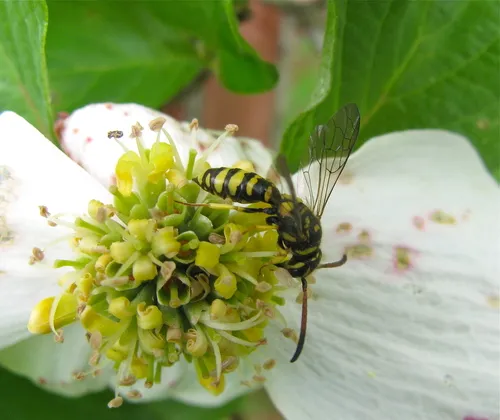
| Feature | Details |
|---|---|
| Head | Black, rough textured. Inner eye indented (emarginate) with yellow margin. Yellow dash on back eye margin. Yellow triangle above and between antenna bases on male. Mouth (clypeus) with yellow marks. Mandibles black with a yellow spot. Antenna: Black, underside mostly orangish-yellow. |
| Thorax | Collar (prothorax) is very wide, black and pebbly with a yellow stripe, widely interrupted at center. Segment 1 (scutum) may have a pair of yellow dots, but usually none. Segment 2 (scutellum) has two wider spaced dots. Segment 3 (propodeum) has large oblong yellow spot on each side. Thorax side has a large yellow spot below wing base. Wings: Wing knobs (tegulae) yellow with a brownish line through center. Wings clear, nerves and stigma dark brown, marginal cell tinted brown. |
| Legs | Thighs (femora) black, tip yellow. Shins (tibiae) yellow. Feet darker, brownish-yellow. |
| Abdomen | Black, smooth and shiny with yellow stripes. Segment 1 entirely black on female; a yellow spot at each side on male. Segments 2, 3 and 4 have wide stripes indented or only slightly interrupted at center. Segment 5 has triangular-like marks at each side. Segment 6 stripe usually entire. Underside of 2 to 5 striped on male; 3 to 5 on female. Types: Holotype female as Sapyga americana by Cresson, 1880. Locality: New York. In the Academy of Natural Sciences of Philadelphia, Drexel University. Holotype as Sapyga pelopaei by Ashmead, 1896. Locality: Toronto, Ontario, no date. Bred by W. A. Williams from Black & Yellow Mud Dauber nest ( Sceliphron caementarium ). In United States National Museum, Smithsonian as Inquire types – legacy date of uncertain quality. No photos. Note: Disputed by Krombein in 1967, who thought the nest was abandoned by the wasps and used by Leaf-cutter Megachile bees. |
Classification
- Kingdom
- Animalia
- Phylum
- Arthropoda
- Class
- Insecta
- Order
- Hymenoptera (Ants, Bees, Wasps and Sawflies)
- Superfamily
- Pompiloidea
- Family
- Sapygidae (Club-horned Wasps)
- Genus
- Sapyga
Imported taxonomy record. Source availability varies; see the source references and editorial policy below.
Habitat and Range
Habitat
Orchards and meadows.
Geographic Range
eastern (Canada: ON; United States: MD, NY, OH, PA)
Seasonal Activity
May - June
Diet and Behavior
Diet: Adults eat nectar.
Life History
A parasite of Osmia bucephala and O. pumila . Does not parasitize Osmia lignaria , possibly because O. lignaria uses mud and not leaves for cell division (per Krombein). Hoplitis truncata was mentioned as a host by Krombein in 1952-53 where S. centrata was found on same pine nesting area as H. truncata . Also parasitizes Leaf-cutter Bees Megachile . Females lay an egg by piercing the cell wall. When the egg hatches, it eats the host egg and provisions. When mature, larva form a cocoon developing into adult form, and over-winter as an adult still in the cocoon. One generation per year.
About Flies: the wider group
Order-level background for Hymenoptera, the group containing Sapyga centrata. Species-specific details appear above.
Group overview
Hymenoptera includes over 150,000 described species of ants, bees, wasps, and sawflies. Earth harbors approximately 20 quadrillion (20×10^15) ants, with a combined biomass of ~12 megatons of dry carbon - exceeding the combined biomass of all wild birds and mammals (PNAS, 2022).
Ecological role of the group
About 35% of the world's food crops depend on animal pollinators. The chocolate industry, valued at over $100 billion, depends on pollinating flies and midges. Ants are the dominant soil engineers in most terrestrial ecosystems, turning more soil than earthworms in many habitats.
Economic and practical significance of the group
Pollinators contribute $235-577 billion worth of annual global food production (FAO). In the U.S., bee pollination alone benefits crops valued at $18 billion annually, and honey bees are responsible for $5.4 billion in agricultural productivity. Between April 2023-2024, 55.1% of managed honey bee colonies were lost. The U.S. bee population dropped from 5 million to 2.5 million.
Recorded sources for this group: FAO, USDA, EPA, PNAS (2022), US Fish & Wildlife Service. Imported estimates may describe particular regions or reporting periods.
Photos of Sapyga centrata (2)
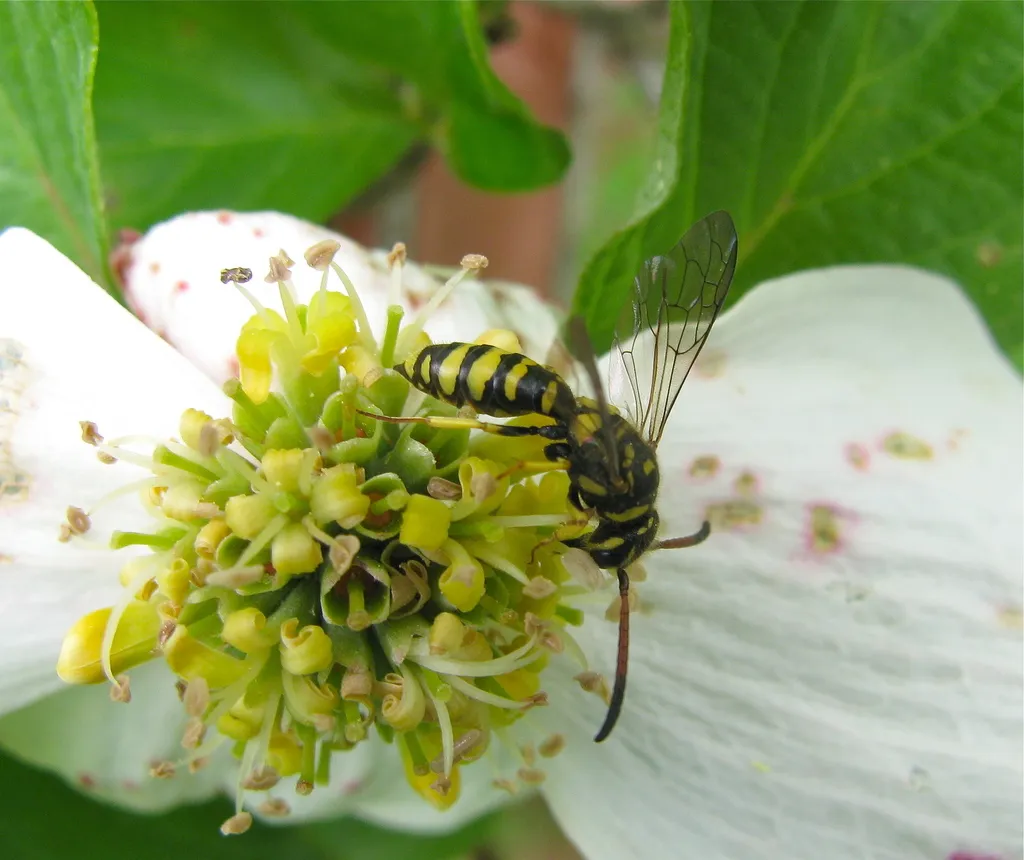
Photo credits: Contributed by Ken Wolgemuth; Additional contributions by v belov , lee_penner , PaleoJon
Frequently Asked Questions About Sapyga centrata
What is Sapyga centrata?
Sapyga centrata is a species in the family Sapygidae, within the order Hymenoptera.
How big is Sapyga centrata?
8 to 9 mm.
How do you identify Sapyga centrata?
| Feature | Details |
|---|---|
| Head | Black, rough textured. Inner eye indented (emarginate) with yellow margin. Yellow dash on back eye margin. Yellow triangle above and between antenna bases on male. Mouth (clypeus) with yellow marks. Mandibles black with a yellow spot. Antenna: Black, underside mostly orangish-yellow. |
| Thorax | Collar (prothorax) is very wide, black and pebbly with a yellow stripe, widely interrupted at center. Segment 1 (scutum) may have a pair of yellow dots, but usually none. Segment 2 (scutellum) has two wider spaced dots. Segment 3 (propodeum) has large oblong yellow spot on each side. Thorax side has a large yellow spot below wing base. Wings: Wing knobs (tegulae) yellow with a brownish line through center. Wings clear, nerves and stigma dark brown, marginal cell tinted brown. |
| Legs | Thighs (femora) black, tip yellow. Shins (tibiae) yellow. Feet darker, brownish-yellow. |
| Abdomen | Black, smooth and shiny with yellow stripes. Segment 1 entirely black on female; a yellow spot at each side on male. Segments 2, 3 and 4 have wide stripes indented or only slightly interrupted at center. Segment 5 has triangular-like marks at each side. Segment 6 stripe usually entire. Underside of 2 to 5 striped on male; 3 to 5 on female. |
Where is Sapyga centrata found?
| Feature | Details |
|---|---|
| Habitat | Orchards and meadows. |
| Range | eastern (Canada: ON; United States: MD, NY, OH, PA) |
What does Sapyga centrata eat?
The diet of the Sapyga centrata includes Adults eat nectar..
When is Sapyga centrata active?
Sapyga centrata: seasonal activity - May - June.
What is the life cycle of a Sapyga centrata?
A parasite of Osmia bucephala and O. pumila . Does not parasitize Osmia lignaria , possibly because O. lignaria uses mud and not leaves for cell division (per Krombein). Hoplitis truncata was mentioned as a host by Krombein in 1952-53 where S. centrata was found on same pine nesting area as H. truncata . Also parasitizes Leaf-cutter Bees Megachile . Females lay an egg by piercing the cell wall. When the egg hatches, it eats the host egg and provisions. When mature, larva form a cocoon developing into adult form, and over-winter as an adult still in the cocoon. One generation per year.