
Dark Ricefield Mosquito
Psorophora columbiae
This record describes Psorophora columbiae (species). Recorded family: Culicidae. Recorded order: Diptera.
Identification and Appearance
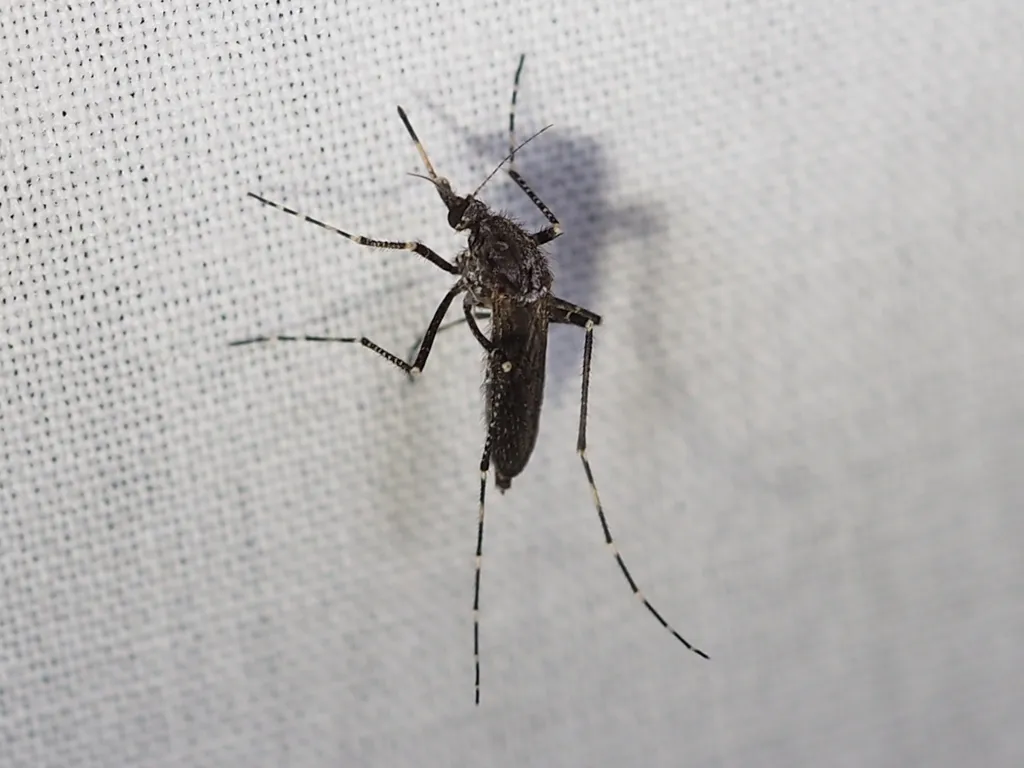
large dark mosquito - FMEL - banded abdomen and legs - FMEL - base of proboscis has wide pale band - FMEL Florida Medical Entomology Lab - FMEL Adult: Medium-sized, dark brown or dull black in color. Proboscis dark on apical quarter, remainder yellowish, although dark scales present at base. Femora with narrow subapical pale ring, tibiae liberally sprinkled with white scales, 1st tarsomere with median stripe, and all tarsomeres with basal white stripes. Wing veins with dark and pale scales intermixed. Larva: Antenna much shorter than head, Setae 5-C and 6-C with four or more branches, base in a straight line to 7-C, siphon moderately inflated (bulbous) medially, 3-6 widely spaced pecten teeth, Seta 1-S as long as apical width of siphon. *Information on this page provided by Sean McCann.
Wikipedia reference for Psorophora columbiae: http://en.wikipedia.org/wiki/Psorophora_columbiae.
Classification
Habitat and Range
Habitat
Larvae in temporary and permanent pools, with grassy or wooded margins, often abundant in rice fields. Differing accounts say that oviposition occurs on rank vegetation surrounding pools, or on bare mud.
Geographic Range
e. US to so. CA / W. Indies / Mex. to S. Amer. (Meisch 1994) reaches its greatest abundance in the rice growing areas of the southwestern U.S. where astronomical numbers, similar in magnitude to the production of saltmarsh mosquitoes, may occur. (Meisch 1994)
Seasonal Activity
Multivoltine in parts of their range, depending on rainfall.
Diet and Behavior
Diet: Larvae: Filter feeders Adults: Males and females feed on nectar, females said to seek bloodmeals from any warm-blooded host, especially cattle.
Life History
Overwinters as diapausing egg. Eggs can withstand desiccation. The females are furious biters in day or night. Hosts include any warm blooded animal; however bovine blood seems to be preferred. (Meisch 1994)
About Flies: the wider group
Order-level background for Diptera, the group containing Psorophora columbiae. Species-specific details appear above.
Group overview
Diptera includes over 150,000 described species of flies, mosquitoes, and midges. Mosquitoes are the deadliest animal on Earth (CDC). Malaria alone causes ~249 million cases and over 608,000 deaths annually, mostly children under 5 (WHO). Vector-borne diseases account for over 17% of all infectious diseases, causing 700,000+ deaths per year.
Ecological role of the group
Despite their disease impact, flies are critical decomposers and pollinators. Hoverflies alone pollinate hundreds of crop and wildflower species. Flies are also the primary food source for many birds, bats, and fish. Forensic entomology relies heavily on fly species for crime scene analysis.
Economic and practical significance of the group
In the U.S., vector-borne disease cases tripled between 2004-2016, with over 640,000 cases reported in that period (CDC). Tickborne diseases doubled from 22,000 to 48,000 annual reports. Globally, mosquito-borne diseases cost billions in healthcare and lost productivity.
Recorded sources for this group: WHO, CDC, PNAS. Imported estimates may describe particular regions or reporting periods.
Photos of Dark Ricefield Mosquito (2)
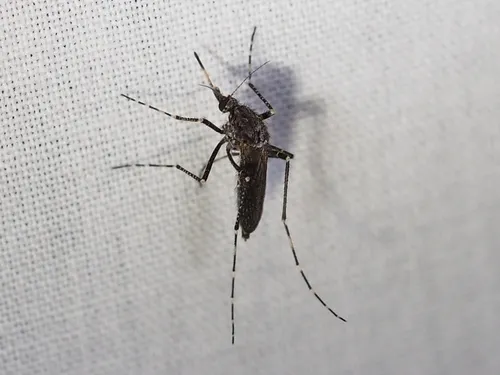
Photo credits: Contributed by Lynette Elliott; Additional contributions by Beatriz Moisset , Omar Fahmy , Mike Quinn , Ted Kropiewnicki
Frequently Asked Questions About Dark Ricefield Mosquito
What is Dark Ricefield Mosquito?
Dark Ricefield Mosquito (Psorophora columbiae) is a species in the family Culicidae, within the order Diptera.
How big is Dark Ricefield Mosquito?
Medium-sized mosquito.
How do you identify Dark Ricefield Mosquito?
large dark mosquito - FMEL - banded abdomen and legs - FMEL - base of proboscis has wide pale band - FMEL Florida Medical Entomology Lab - FMEL Adult: Medium-sized, dark brown or dull black in color. Proboscis dark on apical quarter, remainder yellowish, although dark scales present at base. Femora with narrow subapical pale ring, tibiae liberally sprinkled with white scales, 1st tarsomere with median stripe, and all tarsomeres with basal white stripes. Wing veins with dark and pale scales intermixed. Larva: Antenna much shorter than head, Setae 5-C and 6-C with four or more branches, base in a straight line to 7-C, siphon moderately inflated (bulbous) medially, 3-6 widely spaced pecten teeth, Seta 1-S as long as apical width of siphon.
Where is Dark Ricefield Mosquito found?
| Feature | Details |
|---|---|
| Habitat | Larvae in temporary and permanent pools, with grassy or wooded margins, often abundant in rice fields. Differing accounts say that oviposition occurs on rank vegetation surrounding pools, or on bare mud. |
| Range | e. US to so. CA / W. Indies / Mex. to S. Amer. (Meisch 1994) reaches its greatest abundance in the rice growing areas of the southwestern U.S. where astronomical numbers, similar in magnitude to the production of saltmarsh mosquitoes, may occur. (Meisch 1994) |
What does Dark Ricefield Mosquito eat?
The diet of the Dark Ricefield Mosquito includes Larvae: Filter feeders Adults: Males and females feed on nectar, females said to seek bloodmeals from any warm-blooded host, especially cattle..
When is Dark Ricefield Mosquito active?
Dark Ricefield Mosquito: seasonal activity - Multivoltine in parts of their range, depending on rainfall..
What is the life cycle of a Dark Ricefield Mosquito?
Overwinters as diapausing egg. Eggs can withstand desiccation. The females are furious biters in day or night. Hosts include any warm blooded animal; however bovine blood seems to be preferred. (Meisch 1994)