
Becker's White - Hodges#4191
Pontia beckerii
This record describes Pontia beckerii (species). Recorded family: Pieridae. Recorded order: Lepidoptera.
Identification and Appearance
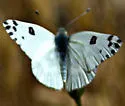
White with black markings above and mostly green on white below. Upper front wings with subapical dark markings normally broken into two distinctly offset rectangles, forming something of a Z shape (same markings forming a continuous patch in other North American Pontia species). Underside always strongly patterned, with a clear white patch crossing four cells near middle of hind wings (same area of wings on other species, if green ventral pattern is present, has veins at least partially edged in greenish, yellowish, brownish, and/or blackish scaling). Also, on basal side of same white patch, in middle of wing, there are two distinct (usually connected) dark ovals (not the same in other species).
Classification
- Kingdom
- Animalia
- Phylum
- Arthropoda
- Class
- Insecta
- Order
- Lepidoptera (Butterflies and Moths)
- Superfamily
- Papilionoidea
- Family
- Pieridae (Whites, Sulphurs, Yellows)
- Subfamily
- Pierinae
- Tribe
- Pierini
- Genus
- Pontia (Checkered Whites)
Imported taxonomy record. Source availability varies; see the source references and editorial policy below.
Habitat and Range
Habitat
Varied, but almost always in open semi-arid to arid areas. Tends to avoid highly disturbed agricultural areas.
Geographic Range
Most of western U.S., westward from western edge of Great Plains. Not in southern New Mexico or southern Arizona. Rarely encountered west of Sierra Nevada or Cascades near west coast, except mostly west of Colorado Desert in southernmost California and Baja California Norte in Mexico. Extends into interior southern British Columbia in Canada. Apparently not yet recorded from Alberta, though it comes close.
Diet and Behavior
Life History
Multiple broods, probably at least two in north and three or more southward. Flights from as early as February to as late as November (mostly April to September or October in north). In many areas seemingly most abundant as adults in spring.
About Butterflies and Moths: the wider group
Order-level background for Lepidoptera, the group containing Pontia beckerii. Species-specific details appear above.
Group overview
Lepidoptera includes approximately 180,000 described species of butterflies and moths. Moths outnumber butterflies roughly 10:1. The monarch butterfly's eastern population has declined by more than 80% since the mid-1990s, and the western population by over 95% since the 1980s. The IUCN lists the migratory monarch as Vulnerable.
Ecological role of the group
Butterflies and moths are essential indicators of ecosystem health. As caterpillars, they are a primary food source for birds - a single nest of blue tit chicks requires ~10,000 caterpillars. Adult moths pollinate many night-blooming plants.
Economic and practical significance of the group
Lepidoptera are critical pollinators. In Europe, grassland butterfly species have declined by almost 50% since the early 1990s. In the UK, three-quarters of butterflies are in decline. In the U.S., five butterfly species have gone extinct since 1950, with 29 listed as endangered.
Recorded sources for this group: IUCN Red List, Xerces Society, USFWS, PNAS, WWF. Imported estimates may describe particular regions or reporting periods.
Photos of Becker's White - Hodges#4191 (5)
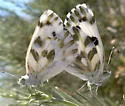
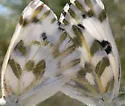
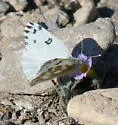
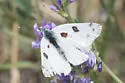
Photo credits: Contributed by tom murray; Additional contributions by Steve Nanz , David Ferguson
Frequently Asked Questions About Becker's White - Hodges#4191
What is Becker's White - Hodges#4191?
Becker's White - Hodges#4191 (Pontia beckerii) is a species in the family Pieridae, within the order Lepidoptera.
How do you identify Becker's White - Hodges#4191?
White with black markings above and mostly green on white below. Upper front wings with subapical dark markings normally broken into two distinctly offset rectangles, forming something of a Z shape (same markings forming a continuous patch in other North American Pontia species). Underside always strongly patterned, with a clear white patch crossing four cells near middle of hind wings (same area of wings on other species, if green ventral pattern is present, has veins at least partially edged in greenish, yellowish, brownish, and/or blackish scaling). Also, on basal side of same white patch, in middle of wing, there are two distinct (usually connected) dark ovals (not the same in other species).
Where is Becker's White - Hodges#4191 found?
| Feature | Details |
|---|---|
| Habitat | Varied, but almost always in open semi-arid to arid areas. Tends to avoid highly disturbed agricultural areas. |
| Range | Most of western U.S., westward from western edge of Great Plains. Not in southern New Mexico or southern Arizona. Rarely encountered west of Sierra Nevada or Cascades near west coast, except mostly west of Colorado Desert in southernmost California and Baja California Norte in Mexico. Extends into interior southern British Columbia in Canada. Apparently not yet recorded from Alberta, though it comes close. |
What is the life cycle of a Becker's White - Hodges#4191?
Multiple broods, probably at least two in north and three or more southward. Flights from as early as February to as late as November (mostly April to September or October in north). In many areas seemingly most abundant as adults in spring.