
Long Dash - Hodges#4043
Polites mystic
This record describes Polites mystic (species). Recorded family: Hesperiidae. Recorded order: Lepidoptera.
Identification and Appearance
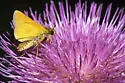
Adult: male upperside bright orangish-brown with wide dark brown border covering outer third of each wing; dark patch along outer edge of black stigma, and another wide rectangular patch near wingtip makes stigma appear much longer and wider than it is, and gives the species its common name female upperside mostly dark brown with varying amounts of dull orange or straw-colored shading on costa; both sexes have pale orange medial patch on hindwing above, crossed by dark veins, and a crescent-shaped band of pale medial spots on underside, parallel to outer margin of wing [adapted from description at Butterflies of Canada] western individuals may have less conspicuous spots on underside of wings, and in some individuals the underside may appear uniformly yellowish-orange Larva: body brownish-green or dark brown with white mottling and darker dorsal stripe Specimens from the Prairies tend to be paler on the underside and have been treated as subspecies dacotah , but we find the difference too slight and too variable and do not recognize any subspecies in Polites mystic . [quoted from Butterflies of Canada by Layberry et al ] Judging from photos of western specimens of P. mystic at BugGuide, the phrase tend to be paler seems like an understatement: the photo from Colorado by Tom Murray here shows virtually no trace of spots on the underside; likewise with the photo from North Dakota by Brian Reynolds here . Compare those photos with an image from Wisconsin here . The individual on the left looks very similar to Tom's and Brian's photos, but the text in the URL of the image identifies it as a Delaware Skipper.
Classification
- Kingdom
- Animalia
- Phylum
- Arthropoda
- Class
- Insecta
- Order
- Lepidoptera (Butterflies and Moths)
- Superfamily
- Papilionoidea
- Family
- Hesperiidae (Skippers)
- Subfamily
- Hesperiinae
- Tribe
- Hesperiini
- Genus
- Polites
Imported taxonomy record. Source availability varies; see the source references and editorial policy below.
Habitat and Range
Habitat
open moist areas: meadows, marshes, streamsides, wood edges, prairie swales
Geographic Range
throughout northern United States and southern Canada
Seasonal Activity
adults fly from late May or early June to late July in the east, and to mid-August in the west
Diet and Behavior
Diet: larvae feed on grasses, including blue grass ( Poa spp.), Quack Grass ( Agropyron repens ), Barnyard Grass ( Echinochloa crus-galli ), and Timothy Grass ( Phleum pratense ) adults take nectar from flowers of herbaceous plants
Life History
eggs deposited singly on or near host plant; larva feeds on leaves and lives in shelter of tied leaves; overwinters as a fourth-stage larva; one generation per year
About Butterflies and Moths: the wider group
Order-level background for Lepidoptera, the group containing Polites mystic. Species-specific details appear above.
Group overview
Lepidoptera includes approximately 180,000 described species of butterflies and moths. Moths outnumber butterflies roughly 10:1. The monarch butterfly's eastern population has declined by more than 80% since the mid-1990s, and the western population by over 95% since the 1980s. The IUCN lists the migratory monarch as Vulnerable.
Ecological role of the group
Butterflies and moths are essential indicators of ecosystem health. As caterpillars, they are a primary food source for birds - a single nest of blue tit chicks requires ~10,000 caterpillars. Adult moths pollinate many night-blooming plants.
Economic and practical significance of the group
Lepidoptera are critical pollinators. In Europe, grassland butterfly species have declined by almost 50% since the early 1990s. In the UK, three-quarters of butterflies are in decline. In the U.S., five butterfly species have gone extinct since 1950, with 29 listed as endangered.
Recorded sources for this group: IUCN Red List, Xerces Society, USFWS, PNAS, WWF. Imported estimates may describe particular regions or reporting periods.
Photos of Long Dash - Hodges#4043 (5)
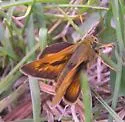
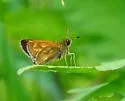
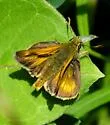
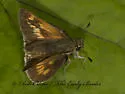
Photo credits: Contributed by Robin McLeod; Additional contributions by Abigail Parker , Steve Morris
Frequently Asked Questions About Long Dash - Hodges#4043
What is Long Dash - Hodges#4043?
Long Dash - Hodges#4043 (Polites mystic) is a species in the family Hesperiidae, within the order Lepidoptera.
How big is Long Dash - Hodges#4043?
wingspan 29-38 mm in United States; 23-29 mm in Canada
How do you identify Long Dash - Hodges#4043?
Adult: male upperside bright orangish-brown with wide dark brown border covering outer third of each wing; dark patch along outer edge of black stigma, and another wide rectangular patch near wingtip makes stigma appear much longer and wider than it is, and gives the species its common name female upperside mostly dark brown with varying amounts of dull orange or straw-colored shading on costa; both sexes have pale orange medial patch on hindwing above, crossed by dark veins, and a crescent-shaped band of pale medial spots on underside, parallel to outer margin of wing [adapted from description at Butterflies of Canada] western individuals may have less conspicuous spots on underside of wings, and in some individuals the underside may appear uniformly yellowish-orange Larva: body brownish-green or dark brown with white mottling and darker dorsal stripe
Where is Long Dash - Hodges#4043 found?
| Feature | Details |
|---|---|
| Habitat | open moist areas: meadows, marshes, streamsides, wood edges, prairie swales |
| Range | throughout northern United States and southern Canada |
What does Long Dash - Hodges#4043 eat?
The diet of the Long Dash - Hodges#4043 includes larvae feed on grasses, including blue grass ( Poa spp.), Quack Grass ( Agropyron repens ), Barnyard Grass ( Echinochloa crus-galli ), and Timothy Grass ( Phleum pratense ) adults take nectar from flowers of herbaceous plants.
When is Long Dash - Hodges#4043 active?
Long Dash - Hodges#4043: seasonal activity - adults fly from late May or early June to late July in the east, and to mid-August in the west.
What is the life cycle of a Long Dash - Hodges#4043?
eggs deposited singly on or near host plant; larva feeds on leaves and lives in shelter of tied leaves; overwinters as a fourth-stage larva; one generation per year