
Pied Shieldbug
Tritomegas bicolor
This record describes Tritomegas bicolor (species). Recorded family: Cydnidae. Recorded order: Hemiptera.
Identification and Appearance
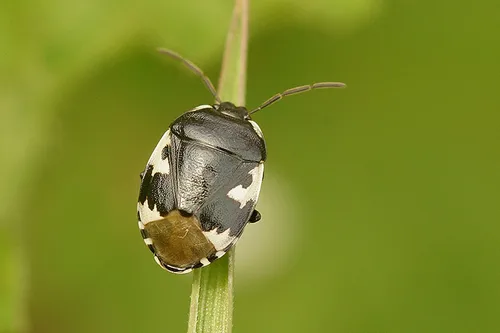
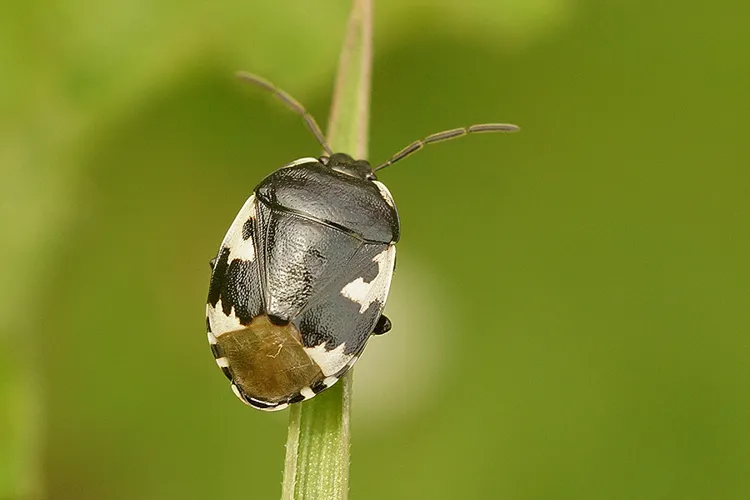
Length 5.5-7.5 mm. A distinctively marked black and white shieldbug with a brown wing membrane. Like other members of this family, it is a ground-dwelling species, but may be found feeding on the aerial parts of the main host plants. The sexes can vary considerably in size. Found in hedgerow and woodland edge habitats, feeding on White Dead-nettle and Black Horehound. There may be two overlapping generations each summer and females exhibit brood care of the eggs. While later larval stages are characteristic, early instar nymphs lack the pale patch on the pronotum and may be confused with those of Eysarcoris venustissimus . Widespread in southern Britain, becoming rarer northwards and absent from Scotland and Ireland.
Wikipedia reference for Tritomegas bicolor: http://en.wikipedia.org/wiki/Tritomegas_bicolor.
Classification
Habitat and Range
Habitat
Found in hedgerow and woodland edge habitats, feeding on White Dead-nettle and Black Horehound.
Seasonal Activity
Adult: All year.
Diet and Behavior
Life History
There may be two overlapping generations each summer and females exhibit brood care of the eggs. While later larval stages are characteristic, early instar nymphs lack the pale patch on the pronotum and may be confused with those of
Additional species information
Recorded status
Widespread in southern Britain, becoming rarer northwards and absent from Scotland and Ireland.
About True Bugs, Cicadas, Hoppers, Aphids and Allies: the wider group
Order-level background for Hemiptera, the group containing Tritomegas bicolor. Species-specific details appear above.
Group overview
Hemiptera (true bugs) includes over 80,000 described species across cicadas, aphids, leafhoppers, shield bugs, and bed bugs. Aphids alone cost global agriculture an estimated $2.5 billion annually in crop losses.
Ecological role of the group
Many Hemiptera are essential food sources for birds and predatory insects. Cicadas provide massive nutrient pulses during emergence events - a single Brood X emergence can involve trillions of individuals across 15 states.
Economic and practical significance of the group
The brown marmorated stink bug (Halyomorpha halys) caused $37 million in apple crop losses in a single year in the U.S. Mid-Atlantic region. Bed bug infestations in the U.S. increased by 500% between 2001-2010, costing the hotel industry hundreds of millions annually.
Recorded sources for this group: USDA, EPA, University research. Imported estimates may describe particular regions or reporting periods.
Photos of Pied Shieldbug (3)
Frequently Asked Questions About Pied Shieldbug
What is Pied Shieldbug?
Pied Shieldbug (Tritomegas bicolor) is a species in the family Cydnidae, within the order Hemiptera.
How big is Pied Shieldbug?
5.5-7.5 mm. A distinctively marked black and white shieldbug with a brown wing membrane. Like other members of this family, it is a ground-dwelling species, but may be found feeding on the aerial parts of the main host plants. The sexes can vary considerably in size.
Where is Pied Shieldbug found?
Habitat: Found in hedgerow and woodland edge habitats, feeding on White Dead-nettle and Black Horehound.
When is Pied Shieldbug active?
Pied Shieldbug: seasonal activity - Adult: All year..
What is the life cycle of a Pied Shieldbug?
There may be two overlapping generations each summer and females exhibit brood care of the eggs. While later larval stages are characteristic, early instar nymphs lack the pale patch on the pronotum and may be confused with those of