
Maple Leafcutter Moth - Hodges#0181
Paraclemensia acerifoliella
This record describes Paraclemensia acerifoliella (species). Recorded family: Incurvariidae. Recorded order: Lepidoptera.
Identification and Appearance
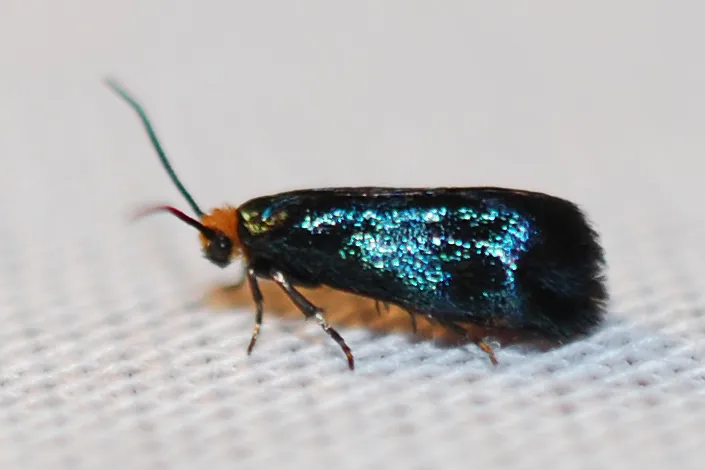
Adult: forewing metallic blue with black area at wingtip; head orange or yellowish Genitalia: Larva: thorax brownish; head black; abdomen mostly clear or translucent whitish, allowing blackish innards to be seen through the surface First instar larvae are flattened, about 1.5mm long and taper from the front to the rear. Full-grown larvae are slender, flattened, and usually dull white with amber brown heads and a broad longitudinal stripe.
Wikipedia reference for Paraclemensia acerifoliella: http://en.wikipedia.org/wiki/Paraclemensia_acerifoliella.
Classification
- Kingdom
- Animalia
- Phylum
- Arthropoda
- Class
- Insecta
- Order
- Lepidoptera (Butterflies and Moths)
- Superfamily
- Adeloidea
- Family
- Incurvariidae (Leafcutter Moths)
- Genus
- Paraclemensia
Imported taxonomy record. Source availability varies; see the source references and editorial policy below.
Habitat and Range
Habitat
woodlands, parks etc. where the host plant (maple) grows
Geographic Range
southeastern Canada and northeastern US, south to the tip of the Appalachians (western North Carolina and perhaps northwestern Georgia)
Seasonal Activity
adults fly from April to June larvae found June through September
Diet and Behavior
Diet: larvae feed on the leaves of maple and sometimes birch (older larvae cut two circular portions of leaf and sew them together as a portable case)
Life History
one generation per year; overwinters as a pupa on the ground inside the case made previously as a larva from two portions of maple leaf; adults emerge in spring and eggs are laid on maple leaves Eggs are deposited singly in pockets on the undersides of leaves. When they hatch, the larvae bore into the leaf and feed as miners for 10-14 days. Then each larva cutes a round disc out of the leaf and makes an oval movable case in which it resides as a casebearer. As it grows, it cuts out larger oval pieces and attaches them to its case. To feed, it attaches the case to a leaf and reaches out from it in a circle as far as it can. The uneaten center of this circle often drops out, leaving a 1/2" diameter hole in the leaf. When full grown, the larva drops to the ground to pupate. Overwinters as pupa One generation per year.
About Butterflies and Moths: the wider group
Order-level background for Lepidoptera, the group containing Paraclemensia acerifoliella. Species-specific details appear above.
Group overview
Lepidoptera includes approximately 180,000 described species of butterflies and moths. Moths outnumber butterflies roughly 10:1. The monarch butterfly's eastern population has declined by more than 80% since the mid-1990s, and the western population by over 95% since the 1980s. The IUCN lists the migratory monarch as Vulnerable.
Ecological role of the group
Butterflies and moths are essential indicators of ecosystem health. As caterpillars, they are a primary food source for birds - a single nest of blue tit chicks requires ~10,000 caterpillars. Adult moths pollinate many night-blooming plants.
Economic and practical significance of the group
Lepidoptera are critical pollinators. In Europe, grassland butterfly species have declined by almost 50% since the early 1990s. In the UK, three-quarters of butterflies are in decline. In the U.S., five butterfly species have gone extinct since 1950, with 29 listed as endangered.
Recorded sources for this group: IUCN Red List, Xerces Society, USFWS, PNAS, WWF. Imported estimates may describe particular regions or reporting periods.
Photos of Maple Leafcutter Moth - Hodges#0181 (2)
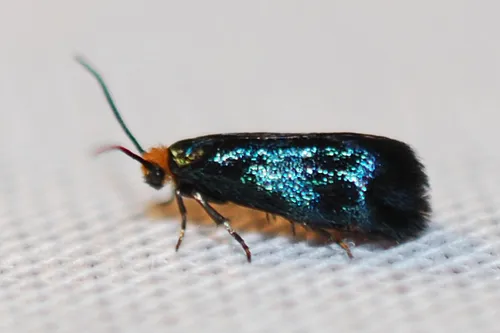
Photo credits: Contributed by Robin McLeod; Additional contributions by anitagould , marcie oconnor , Marci Hess , Robert H. Biagi
Frequently Asked Questions About Maple Leafcutter Moth - Hodges#0181
What is Maple Leafcutter Moth - Hodges#0181?
Maple Leafcutter Moth - Hodges#0181 (Paraclemensia acerifoliella) is a species in the family Incurvariidae, within the order Lepidoptera.
How big is Maple Leafcutter Moth - Hodges#0181?
adult body less than 10 mm Full-grown larvlae are 6mm long Pupa are 5-6mm
How do you identify Maple Leafcutter Moth - Hodges#0181?
Adult: forewing metallic blue with black area at wingtip; head orange or yellowish Genitalia: Larva: thorax brownish; head black; abdomen mostly clear or translucent whitish, allowing blackish innards to be seen through the surface First instar larvae are flattened, about 1.5mm long and taper from the front to the rear. Full-grown larvae are slender, flattened, and usually dull white with amber brown heads and a broad longitudinal stripe.
Where is Maple Leafcutter Moth - Hodges#0181 found?
| Feature | Details |
|---|---|
| Habitat | woodlands, parks etc. where the host plant (maple) grows |
| Range | southeastern Canada and northeastern US, south to the tip of the Appalachians (western North Carolina and perhaps northwestern Georgia) |
What does Maple Leafcutter Moth - Hodges#0181 eat?
The diet of the Maple Leafcutter Moth - Hodges#0181 includes larvae feed on the leaves of maple and sometimes birch (older larvae cut two circular portions of leaf and sew them together as a portable case).
When is Maple Leafcutter Moth - Hodges#0181 active?
Maple Leafcutter Moth - Hodges#0181: seasonal activity - adults fly from April to June larvae found June through September.
What is the life cycle of a Maple Leafcutter Moth - Hodges#0181?
one generation per year; overwinters as a pupa on the ground inside the case made previously as a larva from two portions of maple leaf; adults emerge in spring and eggs are laid on maple leaves Eggs are deposited singly in pockets on the undersides of leaves. When they hatch, the larvae bore into the leaf and feed as miners for 10-14 days. Then each larva cutes a round disc out of the leaf and makes an oval movable case in which it resides as a casebearer. As it grows, it cuts out larger oval pieces and attaches them to its case. To feed, it attaches the case to a leaf and reaches out from it in a circle as far as it can. The uneaten center of this circle often drops out, leaving a 1/2" diameter hole in the leaf. When full grown, the larva drops to the ground to pupate. Overwinters as pupa One generation per year.