
Horned Passalid
Odontotaenius disjunctus
This record describes Odontotaenius disjunctus (species). Recorded family: Passalidae. Recorded order: Coleoptera.
Identification and Appearance
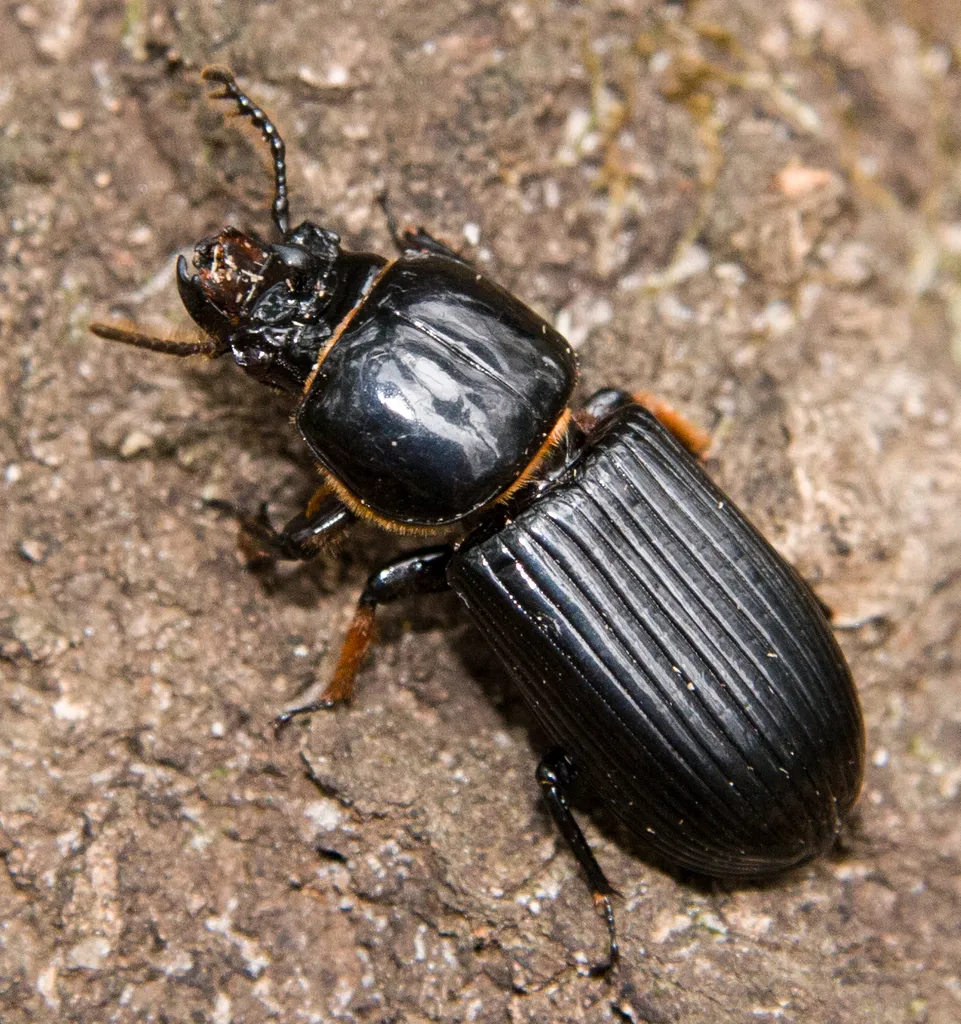
Unique in its range: elongate shape, large size, deeply striated elytra. Larvae are scarabaeiform ( Passalidae page at Univ. Florida ), and appear to have only four legs. Hind legs are shortened, used for stridulation , communication with adults, presumably. See also characteristics given for family . Larvae only have two pairs of thoracic legs
Wikipedia reference for Odontotaenius disjunctus: http://en.wikipedia.org/wiki/Odontotaenius_disjunctus.
Classification
- Kingdom
- Animalia
- Phylum
- Arthropoda
- Class
- Insecta
- Order
- Coleoptera (Beetles)
- Suborder
- Polyphaga
- Superfamily
- Scarabaeoidea
- Family
- Passalidae (Bess Beetles)
- Genus
- Odontotaenius
Imported taxonomy record. Source availability varies; see the source references and editorial policy below.
Habitat and Range
Habitat
Deciduous forests with rotting, fallen logs.
Geographic Range
e. US (TX-FL-QC-NE) / Mex. to S. Amer. - Map
Seasonal Activity
Can be found all year in rotting logs. Comes to lights in spring and summer (see life cycle)
Diet and Behavior
Diet: Decaying wood and/or fungi. Larvae feed on wood but not until after it is reduced do a pulp and treated with digestive secretions by the parents. ( 5 )
Life History
Lifestyle of this family is unique for beetles: live in small colonies where larvae are cared for by adults of both sexes. Long life cycle, apparently more than one year. Larvae eat a rotting wood pre-chewed by adults. (Some references state larvae eat feces of adults as well.) Larvae and adults also cannibalize injured larvae. Adults reported to fly very seldom, however they are capable of flight, contrary to statements in some sources. Adults are found at lights on occasion. They may disperse by walking, but have been observed flying under lights ( image ), and they are sometimes taken in light traps (MacGown and MacGown, 1996). A nuptial flight has been observed in Mississippi, with a group of 12-15 individuals flying at dusk, and one pair even mating in flight (MacGown and MacGown, 1996). Mating is also observed in the tunnels, the copulation occurring, characteristically as shown: Both adults and larvae stridulate , and this is said to serve as communication between them. Adults also stridulate when picked up, and especially, blown on. Adults stridulate by rubbing abdomen against the wings. Larvae stridulate with reduced third pair of legs--these scratch against other legs. Illustration of larva, pupa, and adult:
Additional species information
Species notes from the sources
Etymology: disjunctus likely refers to the jointed body. Horned Passalus is the common name listed by the Entomological Society of America. Bess Bug is a name in common use by non-entomologists. This is likely an imitation of the stridulation ( Merriam-Webster ). Speculation: "Bess" perhaps comes from French baiser, "to kiss" (compare English buss , kiss), and likely refers to the ability of this beetle to pinch with its mandibles (which it does rarely) or the sound of the stridulation--a squeaky "kissy" sound. See family account for more on common names.
About Primitive Winged Insects: the wider group
Order-level background for Coleoptera, the group containing Odontotaenius disjunctus. Species-specific details appear above.
Group overview
Coleoptera is the largest order of insects with over 400,000 described species, representing ~25% of all known animal species and ~40% of all insects. In the U.S. alone, nearly 30,000 beetle species have been identified.
Ecological role of the group
Beetles are prominent decomposers, especially in forests, breaking down dead wood and recycling nutrients. As predators, they reduce populations of pest insects. Many species are also important pollinators of flowering plants.
Economic and practical significance of the group
Beetles have major economic significance: leaf beetles (Chrysomelidae) and weevils (Curculionoidea) are among the most destructive agricultural pests globally, costing billions annually, while predatory species like ladybugs provide natural pest control.
Recorded sources for this group: Britannica, Smithsonian, NCSU Entomology. Imported estimates may describe particular regions or reporting periods.
Photos of Horned Passalid (3)
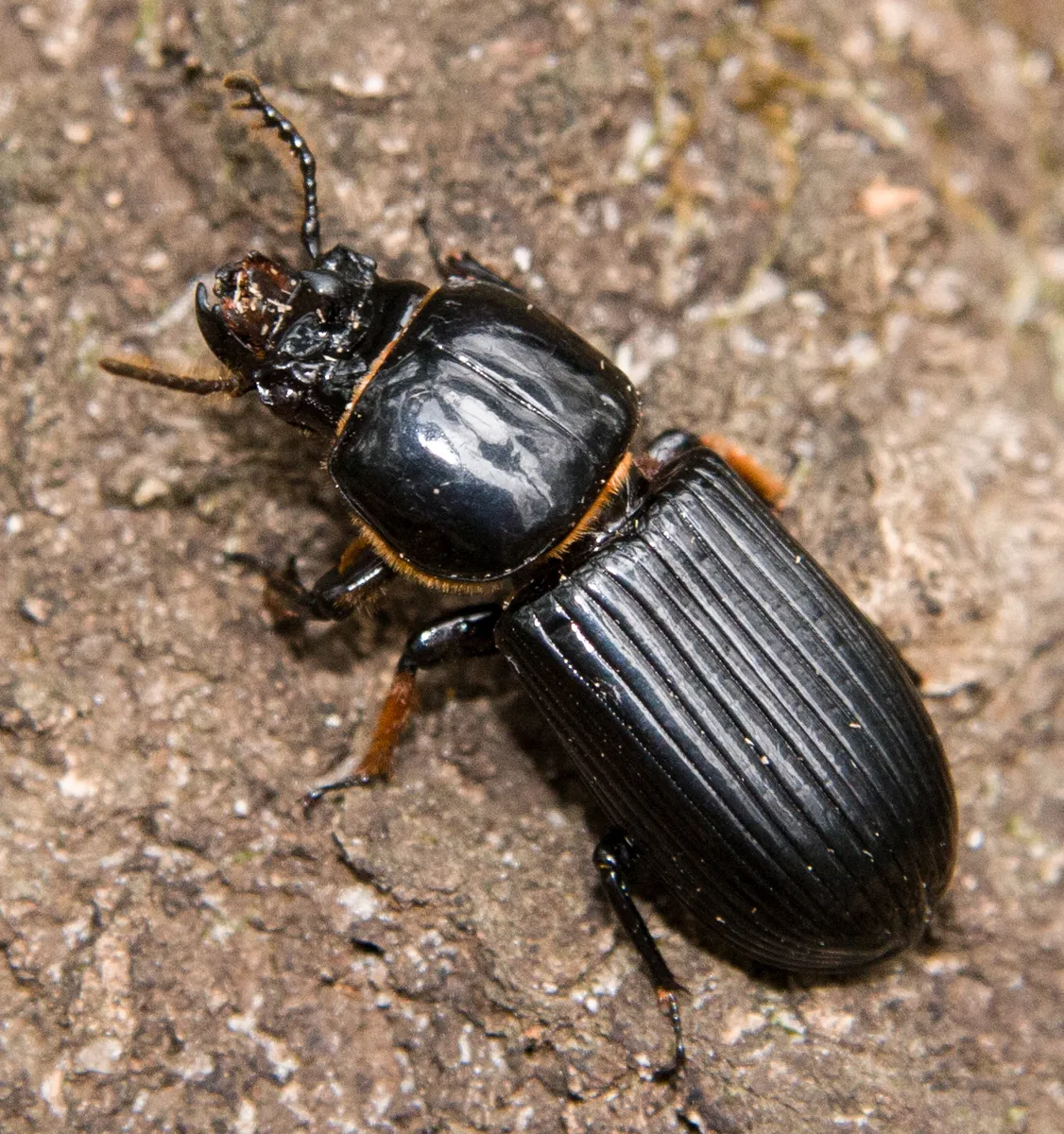
Photo credits: Contributed by Cotinis; Additional contributions by Stephen_WV , Phillip Harpootlian , Mike Quinn , nebbeetle , Marci Hess
Frequently Asked Questions About Horned Passalid
What is Horned Passalid?
Horned Passalid (Odontotaenius disjunctus) is a species in the family Passalidae, within the order Coleoptera.
How big is Horned Passalid?
32-36 mm
How do you identify Horned Passalid?
Unique in its range: elongate shape, large size, deeply striated elytra. Larvae are scarabaeiform ( Passalidae page at Univ. Florida ), and appear to have only four legs. Hind legs are shortened, used for stridulation , communication with adults, presumably. See also characteristics given for family . Larvae only have two pairs of thoracic legs
Where is Horned Passalid found?
| Feature | Details |
|---|---|
| Habitat | Deciduous forests with rotting, fallen logs. |
| Range | e. US (TX-FL-QC-NE) / Mex. to S. Amer. - Map |
What does Horned Passalid eat?
The diet of the Horned Passalid includes Decaying wood and/or fungi. Larvae feed on wood but not until after it is reduced do a pulp and treated with digestive secretions by the parents. ( 5 ).
When is Horned Passalid active?
Horned Passalid: seasonal activity - Can be found all year in rotting logs. Comes to lights in spring and summer (see life cycle).
What is the life cycle of a Horned Passalid?
Lifestyle of this family is unique for beetles: live in small colonies where larvae are cared for by adults of both sexes. Long life cycle, apparently more than one year. Larvae eat a rotting wood pre-chewed by adults. (Some references state larvae eat feces of adults as well.) Larvae and adults also cannibalize injured larvae. Adults reported to fly very seldom, however they are capable of flight, contrary to statements in some sources. Adults are found at lights on occasion. They may disperse by walking, but have been observed flying under lights ( image ), and they are sometimes taken in light traps (MacGown and MacGown, 1996). A nuptial flight has been observed in Mississippi, with a group of 12-15 individuals flying at dusk, and one pair even mating in flight (MacGown and MacGown, 1996). Mating is also observed in the tunnels, the copulation occurring, characteristically as shown: Both adults and larvae stridulate , and this is said to serve as communication between them. Adults also stridulate when picked up, and especially, blown on. Adults stridulate by rubbing abdomen against the wings. Larvae stridulate with reduced third pair of legs--these scratch against other legs. Illustration of larva, pupa, and adult: