
Odontomyia ornata
This record describes Odontomyia ornata (species). Recorded family: Stratiomyidae. Recorded order: Diptera.
Identification and Appearance
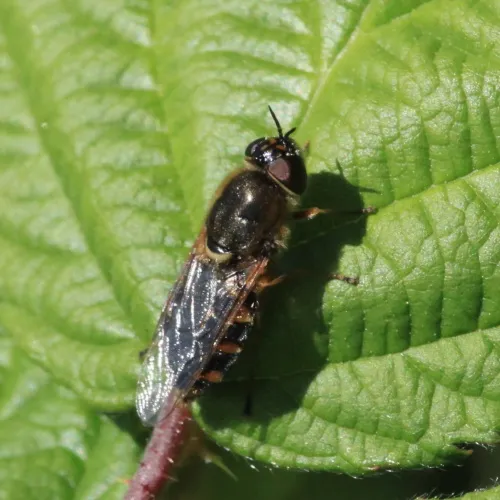
A large (up to 15mm) bee or wasp-mimicking fly. The tergites (the plates on its upper abdomen) are primarily black but feature striking orange or bright yellow markings along the lateral margins. An indicator of healthy, high-quality wetland ecosystems. This species reacts poorly to pollution, ditch clearance, etc, so indicates a wetland ecosystem which is clean and well-managed. The larvae are aquatic, breathing via a delicate, feathery ring of respiratory hairs at the tip of their tail, which they poke through the surface film of the water. Their diet is primarily detritivorous, meaning they feed on decaying organic matter and microorganisms at the water's surface. The adults emerge in early summer. They are diurnal and are strong fliers but usually stay close to their larval water bodies. They feed heavily on nectar to fuel their short lives, showing a strong preference for large, white umbellifer flowers. Mainly in the south east but localized. This species is spreading but still currently classed as Nationally Scarce. No additional images available for this species.
Classification
- Kingdom
- Animalia
- Phylum
- Arthropoda
- Class
- Insecta
- Order
- Diptera
- Family
- Stratiomyidae
- Genus
- Odontomyia
Imported taxonomy record. Source availability varies; see the source references and editorial policy below.
Habitat and Range
Habitat
An indicator of healthy, high-quality wetland ecosystems. This species reacts poorly to pollution, ditch clearance, etc, so indicates a wetland ecosystem which is clean and well-managed.
Seasonal Activity
Late spring-summer.
Additional species information
Recorded status
Mainly in the south east but localized. This species is spreading but still currently classed as Nationally Scarce.
About Flies: the wider group
Order-level background for Diptera, the group containing Odontomyia ornata. Species-specific details appear above.
Group overview
Diptera includes over 150,000 described species of flies, mosquitoes, and midges. Mosquitoes are the deadliest animal on Earth (CDC). Malaria alone causes ~249 million cases and over 608,000 deaths annually, mostly children under 5 (WHO). Vector-borne diseases account for over 17% of all infectious diseases, causing 700,000+ deaths per year.
Ecological role of the group
Despite their disease impact, flies are critical decomposers and pollinators. Hoverflies alone pollinate hundreds of crop and wildflower species. Flies are also the primary food source for many birds, bats, and fish. Forensic entomology relies heavily on fly species for crime scene analysis.
Economic and practical significance of the group
In the U.S., vector-borne disease cases tripled between 2004-2016, with over 640,000 cases reported in that period (CDC). Tickborne diseases doubled from 22,000 to 48,000 annual reports. Globally, mosquito-borne diseases cost billions in healthcare and lost productivity.
Recorded sources for this group: WHO, CDC, PNAS. Imported estimates may describe particular regions or reporting periods.
Frequently Asked Questions About Odontomyia ornata
What is Odontomyia ornata?
Odontomyia ornata is a species in the family Stratiomyidae, within the order Diptera.
Where is Odontomyia ornata found?
Habitat: An indicator of healthy, high-quality wetland ecosystems. This species reacts poorly to pollution, ditch clearance, etc, so indicates a wetland ecosystem which is clean and well-managed.
When is Odontomyia ornata active?
Odontomyia ornata: seasonal activity - Late spring-summer..