
Eastern Treehole Mosquito
Ochlerotatus triseriatus
This record describes Ochlerotatus triseriatus (species). Recorded family: Culicidae. Recorded order: Diptera.
Identification and Appearance
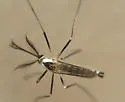
- top of scutum dark - FMEL - patch of white scales along edge of scutum; legs dark - FMEL Florida Medical Entomology Lab - FMEL Adult Female: - Legs, wings and proboscis are completely darkscaled - The abdomen is mainly dark scaled with only the margins of the last four segments with pale patches - Scutum with dark reddish brown broad medial band contrasting with silver scales laterally* Primary vector of LaCrosse Encephalitis virus. Females will bite any time of day. Ochlerotatus triseriatus is not the mosquito that you slap in the evening, or the one that has Joe Public on the phone all summer long with complaint calls. It just isn't all that abundant in most places in its range. Ochlerotatus triseriatus never drew much attention until it was found to be the vector of La Crosse encephalitis virus. La Crosse encephalitis is primarily a problem of children in the upper Midwest and east. Symptoms can range from a mild flu-like illness to seizures and coma. Ohio leads the nation in number of cases, followed by Wisconsin, Minnesota, Illinois and Indiana. Outside this LaCrosse encephalitis crescent, cases occur in Texas, North Carolina, Michigan, Missouri, Iowa, West Virginia and New York. (Walker 1992) Filial infection is important for the La Crosse virus, which causes serious brain disease or death in about 72 Americans each year, most of them children. That virus is transmitted to humans by Aedes triseriatus , a forest mosquito that picks it up from chipmunks. La Crosse virus passes down easily in mosquito eggs; about 70 percent of mosquito females maturing from those eggs inherit the virus, Dr. Tesh said. New York Times, 2016
Classification
Habitat and Range
Habitat
The larvae live in temporary tree holes. Even though the accepted common name is "eastern treehole mosquito", it also breeds in tires, mainly in shaded locations. It can be found in a single water-filled tire behind the garage or in a tire dump with thousands of tires. In scrap tire yards, adults reach incredibly high numbers, as many as 60,000 females per acre in mid-summer. Ochlerotatus triseriatus has become an important urban mosquito because of its association with scrap tires. (Walker 1992)
Geographic Range
e US (TX-FL-ON-ND) (Walker 1992)
Seasonal Activity
Larvae: May - September Adults: June - October
Diet and Behavior
Diet: Females prefer blood from mammals and reptiles. Few mosquito species feed on rodents. These mammals are just too jittery and quick to sit still for that. But Ochlerotatus triseriatus , even though it bites a wide variety of mammals (including humans) and sometimes birds, particularly likes chipmunks squirrels. These woodland rodents are active during the day when Ochlerotatus triseriatus is seeking hosts in the woods. (Walker 1992)
Life History
Overwinters as an egg. It has many generations per year (multivoltine).
About Flies: the wider group
Order-level background for Diptera, the group containing Ochlerotatus triseriatus. Species-specific details appear above.
Group overview
Diptera includes over 150,000 described species of flies, mosquitoes, and midges. Mosquitoes are the deadliest animal on Earth (CDC). Malaria alone causes ~249 million cases and over 608,000 deaths annually, mostly children under 5 (WHO). Vector-borne diseases account for over 17% of all infectious diseases, causing 700,000+ deaths per year.
Ecological role of the group
Despite their disease impact, flies are critical decomposers and pollinators. Hoverflies alone pollinate hundreds of crop and wildflower species. Flies are also the primary food source for many birds, bats, and fish. Forensic entomology relies heavily on fly species for crime scene analysis.
Economic and practical significance of the group
In the U.S., vector-borne disease cases tripled between 2004-2016, with over 640,000 cases reported in that period (CDC). Tickborne diseases doubled from 22,000 to 48,000 annual reports. Globally, mosquito-borne diseases cost billions in healthcare and lost productivity.
Recorded sources for this group: WHO, CDC, PNAS. Imported estimates may describe particular regions or reporting periods.
Photos of Eastern Treehole Mosquito (5)
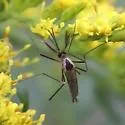
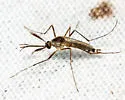
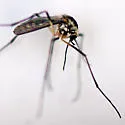
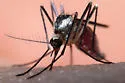
Photo credits: Contributed by tom murray; Additional contributions by Robin McLeod , Omar Fahmy , Mike Quinn
Frequently Asked Questions About Eastern Treehole Mosquito
What is Eastern Treehole Mosquito?
Eastern Treehole Mosquito (Ochlerotatus triseriatus) is a species in the family Culicidae, within the order Diptera.
How do you identify Eastern Treehole Mosquito?
- top of scutum dark - FMEL - patch of white scales along edge of scutum; legs dark - FMEL Florida Medical Entomology Lab - FMEL Adult Female: - Legs, wings and proboscis are completely darkscaled - The abdomen is mainly dark scaled with only the margins of the last four segments with pale patches - Scutum with dark reddish brown broad medial band contrasting with silver scales laterally*
Where is Eastern Treehole Mosquito found?
| Feature | Details |
|---|---|
| Habitat | The larvae live in temporary tree holes. Even though the accepted common name is eastern treehole mosquito, it also breeds in tires, mainly in shaded locations. It can be found in a single water-filled tire behind the garage or in a tire dump with thousands of tires. In scrap tire yards, adults reach incredibly high numbers, as many as 60,000 females per acre in mid-summer. Ochlerotatus triseriatus has become an important urban mosquito because of its association with scrap tires. (Walker 1992) |
| Range | e US (TX-FL-ON-ND) (Walker 1992) |
What does Eastern Treehole Mosquito eat?
The diet of the Eastern Treehole Mosquito includes Females prefer blood from mammals and reptiles. Few mosquito species feed on rodents. These mammals are just too jittery and quick to sit still for that. But Ochlerotatus triseriatus , even though it bites a wide variety of mammals (including humans) and sometimes birds, particularly likes chipmunks squirrels. These woodland rodents are active during the day when Ochlerotatus triseriatus is seeking hosts in the woods. (Walker 1992).
When is Eastern Treehole Mosquito active?
Eastern Treehole Mosquito: seasonal activity - Larvae: May - September Adults: June - October.
What is the life cycle of a Eastern Treehole Mosquito?
Overwinters as an egg. It has many generations per year (multivoltine).