
Black Saltmarsh Mosquito
Ochlerotatus taeniorhynchus
This record describes Ochlerotatus taeniorhynchus (species). Recorded family: Culicidae. Recorded order: Diptera.
Identification and Appearance
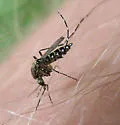
Adult: Dark overall. Proboscis with distinct white ring at middle. Palps white-tipped. Wing scales dark. Abdominal terga with transverse basal pale bands, lacking median longitudinal stripe. Hind tarsomeres with pale rings basally. Lacks pale ring medially on first hind tarsomere. Larva: Seta 1-S attached distal to pecten, pecten teeth evenly spaced, comb scales with subequal to subapical spinules, comb scales small, numbering 10-30, seta 6-III-V with 2-5 branches. Found in saltmarsh or mangrove habitat. A very common nuisance mosquito in coastal areas, especially in the Southeast. Vector of dog heartworm.
Classification
Habitat and Range
Habitat
Larvae in saltmarsh habitats or inland waterways, mangrove swamps etc. Also in salt ponds and other inland saline habitats.
Geographic Range
coastal counties from New Hamphire to Mexico and beyond, scattered distribution inland, California from Monterey area south. Distribution in Texas
Seasonal Activity
Major pests during summer and early fall.
Diet and Behavior
Diet: Larvae: Filter feeders Adults: Males and females feed on nectar, females often fly far inland to take a bloodmeal from warm-blooded hosts. Often encountered by ships at sea when host seeking swarms are blown from shore.
Life History
Oviposition occurs on bare mud of saltmarsh habitats, hatching stimulated by tidal inundation or rainfall-associated depth increases inland. Control methods can include flooding mudflats during breeding seasons to prevent oviposition.
About Flies: the wider group
Order-level background for Diptera, the group containing Ochlerotatus taeniorhynchus. Species-specific details appear above.
Group overview
Diptera includes over 150,000 described species of flies, mosquitoes, and midges. Mosquitoes are the deadliest animal on Earth (CDC). Malaria alone causes ~249 million cases and over 608,000 deaths annually, mostly children under 5 (WHO). Vector-borne diseases account for over 17% of all infectious diseases, causing 700,000+ deaths per year.
Ecological role of the group
Despite their disease impact, flies are critical decomposers and pollinators. Hoverflies alone pollinate hundreds of crop and wildflower species. Flies are also the primary food source for many birds, bats, and fish. Forensic entomology relies heavily on fly species for crime scene analysis.
Economic and practical significance of the group
In the U.S., vector-borne disease cases tripled between 2004-2016, with over 640,000 cases reported in that period (CDC). Tickborne diseases doubled from 22,000 to 48,000 annual reports. Globally, mosquito-borne diseases cost billions in healthcare and lost productivity.
Recorded sources for this group: WHO, CDC, PNAS. Imported estimates may describe particular regions or reporting periods.
Photos of Black Saltmarsh Mosquito (5)
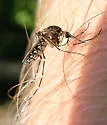
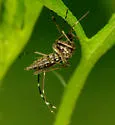
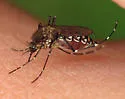
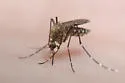
Photo credits: Contributed by Lynette Elliott; Additional contributions by john and jane balaban , Mike Quinn
Frequently Asked Questions About Black Saltmarsh Mosquito
What is Black Saltmarsh Mosquito?
Black Saltmarsh Mosquito (Ochlerotatus taeniorhynchus) is a species in the family Culicidae, within the order Diptera.
How big is Black Saltmarsh Mosquito?
Medium sized
How do you identify Black Saltmarsh Mosquito?
Adult: Dark overall. Proboscis with distinct white ring at middle. Palps white-tipped. Wing scales dark. Abdominal terga with transverse basal pale bands, lacking median longitudinal stripe. Hind tarsomeres with pale rings basally. Lacks pale ring medially on first hind tarsomere. Larva: Seta 1-S attached distal to pecten, pecten teeth evenly spaced, comb scales with subequal to subapical spinules, comb scales small, numbering 10-30, seta 6-III-V with 2-5 branches. Found in saltmarsh or mangrove habitat.
Where is Black Saltmarsh Mosquito found?
| Feature | Details |
|---|---|
| Habitat | Larvae in saltmarsh habitats or inland waterways, mangrove swamps etc. Also in salt ponds and other inland saline habitats. |
| Range | coastal counties from New Hamphire to Mexico and beyond, scattered distribution inland, California from Monterey area south. Distribution in Texas |
What does Black Saltmarsh Mosquito eat?
The diet of the Black Saltmarsh Mosquito includes Larvae: Filter feeders Adults: Males and females feed on nectar, females often fly far inland to take a bloodmeal from warm-blooded hosts. Often encountered by ships at sea when host seeking swarms are blown from shore..
When is Black Saltmarsh Mosquito active?
Black Saltmarsh Mosquito: seasonal activity - Major pests during summer and early fall..
What is the life cycle of a Black Saltmarsh Mosquito?
Oviposition occurs on bare mud of saltmarsh habitats, hatching stimulated by tidal inundation or rainfall-associated depth increases inland. Control methods can include flooding mudflats during breeding seasons to prevent oviposition.