
Eastern Saltmarsh Mosquito
Ochlerotatus sollicitans
This record describes Ochlerotatus sollicitans (species). Recorded family: Culicidae. Recorded order: Diptera.
Identification and Appearance
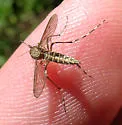
- pale band across middle of proboscis - FMEL - sides of thorax covered with many white scales - FMEL - legs banded - FEML Florida Medical Entomology Laboratory - FMEL (adult female) Proboscis is dark-scaled and with white band near middle. Palpi are short and dark with a few white scales at the tips. First tergite has a median patch of yellowish-white scales; other tergites dark, each white laterally, pale yellow basally and medially. Venter whitish to pale-yellow scaled, speckled with dark scales. Femora and Tibiae are dark and liberally speckled with pale scales; posterior surface pale, knee spots white. Hind Tarsus with segment 1 ringed with white base and with a yellow ring at middle, segments 2 to 4 with broad white based rings, and segment 5 entirely white. Front and middle tarsi similarly marked but with bands narrower on segments 1 to 3, absent on 4; segment 5 on front tarsus varies from entirely dark to nearly all white; segment 5 of middle tarsus mostly white, blended with dark scales. Wing length is about 3.5 to 4.5 mm and has mixed broad brown and white scales. The females are persistent biters and will attack any time during the day or night. An important vector of Eastern equine encephalitis (Tripe E) and dog heartworm. Numerous coastal mosquito control districts have been established primarily to combat the pest and disease problems caused by Ae. sollicitans - (O'Meara 1992)
Classification
Habitat and Range
Habitat
mostly in salt marshes in coastal areas. Also found in brackish water swamps in many of the inland states, particularly in oil fields.
Geographic Range
AZ-FL-NS-NE / W. Indies (O'Meara 1992), mostly coastal states from TX to ME (BG data)
Seasonal Activity
The larvae and adults may be found any time during the year in the extreme south. It occurs from April or May to October in the marshes along the north Atlantic seaboard.
Diet and Behavior
Life History
The adults are strong fliers and often migrate in large numbers to communities many miles from the salt-water marshes in which they breed. An occasional female specimen has been captured in light traps at distances as great as 100 miles from the salt-water pools in which the larvae are known to develop.
About Flies: the wider group
Order-level background for Diptera, the group containing Ochlerotatus sollicitans. Species-specific details appear above.
Group overview
Diptera includes over 150,000 described species of flies, mosquitoes, and midges. Mosquitoes are the deadliest animal on Earth (CDC). Malaria alone causes ~249 million cases and over 608,000 deaths annually, mostly children under 5 (WHO). Vector-borne diseases account for over 17% of all infectious diseases, causing 700,000+ deaths per year.
Ecological role of the group
Despite their disease impact, flies are critical decomposers and pollinators. Hoverflies alone pollinate hundreds of crop and wildflower species. Flies are also the primary food source for many birds, bats, and fish. Forensic entomology relies heavily on fly species for crime scene analysis.
Economic and practical significance of the group
In the U.S., vector-borne disease cases tripled between 2004-2016, with over 640,000 cases reported in that period (CDC). Tickborne diseases doubled from 22,000 to 48,000 annual reports. Globally, mosquito-borne diseases cost billions in healthcare and lost productivity.
Recorded sources for this group: WHO, CDC, PNAS. Imported estimates may describe particular regions or reporting periods.
Photos of Eastern Saltmarsh Mosquito (5)
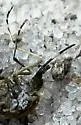
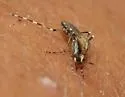
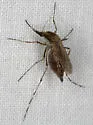
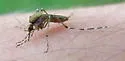
Photo credits: Contributed by Richard Leung; Additional contributions by john and jane balaban , Omar Fahmy , Mike Quinn
Frequently Asked Questions About Eastern Saltmarsh Mosquito
What is Eastern Saltmarsh Mosquito?
Eastern Saltmarsh Mosquito (Ochlerotatus sollicitans) is a species in the family Culicidae, within the order Diptera.
How do you identify Eastern Saltmarsh Mosquito?
- pale band across middle of proboscis - FMEL - sides of thorax covered with many white scales - FMEL - legs banded - FEML Florida Medical Entomology Laboratory - FMEL (adult female) Proboscis is dark-scaled and with white band near middle. Palpi are short and dark with a few white scales at the tips. First tergite has a median patch of yellowish-white scales; other tergites dark, each white laterally, pale yellow basally and medially. Venter whitish to pale-yellow scaled, speckled with dark scales. Femora and Tibiae are dark and liberally speckled with pale scales; posterior surface pale, knee spots white. Hind Tarsus with segment 1 ringed with white base and with a yellow ring at middle, segments 2 to 4 with broad white based rings, and segment 5 entirely white. Front and middle tarsi similarly marked but with bands narrower on segments 1 to 3, absent on 4; segment 5 on front tarsus varies from entirely dark to nearly all white; segment 5 of middle tarsus mostly white, blended with dark scales. Wing length is about 3.5 to 4.5 mm and has mixed broad brown and white scales.
Where is Eastern Saltmarsh Mosquito found?
| Feature | Details |
|---|---|
| Habitat | mostly in salt marshes in coastal areas. Also found in brackish water swamps in many of the inland states, particularly in oil fields. |
| Range | AZ-FL-NS-NE / W. Indies (O'Meara 1992), mostly coastal states from TX to ME (BG data) |
When is Eastern Saltmarsh Mosquito active?
Eastern Saltmarsh Mosquito: seasonal activity - The larvae and adults may be found any time during the year in the extreme south. It occurs from April or May to October in the marshes along the north Atlantic seaboard..
What is the life cycle of a Eastern Saltmarsh Mosquito?
The adults are strong fliers and often migrate in large numbers to communities many miles from the salt-water marshes in which they breed. An occasional female specimen has been captured in light traps at distances as great as 100 miles from the salt-water pools in which the larvae are known to develop.