
Murky-legged Black Legionnaire
Beris chalybata
This record describes Beris chalybata (species). Recorded family: Stratiomyidae. Recorded order: Diptera.
Identification and Appearance
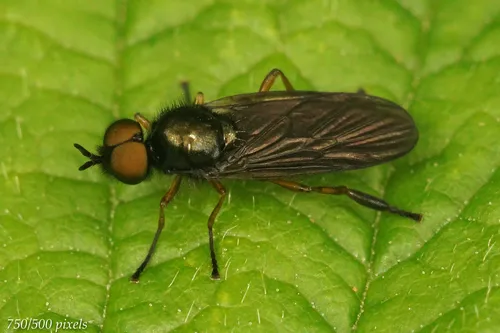
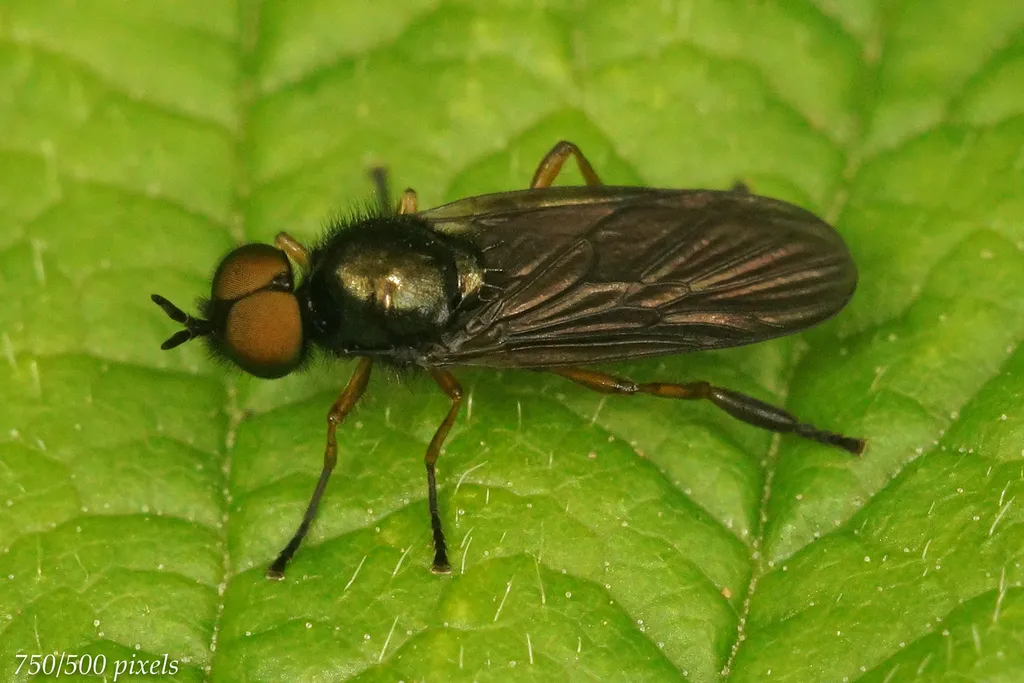
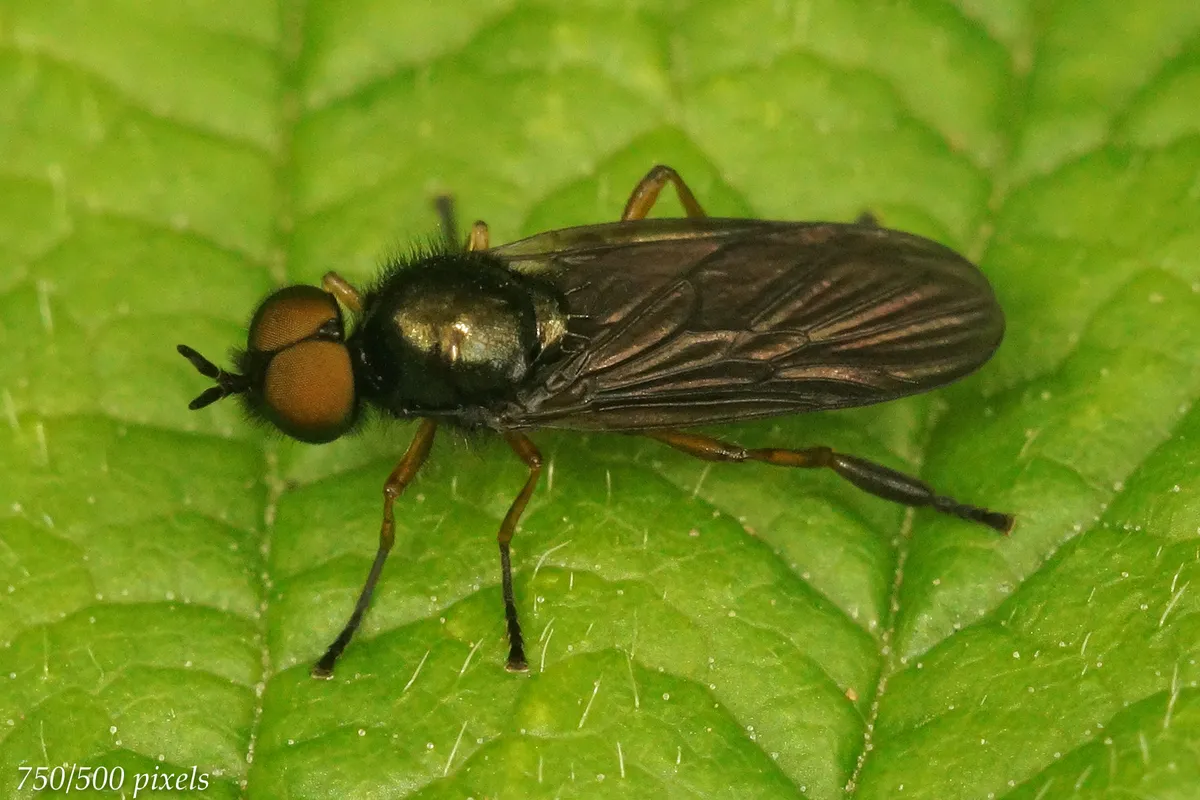
5-6mm. Males and females are noticeably different. Beris , as a genus, can generally be recognised by having 6 spines projecting from the scutellum (Four spines in Choriceps , however occasionally variants can have 5). Males (eyes touching) have a dark green thorax, smoky wings and very hairy eyes. Males legs are dull yellow-brown but with dark tarsi and an inflated hind basitarsus. Females (eyes widely separated) have a brighter glossy green thorax and clearer wings with a black stigma. Their legs are generally yellow with dark tarsi. There are 6 British species in the Beris genus and these can usually be distinguished by the combination of abdomen and leg colours. See ID Aids below. This genus of soldierflies are all of modest size with an elliptical abdomen. The abdomen is either blackish or mainly orange but without a striking pattern. They also have 6 spines projecting backwards from the scutellum. Note that flies in the related Chorisops genus have 4 spines. Note: as with many species there can be variation amongst specimens. Unless identified by a recognised expert, a photo is required. If the photo doesn't show the key ID features then in the comments box describe the size and identifying characters you have observed.
Wikipedia reference for Beris chalybata: https://en.wikipedia.org/wiki/Beris_chalybata.
Classification
- Kingdom
- Animalia
- Phylum
- Arthropoda
- Class
- Insecta
- Order
- Diptera
- Family
- Stratiomyidae
- Genus
- Beris
Imported taxonomy record. Source availability varies; see the source references and editorial policy below.
Habitat and Range
Habitat
Flying, or resting, on sunlit leaves in bushes, hedges or other flowering plants.
Seasonal Activity
Early summer.
Diet and Behavior
Life History
It feeds on pollen and nectar and sometimes also on the substrate of rotten plants. Females lay eggs individually on rotting plants. The larvae overwinter. They pupate in spring, in a hardened larval skin. The adult flies leave this through a T-shaped slit.
Additional species information
Recorded status
B. chalybata
About Flies: the wider group
Order-level background for Diptera, the group containing Beris chalybata. Species-specific details appear above.
Group overview
Diptera includes over 150,000 described species of flies, mosquitoes, and midges. Mosquitoes are the deadliest animal on Earth (CDC). Malaria alone causes ~249 million cases and over 608,000 deaths annually, mostly children under 5 (WHO). Vector-borne diseases account for over 17% of all infectious diseases, causing 700,000+ deaths per year.
Ecological role of the group
Despite their disease impact, flies are critical decomposers and pollinators. Hoverflies alone pollinate hundreds of crop and wildflower species. Flies are also the primary food source for many birds, bats, and fish. Forensic entomology relies heavily on fly species for crime scene analysis.
Economic and practical significance of the group
In the U.S., vector-borne disease cases tripled between 2004-2016, with over 640,000 cases reported in that period (CDC). Tickborne diseases doubled from 22,000 to 48,000 annual reports. Globally, mosquito-borne diseases cost billions in healthcare and lost productivity.
Recorded sources for this group: WHO, CDC, PNAS. Imported estimates may describe particular regions or reporting periods.
Photos of Murky-legged Black Legionnaire (3)
Frequently Asked Questions About Murky-legged Black Legionnaire
What is Murky-legged Black Legionnaire?
Murky-legged Black Legionnaire (Beris chalybata) is a species in the family Stratiomyidae, within the order Diptera.
Where is Murky-legged Black Legionnaire found?
Habitat: Flying, or resting, on sunlit leaves in bushes, hedges or other flowering plants.
When is Murky-legged Black Legionnaire active?
Murky-legged Black Legionnaire: seasonal activity - Early summer..
What is the life cycle of a Murky-legged Black Legionnaire?
It feeds on pollen and nectar and sometimes also on the substrate of rotten plants. Females lay eggs individually on rotting plants. The larvae overwinter. They pupate in spring, in a hardened larval skin. The adult flies leave this through a T-shaped slit.